304 million young Africans are working in 2026, representing an employment rate of 57% higher than the global average. Yet 104 million of them live in households in extreme poverty.
The first joint report from the World Data Lab and the Mastercard Foundation, published in February 2026, completely redefines our understanding of youth employment in Africa. The problem is no longer mass unemployment, but employment quality that no longer offers an escape from poverty. With 12 million new workers entering the labor force each year, the continent faces an unprecedented challenge: transforming informal employment into development opportunities.
The essentials
- 57% of young Africans aged 15-35 are employed, compared to 48% globally
- 90% work in informal employment; only 3 million formal jobs are created annually against 15 million needed
- 104 million young workers live in households in extreme poverty
- 2033 will mark the turning point: services will surpass agriculture as the primary employer of young people
The myth of mass unemployment collapses against the reality of working poverty
The widespread notion that young Africans are massively unemployed does not withstand new data. At 57%, the employment rate for those aged 15-35 exceeds the global average by 9 percentage points and even surpasses some developed economies. Ethiopia has a youth employment rate of 71%, Nigeria 61%—levels that many European economies envy.
This performance conceals, however, a worrying reality: 90% of these jobs fall within the informal economy. Subsistence agriculture, petty commerce, and domestic services constitute the bulk of these activities that keep their workers in structural precarity. A street vendor in Lagos works 12 hours a day but earns only 2 dollars, insufficient to lift his household out of extreme poverty.
The report reveals that 104 million young African workers—one-third of the total—live in households earning less than $2.15 per day per person. This “working poverty” affects women particularly: 38% of employed young women live below the poverty threshold compared to 32% of men.
The impossible equation of 15 million formal jobs annually
The scale of Africa’s demographic challenge redefines the parameters of economic growth. With 12 million new entrants into the labor market each year, sub-Saharan Africa should create 15 million formal jobs annually to absorb this growth and reduce existing informal employment. The reality: 3 million formal jobs created per year according to the latest estimates from the International Labour Organization.
This equation illustrates the magnitude of the gap between demographic growth and economic absorption capacity. Global debt reaching 109 trillion dollars limits the budgetary margins of African states to invest massively in formal employment. Kenya, despite being considered a dynamic economy, creates only 800,000 formal jobs per year against 1.2 million new job seekers.
The manufacturing industry, traditionally a mass employer, struggles to take off. Representing less than 10% of GDP in most sub-Saharan countries, it employs only 6% of young Africans. The increasing automation of industrial processes even jeopardizes this meager contribution: new Ethiopian textile factories employ 40% less labor than their 2010s equivalents.
2033: The structural turning point toward a services economy
A silent transformation is reshaping Africa’s employment structure. According to the report’s projections, 2033 will mark a historic turning point: services will surpass agriculture as the primary employment sector for young people. This shift, which took decades in Europe and Asia, is accelerating in Africa due to digitalization.
The services sector already employs 38% of urban youth compared to 28% a decade ago. This growth rests on three engines: mobile telephony, which created 3.5 million direct and indirect jobs; digital financial services with 2.8 million active agents in 8 countries; and the platform economy, which generates 1.2 million remunerated activities.
Rwanda illustrates this transformation: 54% of its young people now work in services, primarily in digital and tourism sectors. The country has created 200,000 jobs in these sectors since 2020, surpassing agricultural job creation for the first time in its post-genocide history.
This accelerated shift to services nevertheless raises questions about quality. While service jobs generally offer better conditions than subsistence agriculture, they remain largely informal: 78% of service jobs lack any social protection according to the African Union survey published in 2025.
Emerging technologies redefine the possible
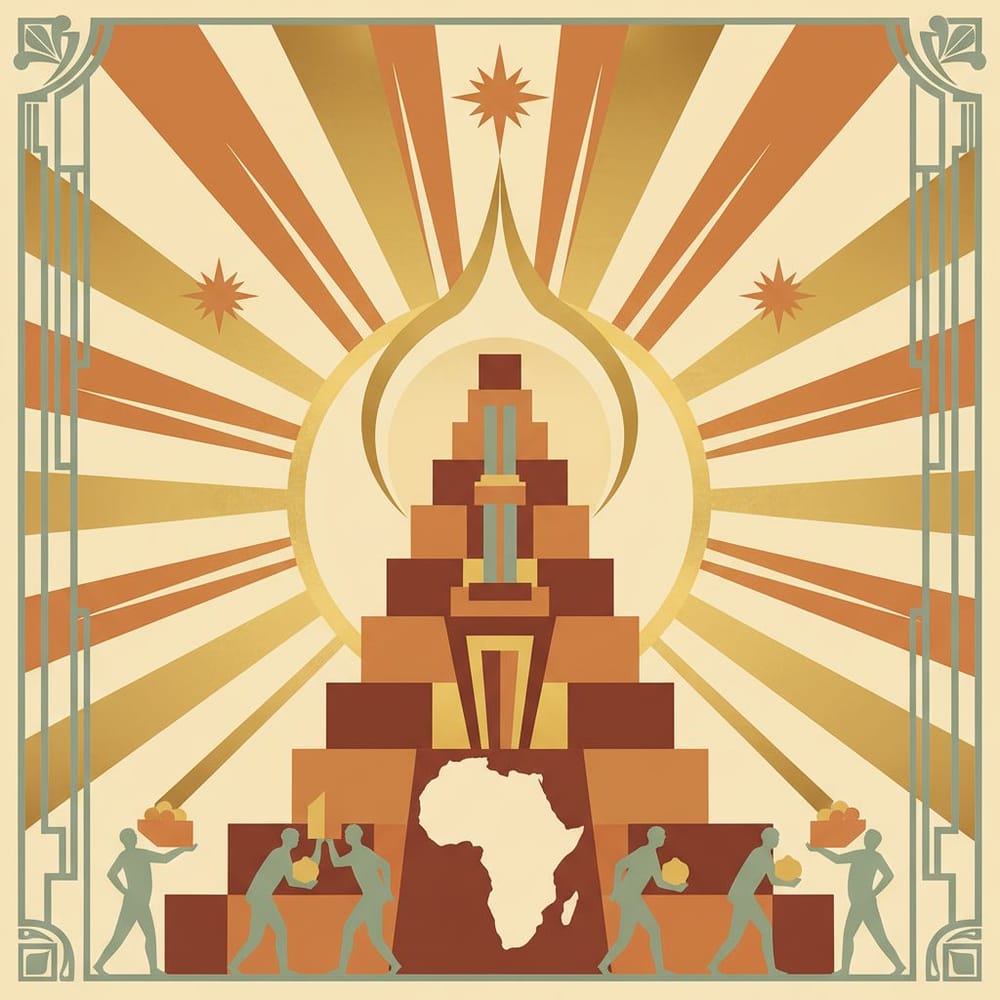
Artificial intelligence and automation, often perceived as threats to African employment, paradoxically open new economic spaces. The traditional employment pyramid that is wavering on other continents creates bypass opportunities for Africa.
Ghana is thus developing 15,000 jobs in content moderation and data annotation for global technology companies. These “click jobs” pay between 300 and 800 dollars monthly—3 to 8 times the local minimum wage. Nigeria has 85,000 digital freelancers generating collectively 340 million dollars in annual revenues.
Precision agriculture is also transforming rural prospects. The use of drones for crop monitoring, IoT sensors for irrigation, and mobile applications for marketing creates new technical professions. Senegal trains 2,000 “digital agricultural technicians” per year, a profile that did not exist five years ago.
These innovations, however, remain concentrated in connected urban hubs. High-speed internet access, a sine qua non of these jobs, covers only 35% of sub-Saharan territory according to the International Telecommunication Union.
Women entrepreneurs chart an alternative path
Faced with the deficiencies of formal employment, female entrepreneurship emerges as a vector of economic transformation. Women represent 58% of African entrepreneurs, the highest rate in the world according to Global Entrepreneurship Monitor. This entrepreneurial dynamic generates 2.1 million direct jobs and 4.7 million indirect jobs in 12 studied countries.
Access to financing remains the principal obstacle: only 23% of African women entrepreneurs obtain bank credit compared to 34% of their male counterparts. Crowdfunding solutions and fintechs partially fill this gap. Kiva, a microcredit platform, has financed 890,000 women’s projects in Africa for a cumulative amount of 2.1 billion dollars.
The social impact of this female entrepreneurship exceeds job creation. Women entrepreneurs reinvest on average 73% of their profits in their families’ education and health compared to 42% for men, according to the longitudinal study by the Grameen Foundation published in 2025.
Vocational training seeks its African model
The mismatch between available skills and economic needs constitutes a critical bottleneck. 67% of African employers report recruitment difficulties—a paradox on a continent where 104 million young people live in poverty despite their employment.
Educational systems, largely modeled on colonial patterns, poorly prepare students for contemporary economies. Morocco is experimenting with a dual training model inspired by the German system: 150,000 young people follow curricula alternating between theoretical courses and company internships. Initial results show 78% employment placement compared to 34% for traditional programs.
South Africa is developing “learning factories”: spaces reproducing real industrial environments where apprentices master cutting-edge technologies. These centers, financed by public-private partnerships, train 25,000 technicians per year in 8 priority sectors.
The digitalization of training accelerates this transformation. The African version of Khan Academy, Eneza Education, reaches 6 million learners in 8 countries. These platforms drastically reduce training costs while adapting to local languages and contexts.
The future of young African employment is drawn between accelerated structural transformation and persistent quality challenges. While 2033 will likely mark the turning point toward a dominant services economy, the central question remains: will this transformation be able to create the 15 million formal jobs annually necessary to transform African employment into a genuine social elevator? The answer will determine whether Africa’s demographic dividend represents a historic opportunity or an insurmountable challenge.
Sources
Sources: