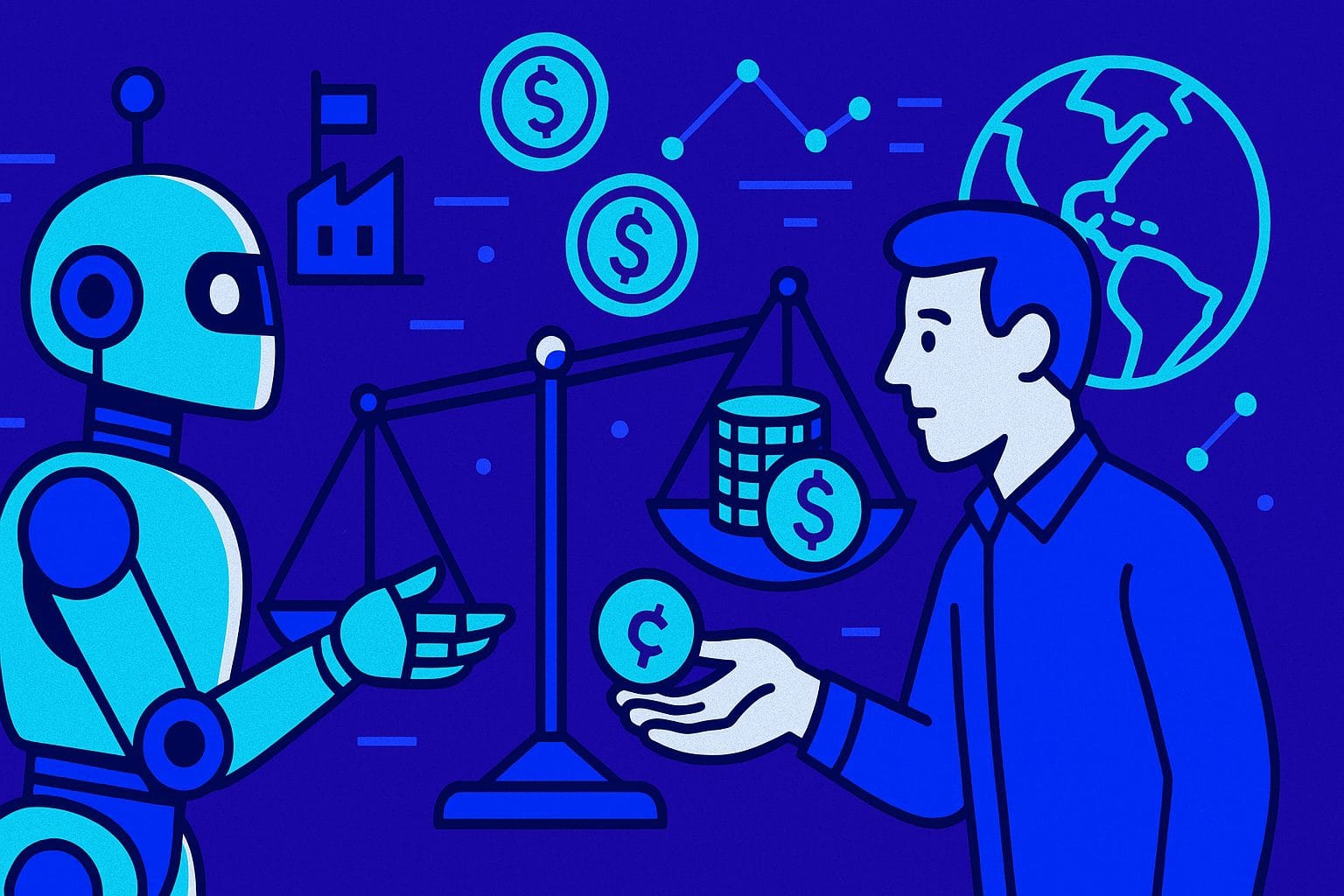
More than half of South Korean workers use generative artificial intelligence at the office. The result? They gain nearly 4% of their work time, but this efficiency translates to neither more production nor higher income. AI produces free time, not growth.
The Essentials
- 51.8% of South Korean workers use generative AI, reducing their work time by 3.8%
- The correlation between time gained and increased production is close to zero
- Productivity gains are reclaimed as free time at the office rather than invested in more work
- This disconnect challenges traditional economic models of technological innovation
South Korea is conducting a real-world experiment on AI’s actual impact at work. A study by Suh & Oh conducted among thousands of workers reveals a paradox: the tool that was supposed to revolutionize the economy primarily produces relaxation. Employees complete their tasks faster, but don’t do more tasks. They reclaim the gained time for themselves.
This Korean reality questions AI’s promises. If productivity gains generate neither economic growth nor additional tax revenues, should we reconsider our approach to this technology? What if AI served primarily to humanize work rather than intensify it?
More Than Half of Koreans Work with AI
Adoption of generative artificial intelligence is exploding in South Korea. According to the Suh & Oh study published in January 2026, 51.8% of South Korean workers now use these tools in their professional activities. AI usage in South Korea increased 43.2% between the first half of 2025 and Q1 2026, the largest increase globally.
Use concentrates on traditional office tasks: writing emails, creating presentations, analyzing documents, synthesizing information. The sectors with the highest usage include finance, marketing, administration, and business services.
This massive adoption is not uniform. Executives and intellectual professionals show usage rates of 67%, compared to 38% for front-line employees. Age also plays a role: 61% of those under 35 use AI compared to 42% of those over 45.
The gap with other countries is striking. By comparison, U.S. growth increased 19% over the period. In Europe, figures oscillate between 25% and 40% depending on the country. South Korea confirms its status as a global technological laboratory.
AI Saves 3.8% of Time but Changes Nothing About Production
Measurements by Suh & Oh reveal an average time gain of 3.8% for generative AI users. Over an eight-hour day, this represents approximately 18 minutes saved. These gains concentrate on repetitive and administrative tasks.
But here’s the paradox: this efficiency translates into no measurable increase in production. The correlation between time gained and change in overall productivity is statistically null. Faster workers don’t produce more.
The study tracked 2,847 employees over six months, measuring both their AI usage and performance indicators. Result: AI users complete their assigned tasks faster, but don’t undertake additional tasks. They use the freed time for breaks, conversations with colleagues, or personal activities at the office.
This situation contrasts with standard economic predictions. Traditionally, productivity gains translate either to more production at constant effort, or the same production with less effort. Here, effort remains constant but production doesn’t increase.
The phenomenon echoes that observed with remote work in the United States, where theoretical efficiency gains don’t always materialize into measurable economic gains.
Employees Appropriate Time Gains as an Acquired Right
The qualitative survey conducted in parallel reveals that workers consider the time gained through AI as belonging to them. 73% of respondents find it “normal” to reclaim this time for themselves rather than for additional tasks.
This appropriation is explained by several factors. First, workload hasn’t been redefined by employers. Objectives remain the same; only the method to achieve them changes. Second, many workers believe AI compensates for the information overload of recent decades rather than providing real efficiency gains.
Managers struggle to measure and redirect these gains. In 62% of cases, supervisors don’t even know their teams use generative AI. The tool integrates discreetly into existing workflows without disrupting the visible organization of work.
This discretion explains why macroeconomic gains are slow to appear. Unlike previous industrial revolutions, generative AI doesn’t immediately reorganize production processes. It inserts itself into existing practices and frees up individual time rather than transforming structures.
Some economists see a transition effect. Real gains would only appear with complete organizational restructuring around AI, a process that could take a decade.
The Korean Economy Feels No AI Effect Despite Massive Adoption
At the macroeconomic level, this massive AI adoption generates no detectable signal. Productivity in South Korea showed improvement of 2.96% in March 2026, contrary to the stated stability, but this one-off change remains within the usual variations of previous years. Sectoral indicators show no acceleration in branches with the highest AI usage.
This absence of macro impact is puzzling. Historically, major technological innovations produce measurable aggregate productivity gains within two to five years of adoption. The computerization of the 1990s thus generated 0.5 additional point of growth in South Korea.
The South Korean Ministry of Finance commissioned a specific study on this “AI productivity paradox.” Preliminary conclusions, expected mid-2026, could shed light on this gap between individual adoption and collective impact.
Several hypotheses circulate. Generative AI could first replace low-value-added tasks, creating comfort without creating wealth. Or real gains might require organizational overhaul that few companies have undertaken.
This situation isn’t unique to South Korea. Preliminary data from other countries show similar patterns: rapid adoption, individual gains, imperceptible macroeconomic impact. AI even widens the gap between countries without keeping its promises in wealthy economies.
Toward Institutionalization of Technological Free Time
Faced with this reality, several Korean voices advocate a radically different approach to AI at work. Instead of trying to capture time gains for more production, why not institutionalize them as free time?
Kim Min-jun, economist at Seoul University, proposes transforming AI gains into an official reduction in work time. “If AI allows us to do in 7 hours 30 minutes what we did in 8 hours, let’s reduce the work day to 7 hours 30 minutes while keeping the same salary,” he argues.
This approach is inspired by four-day week experiments conducted in Iceland, Belgium, and the United Kingdom. But it goes further: it directly links work time reduction to measured technological gains.
Three Korean companies are already testing this logic. They have reduced weekly work time by 3.8% (equivalent to measured AI gains) without cutting wages. Initial results show stable production and improved workplace well-being.
The South Korean government is studying expansion of these experiments. A pilot law could allow companies to legally reduce work time in proportion to documented AI gains, while maintaining social protections.
The Limits of a Growth Model Through Free Time
This vision appeals but raises crucial questions. First, international competitiveness. If South Korea institutionalizes technological free time while other countries capitalize AI gains in additional production, the Korean economy could fall behind.
Next, financing social systems. Less production means fewer tax revenues, so less budget for education, health, or pensions. How do you maintain the welfare state if AI only generates free time?
Some propose directly taxing AI usage to compensate for lost revenues from reduced activity. A “robot tax” could fund a universal free time allocation. But this approach remains largely theoretical.
The Korean experience reveals above all that AI challenges our fundamental economic models. If technology can reduce the painfulness of work without increasing material wealth, should we rethink growth as a central objective?
These questions transcend South Korea. They foreshadow debates that all developed societies will have to settle in the years to come. AI as a tool for humanizing work rather than intensifying production represents a major civilizational wager.
South Korea could thus become the first country to consciously choose free time rather than growth as the dividend from artificial intelligence. An experiment to watch closely.