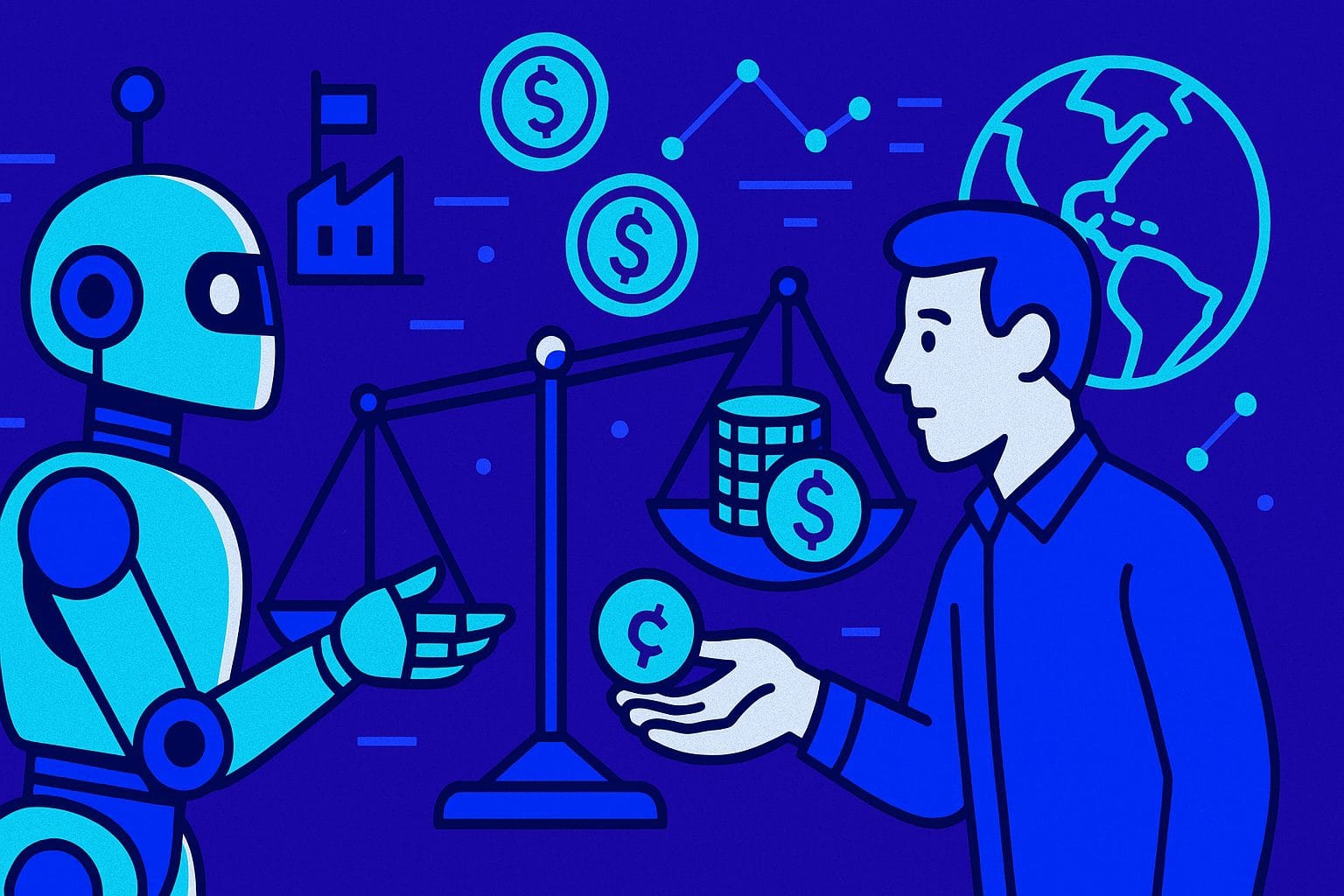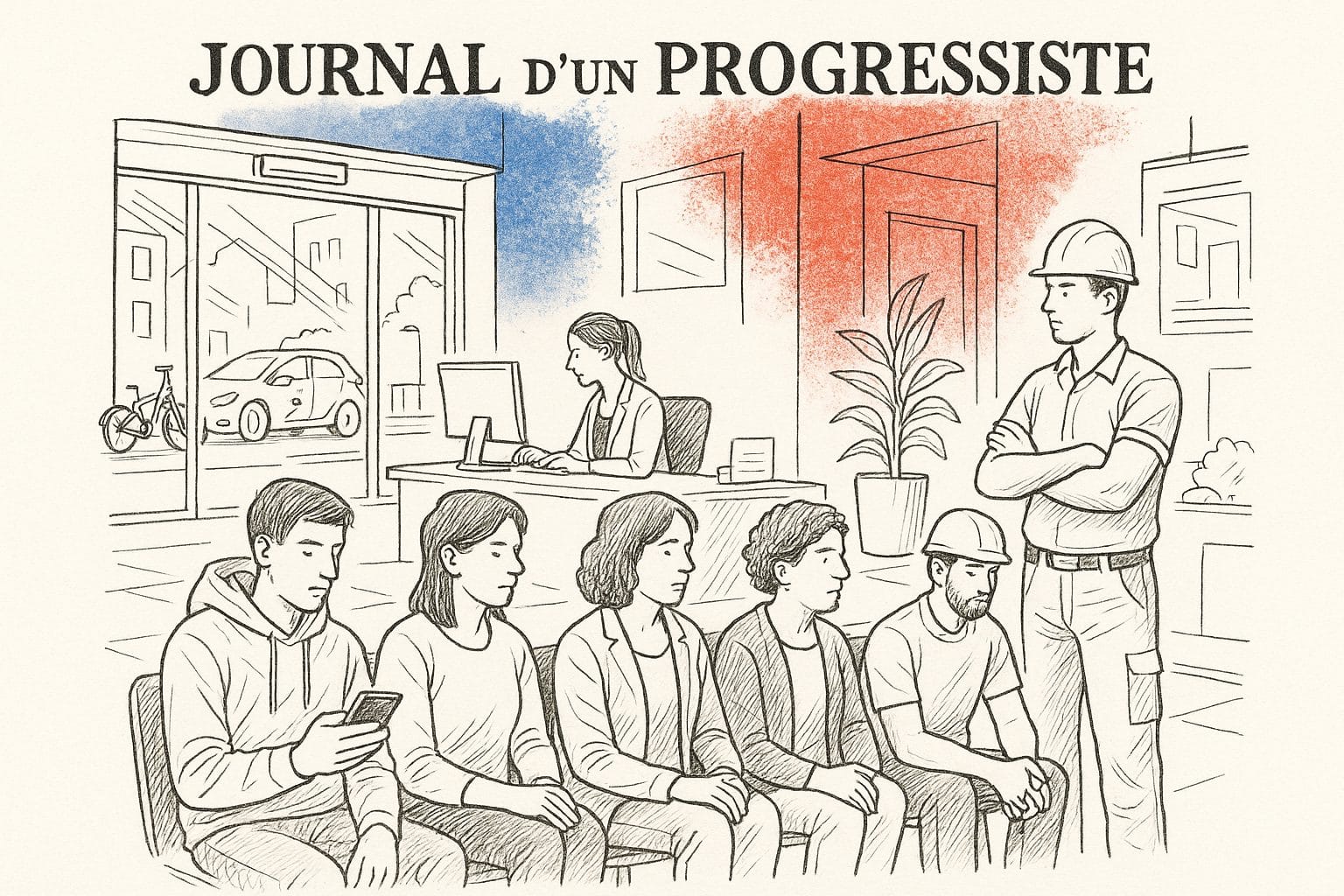
AI agents save knowledge workers 6.4 hours per week—the median measured on real production data, not a sales promise. This figure, released in 2026, ended part of the debate. But it opened another, more uncomfortable one: these hours gained are not distributed uniformly. They concentrate in organizations that had already invested in tooling, evaluation, and governance. Others are still waiting.
AI productivity exists. Its distribution is not automatic. And the gap is widening.
The essentials
- Median knowledge workers equipped with AI agents recover 6.4 weekly hours, according to separate reports from McKinsey, Slack, and Bain compiled by the Digital Applied blog
- In organizations that have deployed AI agents at scale, the cost per customer service ticket has been significantly reduced, according to available data
- Projected net productivity gains reach 14 to 19% by end of 2027, but only in the top quartile of organizations
- The gap between top-quartile and bottom-quartile widens: organizations without structured AI governance underperform and fall further behind the leaders as time passes
6.4 hours per week, and economists stopped debating
For three years, the discussion about AI and productivity resembled a dialogue of the deaf. On one side, software publishers produced studies showing spectacular gains on carefully selected use cases. On the other, productivity economists pointed to the absence of any signal in aggregated macroeconomic data. Solow’s paradox seemed to strike again: technology visible everywhere except in the statistics.
What 2026 changed was the quality of measurement. New studies no longer rely on laboratory conditions or intention surveys. They measure real behavior in real professional environments, on populations large enough that the median is statistically significant. 6.4 weekly hours per equipped knowledge worker: that’s roughly 16% of standard working time. Projected over a year, that’s more than a month of work recovered per employee.
The most striking figure, however, comes from customer service. In organizations that have deployed AI agents at scale, the cost per customer service ticket has been reduced very substantially. For CFOs who still harbored doubts, this type of metric is decisive: it speaks in the same currency as their income statement.
These figures close one debate. AI is productive. The next question is structurally different.
Gains exist, their distribution is another matter
Institutionalist economists have a formula to describe what is currently happening. They speak of “technological gain capture”: the productivity created by an innovation does not distribute mechanically according to exposure to the technology. It distributes according to organizations’ capacity to absorb it, integrate it, and reorganize work accordingly.
Daron Acemoglu and Simon Johnson, in their work on technology and power, showed that the same innovation can reduce or widen inequality depending on the institutions that frame it. What happens at the enterprise scale reproduces this mechanism exactly at the labor market scale.
2026 data confirms this with unusual clarity. Organizations in the top quartile project net productivity gains of 14 to 19% by end of 2027. Those in the bottom quartile, exposed to the same tools and licenses, see no significant signal. The gap does not narrow with time: it widens. Each passing quarter strengthens the first group and leaves the second where they were.
What winning organizations have in common is not a larger technology budget. It is prior investment in three domains: evaluation (the ability to measure what AI actually produces), governance (clear rules on what agents can and cannot do), and integration (reorganizing workflows around new tools rather than simply adding tools to existing workflows).
These three elements are not technological. They are organizational. And they demand time.
What winning organizations did differently
A few examples help understand concretely how the leap occurs, and why it is difficult to reproduce through quick imitation.
Consulting firms that integrated AI agents into their deliverable production did not simply give consultants access to a language model. They redefined their project milestones, identified tasks where AI produces reliably and those where it introduces errors, trained their teams in verification rather than writing, and created feedback loops allowing prompts to improve over missions. This is a complete reorganization cycle, not a technology deployment.
In customer service, organizations that achieved the most significant cost reductions did not replace human agents with AI agents. They redesigned their service architecture: AI agents handle standardized requests with resolution rates measured in real time, human agents handle complex cases and provide training data that improves the former. The result is a hybrid organization whose performance depends on coupling quality, not on the volume of licenses purchased.
Legal and compliance teams that integrated document review agents invested in defining what an agent can sign off on and what requires human validation. This governance is not optional: without it, speed gains come with legal risk that organizations cannot absorb. With it, the gain is real and sustainable.
In all these cases, the limiting factor was not technology. It was the organization’s capacity to think about itself differently.
The widening gap between those who prepare and those who wait
This mechanism creates a situation that business strategists call “path dependency”: future trajectory depends on past investments, and the cost of catching up increases with time.
Organizations that invested early in evaluation today have longitudinal data on their AI performance. This data allows them to identify bottlenecks, prioritize subsequent deployments, and justify future investments with empirical arguments. Those who did not invest in evaluation navigate blind. They do not know what works, they cannot justify the next step, and they make decisions on anecdotal bases.
Governance creates a similar gap. Organizations that defined usage rules early reduced their exposure to incidents: incorrect outputs, data breaches, contestable automated decisions. When these incidents occur in organizations without governance, they produce two negative effects simultaneously: they slow down future deployments and they create lasting internal distrust. Trust in tools, once damaged, is slow to rebuild.
Integration, finally, may create the most durable gap. Organizations that reorganized their workflows around AI developed collective competencies: their teams know how to formulate tasks for agents, interpret their outputs, detect their characteristic errors. These competencies are not transferable through a two-day training. They are acquired through practice, and practice demands time.
The article US States Are Building Piece by Piece a Labor Law for the AI Era documented how regulatory frameworks seek to support this transition. What 2026 data shows is that organizational capacity is a prerequisite just as decisive as the legal framework.
What workers experience concretely
The 6.4 hours recovered per week do not disappear into thin air. They pose a practical question to every organization: will these hours go into more production, less load, or higher-value tasks?
The answer varies by context, and it reveals a real tension. In organizations under strong volume pressure, recovered hours are immediately reabsorbed by increased targets. Workers produce more, but their subjective load does not decrease. The gain goes to the employer, not the employee. This is the scenario unions observe with the most concern.
In organizations that deliberately chose to reduce load and invest the freed time in higher-value-added tasks, the picture is different. Development teams using AI agents for code generation spend less time on repetitive tasks and more time on architecture, code review, and solving complex problems. Work changes in nature, not just in volume.
This distinction is not automatic. It results from an explicit management choice, and this choice is political as much as economic. It determines whether AI productivity gains translate into competitive advantage for the company alone, or into shared improvement of working conditions. An article on what AI demands of beginners documented another dimension of this transformation: required skills change faster than training programs adapt.
What the projected 14-19% gain assumes
The projection of net productivity gain of 14 to 19% by end of 2027 merits precise reading. It does not apply to all organizations. It applies to the top quartile, under mature deployment conditions. And it rests on assumptions that are not all settled.
The first assumption is technological stability: models continue to progress without their interfaces and behaviors changing so much as to render existing integrations obsolete. This is a reasonable assumption over 18 months, but not certain.
The second is absence of major regulatory friction. Regulations under development in several jurisdictions could impose constraints on certain automated uses, particularly in financial, healthcare, and human resources sectors. These constraints will not invalidate existing deployments, but they will slow extensions.
The third, and perhaps most structural, is availability of skills. The shortage of profiles capable of designing and maintaining AI agent architectures is already visible. It will worsen if demand continues to grow at current rates. Organizations that have not begun training their teams today will be competing on an even tighter talent market in eighteen months.
These three constraints do not undermine the direction of movement. They condition its speed and, especially, its distribution.
The question executives still avoid
What 2026 data ultimately illuminates is a strategic question that many organizations have not yet posed explicitly: do they want to be part of the quartile that captures gains, and if so, what are they willing to invest to be there?
This question is uncomfortable because it has no simple technological answer. It assumes honest organizational diagnosis of evaluation, governance, and integration capacities. It assumes budgetary arbitration between buying licenses and investing in transforming practices. It assumes a decision on gain-sharing between shareholders, management, and employees.
Organizations that sidestepped these questions in 2024 and 2025 by buying tools without changing practices are now in the bottom quartile. This is not a permanent condemnation. The current gap is closeable, but it grows with each passing quarter.
The good news, documented by the same data, is that organizational learning curve is real. Organizations that seriously engage in transformation progress rapidly once they have laid the right prerequisites. Productivity follows. It does not precede.
Sources
- Digital Applied — AI Agent Productivity Statistics 2026: ROI Data Points (compilation of McKinsey, Slack and Bain data): https://www.digitalapplied.com/blog/ai-agent-productivity-statistics-2026-roi-data-points
- McKinsey Global Institute — The economic potential of generative AI (report, URL not guaranteed)
- McKinsey — AI productivity gains and the performance paradox (May 2026): https://www.mckinsey.com/capabilities/strategy-and-corporate-finance/our-insights/where-ai-will-create-value-and-where-it-wont
- Daron Acemoglu and Simon Johnson — Power and Progress (PublicAffairs, 2023): https://shapingwork.mit.edu/power-and-progress/
- Slack Workforce Lab — State of Work 2026 (annual report, URL not guaranteed)
- Slack Workforce Index (June 2025 / Q1 2026): https://slack.com/blog/news/the-new-ai-advantage
- PwC 2026 AI Performance Study: https://www.pwc.com/gx/en/news-room/press-releases/2026/pwc-2026-ai-performance-study.html
- Gartner — Predictions on AI strategies (May 2026): https://www.gartner.com/en/newsroom/press-releases/2026-05-13-gartner-predicts-by-2027-50-percent-of-enterprises-without-a-people-centric-ai-strategy-will-lose-their-top-ai-talent
- NBER / Fortune — CEO Survey on the AI productivity paradox (Feb. 2026): https://fortune.com/2026/02/17/ai-productivity-paradox-ceo-study-robert-solow-information-technology-age/