Nearly 750 American business leaders confirm what economists still struggle to measure: artificial intelligence generates real productivity gains but transforms employment rather than destroying it. A survey by the Federal Reserve Bank of Atlanta reveals that 38.3% of American workers were using generative AI at the end of 2025, with positive effects on wages — but the central question is no longer whether AI eliminates jobs, but rather who captures its productivity gains.
Ground-level data stands in stark contrast to apocalyptic prophecies. The majority of executives surveyed report net benefits, little short-term job destruction, but profound recomposition: clerical tasks are declining, technical roles are expanding. The debate is shifting toward the capital-labor distribution of efficiency gains.
The Essentials
- 750 American executives surveyed by the Atlanta Fed: positive AI productivity gains, little net short-term job destruction
- 38.3% of American workers were using generative AI at the end of 2025, with slight positive effects on wages
- Recomposition rather than destruction: clerical jobs in decline, technical roles expanding
- The issue is shifting toward the capture of productivity gains between capital and labor
American Executives Validate AI Productivity Gains
The Federal Reserve Bank of Atlanta’s survey of 750 business executives confirms a reality that macroeconomic statistics struggle to capture: AI generates tangible productivity gains. The majority of executives surveyed report investments already made and positive returns on those investments, contradicting the hypothesis of mere announcements or a technology bubble.
These results converge with a parallel study by Hartley et al., which establishes that 38.3% of American workers were using generative AI at the end of 2025. More significantly still: this adoption comes with “small positive effects on wages,” according to the researchers. The gap between the gains announced by executives and the benefits captured by employees raises the central question of this transformation.
The data confirms that AI does not follow the model of previous technological revolutions. Unlike industrial robots that mechanically replaced labor, AI augments certain human capabilities while automating other tasks. This complementarity explains why job destruction remains limited in the short term, even when productivity gains are real.
Recomposition Outweighs Net Destruction
American companies are experiencing a transformation through task substitution rather than mass layoffs. Clerical and administrative functions are declining — data entry, routine summaries, form processing — while technical roles and supervisory positions are expanding. This recomposition redefines employment profiles without necessarily reducing their total number.
The most visible effect touches intermediate tertiary sector jobs: accountants becoming financial analysts, legal assistants evolving toward legal research, medical secretaries refocusing on patient reception. AI absorbs repetitive tasks and frees up time for higher value-added activities — but this upskilling requires training that not all companies finance.
The most affected sectors include finance, insurance, and business services, where AI excels at processing structured data. Conversely, manual trades, craftsmanship, and personal services fare better. This sectoral geography of automation draws a new map of professional vulnerabilities and opportunities.
Small and medium-sized enterprises lag larger companies in adoption, creating a productivity gap that could translate into competitive distortions. Companies that master AI gain efficiency; those that delay risk losing market share — a mechanism that could accelerate industrial concentration in certain sectors.
Capital-Labor Distribution at the Heart of the Debate
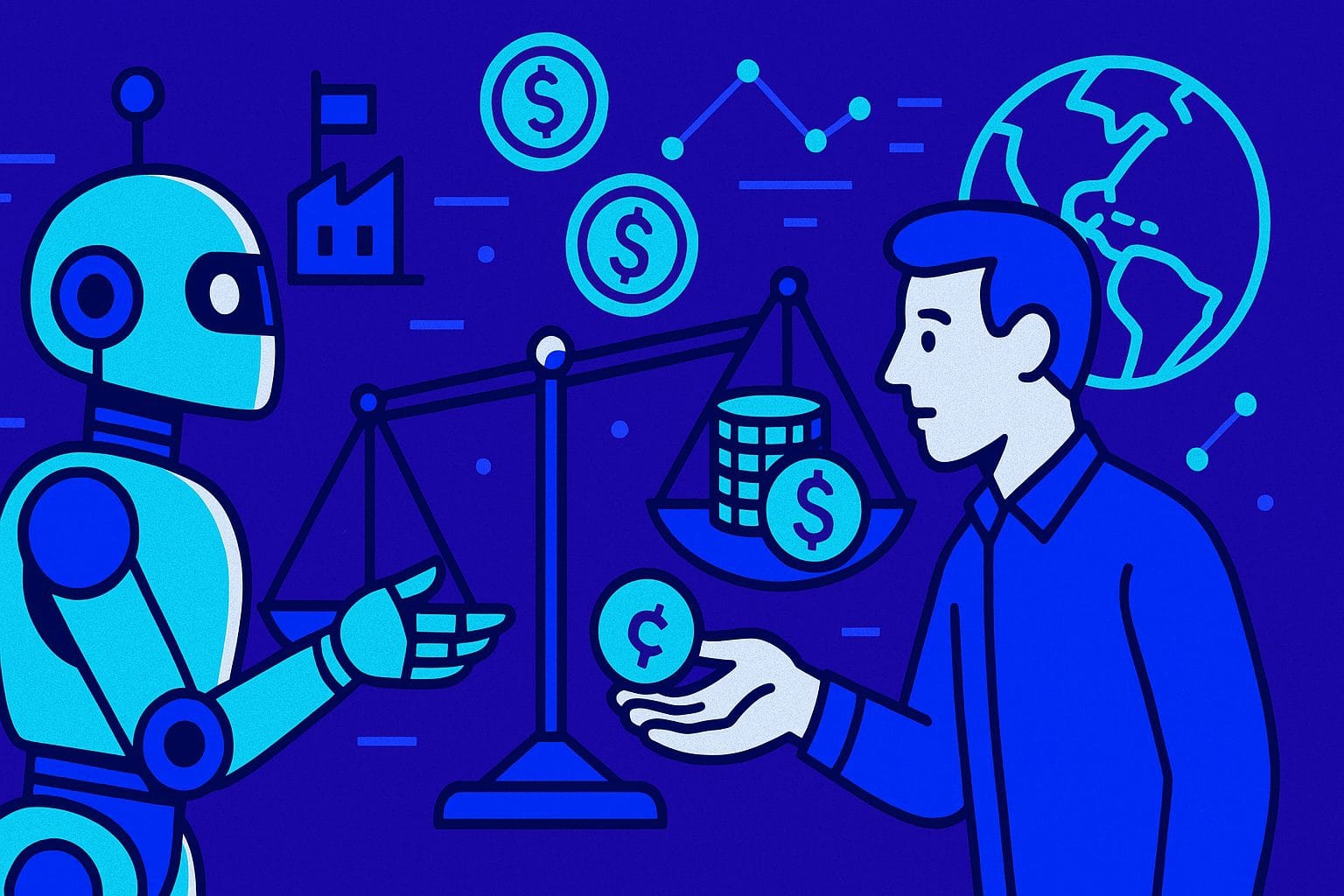
The central question is no longer whether AI destroys employment, but how it redistributes value created between capital owners and workers. The productivity gains confirmed by executives translate only marginally into wage increases, according to Hartley’s study. This asymmetry reveals a distribution issue that transcends technological debate alone.
Companies investing in AI capture the bulk of benefits in the form of increased margins or strengthened competitive positions. Employees recover a fraction of these gains, primarily through upskilling and evolution toward higher value-added positions. But this evolution benefits mostly qualified workers capable of adapting to new tools.
Meta’s deletion of 8,000 positions illustrates this tension: technology companies reduce their workforces while increasing productivity through AI. Gains concentrate on shareholders and executives, while laid-off employees do not benefit from the value they helped create.
This asymmetric distribution raises economic policy questions. Should productivity gains from AI be taxed to finance training for displaced workers? How can automation be prevented from widening wage inequality? The answers will determine whether AI becomes a factor of economic inclusion or exclusion.
The Challenges of Reconversion in the Face of AI
The OECD alerts us to reconversion challenges in light of AI and points to a reality that American data confirms: not all workers can easily adapt to transformations induced by AI. The “small positive effects on wages” observed by Hartley mask significant disparities depending on profiles and sectors.
Workers over 50, those without higher education, or from economically fragile regions struggle more to benefit from AI. This technology favors already-advantaged profiles — young graduates, urban executives, dynamic sectors — and leaves behind those who face multiple disadvantages. Reconversion becomes a privilege rather than a universal solution.
American companies surveyed by the Atlanta Fed prioritize investment in technological equipment over training their existing workforce. This economically rational short-term logic creates pockets of exclusion that could fuel social and political tensions in the medium term.
The issue goes beyond the company framework to become a public policy question. How can funding be secured for upgrading less-qualified workers? What role for the state in accompanying sectoral transformations? The answers determine the social acceptability of automation.
The European Model Lagging Behind
Europe pools its calculation to catch up with AI giants and reveals the extent of European lag behind the United States. While American companies massively experiment with AI and measure its effects, Europe struggles to develop its own tools and remains dependent on solutions from across the Atlantic.
This technological dependence is coupled with adoption lag. European companies invest less in AI, train their employees less, and accumulate less practical experience. The risk is twofold: experiencing the effects of automation without controlling its levers, and seeing productivity gains captured by American platforms rather than local actors.
Europe’s more cautious regulatory approach to AI could further slow adoption and widen the gap with the United States and China. Between worker protection and economic competitiveness, Europe seeks a balance that its competitors have chosen not to pursue.
Toward a New Economic Geography
American data sketches the outlines of a transformation that extends beyond the labor market alone. AI redistributes the cards between sectors, regions, and worker profiles. This redistribution creates winners and losers according to logics that do not align with traditional divides.
Technology metropolises concentrate productivity gains and skilled jobs linked to AI. Traditional industrial regions, where intermediate employment still dominates, experience substitution effects more. This differentiated geography of AI impact could deepen territorial inequalities already widened by globalization.
Companies that master AI gain market share from those that delay equipping themselves, creating a concentration dynamic that could transform American industrial structure. This concentration benefits capital holders and highly skilled workers, but weakens intermediate employment and SMEs.
The political issue becomes one of accompanying this transformation. The United States enjoys a technological and economic advantage but must prevent AI gains from deepening inequalities to the point of threatening social cohesion. Will the American model of productive but socially asymmetrical AI prove sustainably viable?