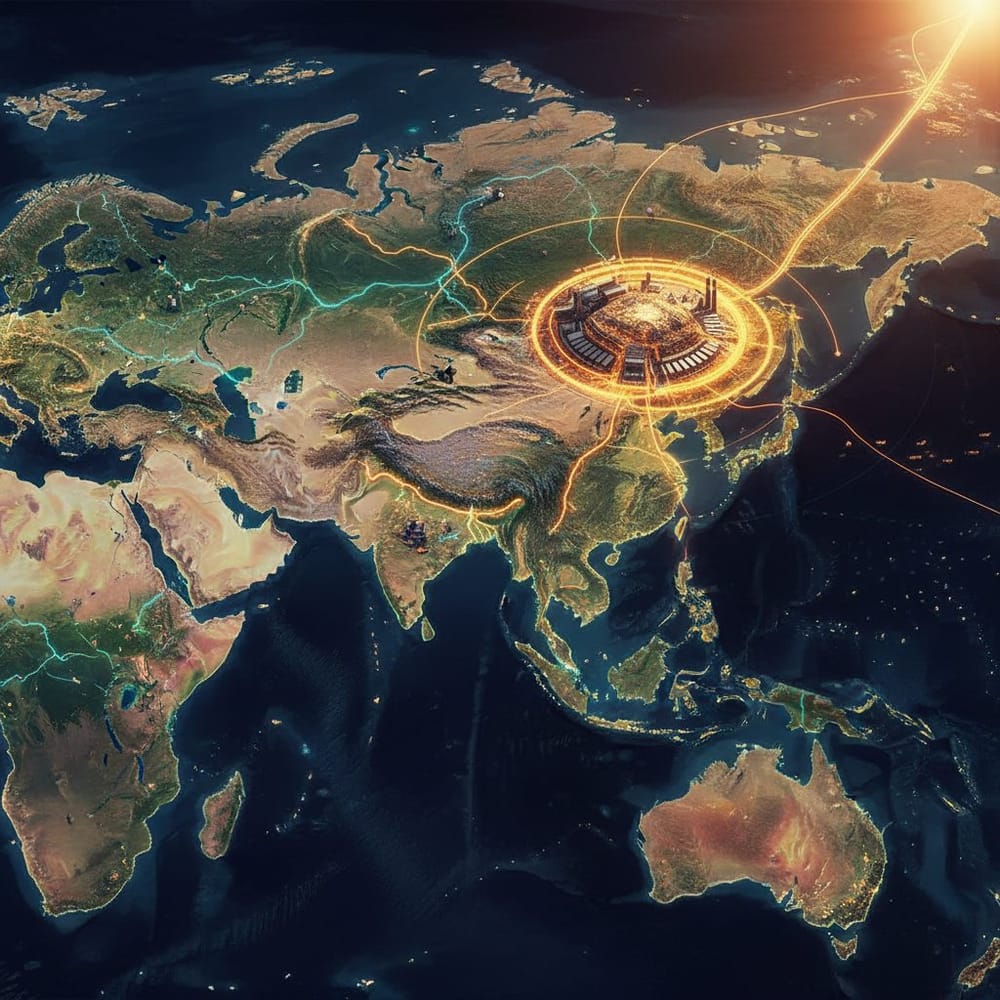
1,800 gigawatts of renewable capacity expected in Asia-Pacific by end of 2026, compared to 1,400 gigawatts currently. This growth of 29% in two years resists geopolitical tensions and inflation affecting the global economy.
Geopolitical tensions have triggered budget reallocations toward defense in Europe, but have had minimal impact on Asia’s energy transition, which remains largely driven by market forces supported by government subsidies, according to analysts at S&P Global.
The Essentials
- Renewable capacity in Asia-Pacific will rise from 1,400 GW currently to 1,800 GW by end of 2026, meaning an additional 400 GW
- China will dominate this expansion with 1.39 TW of additions planned between 2025-2030, compared to 145 GW for India
- Inflation favors institutional demand for real assets with resilient cash flows, according to Keppel Singapore
- China controls the “new three” technologies (solar, electric vehicles, batteries) as well as wind power, making the region dependent on its equipment
China Imposes Its Technological Ecosystem
In 2025, China installed 315 GW of solar and 119 GW of wind power, representing more solar capacity and twice as much wind power than the rest of the world combined. This manufacturing dominance translates into growing technological dependence for Asia.
Chinese technological advances are expected to hold the key to Asia’s energy transition, given the region’s dependence on Chinese renewable equipment, including electrolyzers for hydrogen production. China’s National Energy Administration claims that the country’s solar and wind exports have reduced global carbon emissions by approximately 4.1 billion tons during the 14th five-year plan.
Between 2015 and 2024, China represented 31.9% of all foreign direct investment in electricity production and transmission in ASEAN. This influence extends to future technologies: since 2014, approximately half of hydroelectric capacity commissioned in Southeast Asia has involved Chinese companies in construction.
Inflation Paradoxically Strengthens the Attractiveness of Renewables
Unlike fossil fuels, the costs of clean technologies continue their downward trajectory. The average cost of solar energy (LCOE) in the Asia-Pacific region reached a historic low of 30 dollars per megawatt-hour.
India and Australia are betting heavily on battery storage to solve the intermittency issues of wind and solar, and despite inflationary pressures, the energy cost of batteries is declining, promoting their proliferation. In India, the cost of electricity from new thermal capacity reaches 6 rupees/kWh (0.07$/kWh) while solar energy has fallen to 2.5-2 rupees/kWh.
Geopolitical crises accentuate this advantage. If LNG prices remain 50% above 2025 averages, the cost of gas-fired electricity could increase by 32 to 37%. By contrast, solar energy costs are expected to increase by only 3%, even assuming a 100 basis point increase in the cost of capital.
Investments Resist Macroeconomic Turbulence
Investments in renewable energy projects in Asia-Pacific are expected to exceed 1 trillion dollars by 2026. This resilience is explained by the anti-inflationary characteristics of renewable assets.
Loh Chin Hua, CEO of Keppel, anticipates persistent market volatility and a difficult geopolitical environment in 2026, but inflation should strengthen institutional demand for real assets with inflation-resistant cash flows. These trends favor asset managers capable of creating, developing, and operating such assets. Keppel plans to launch Singapore’s first hydrogen-compatible power plant in the first half of 2026.
Accelerated growth is being verified on the ground. India added 31.24 GW of new renewable capacity between April and November 2025, compared to 14.91 GW in the same period of the previous year, a progression of 109%.
A New Energy Geography Emerges
More than half of the growth in Chinese electric vehicle exports comes from non-OECD countries. Exports to ASEAN jumped 75% between January and August 2025, notably thanks to strong growth in Indonesia.
This reorientation toward the South creates unprecedented energy corridors. Renewable energy in Southeast Asia is largely dominated by China, which has been the largest investor in the ASEAN electricity sector. South-South trade is reshaping global economic geography, a trend that also applies to energy.
The United States and its allies retain a considerable role in the regional energy sector, but are confined to oil and gas. ASEAN governments also have powerful national fossil fuel companies like Petronas in Malaysia. But the United States appears to have largely abandoned the energy terrain even before the beginning of Donald Trump’s second term.
The Limits of a Dependent Model
This acceleration raises questions about energy sovereignty. Beijing faces a difficult trade-off: Chinese expansion without significant benefit-sharing risks intensifying negative reactions that harm the commercial prospects of Chinese companies. But yielding too much by indiscriminately sharing technologies could weaken China’s dominance over solar, batteries, and electric vehicles.
Global economic resilience surprises in the face of American protectionism, but Asia is building its energy transition around an essentially Chinese technological ecosystem. China is well positioned in terms of technology, deployment, scale of capacity creation, and financial resources. If it really commits to it, it can accelerate the transition far more than anyone imagines today.
This geographic concentration creates vulnerabilities. The tariff war with the United States triggered a relocation of certain productions toward ASEAN, particularly in Malaysia and Vietnam. But Chinese companies continue to play a central role, either by controlling factories or by supplying them.
Asia-Pacific is transforming the global energy economy at an unprecedented pace, but this revolution rests largely on a single country. If the region achieves its capacity objectives, it will have created a new model of green growth. If this technological dependence persists, it will also have created a new form of geopolitical vulnerability.
Sources