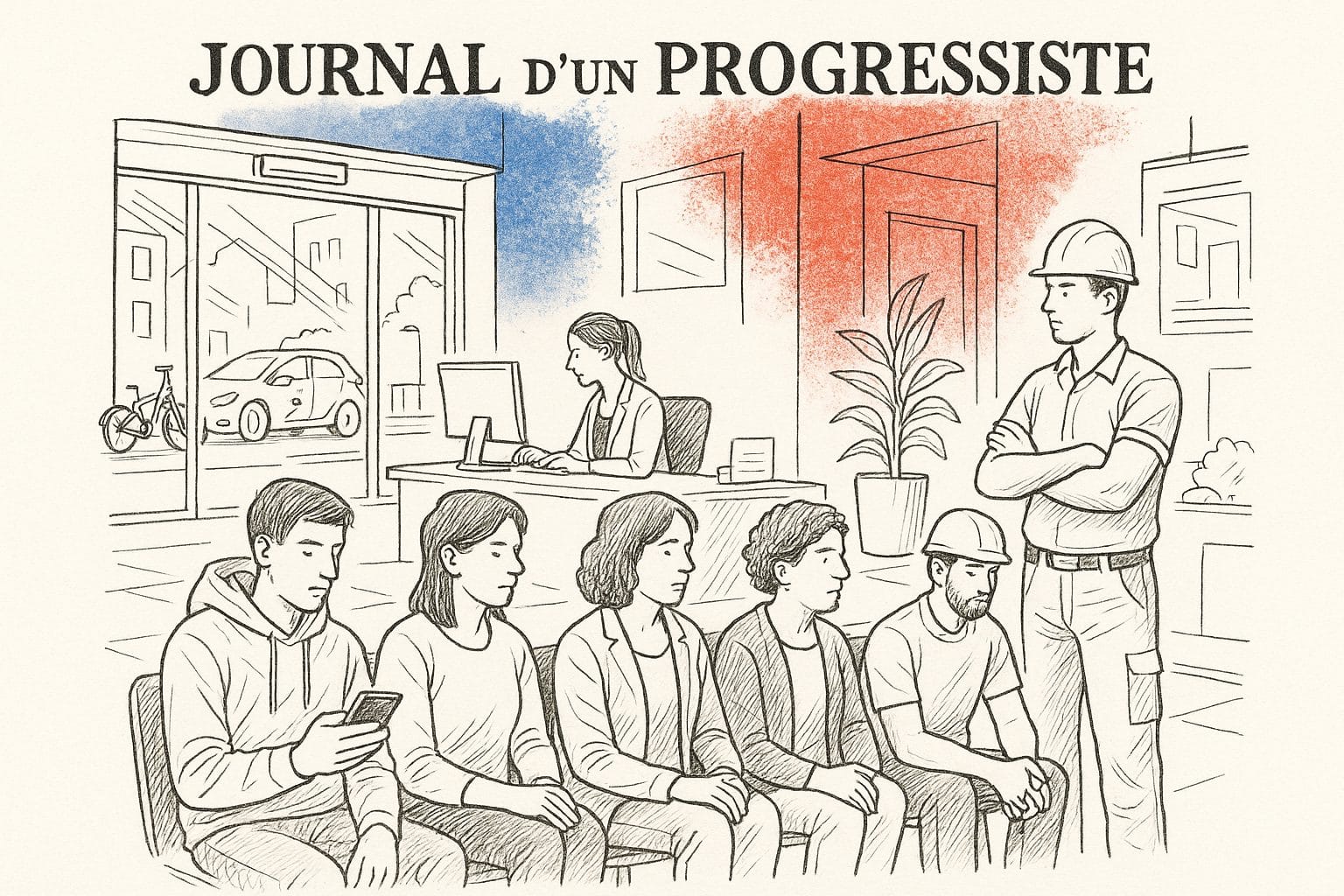
In the United States, robotization does not destroy jobs uniformly. Data spanning twenty years show that job losses hit non-white workers twice as hard as white workers, and men twice as hard as women. These gaps reflect, in the numbers, the unequal position workers face when bearing the cost of technological progress.
The essentials
- Between 1993 and 2014, robot adoption is associated with an estimated decline of 4.5 percentage points in non-white employment, compared to 1.8 points for white workers (Lerch, 2025; Acemoglu & Restrepo, 2020).
- Men lose 3.7 points versus 1.6 for women, because robotics concentrates its substitutions in manufacturing industries dominated by men, where non-white workers are overrepresented.
- Direct losses are amplified by the collapse of local service jobs that depend on demand from industrial households, which further widens racial gaps.
- Acemoglu and Restrepo show that the distributive effects of automation depend notably on displacement effects, productivity gains, and the creation of new tasks.
- By 2040, the next wave of AI could reproduce this pattern if productivity gains do not reach the most exposed workers.
Two decades of data point to the same losers
The study by Acemoglu and Restrepo on American labor markets between 1993 and 2014 quantifies the distributive effects that discourse on “creative destruction” left in the shadows. Robots reduce employment rates in the areas where they are deployed. Jason Lerch’s analysis (2025) adds a breakdown by group: losses do not distribute uniformly.
Between 1993 and 2014, robot adoption is estimated to have reduced non-white employment by 4.5 points. One point eight for white workers. The gap is a factor of two and a half. For men versus women, the ratio is similar: 3.7 versus 1.6. These figures measure the cumulative scale of job losses tied to robot adoption over twenty years, a transformation that concretely affected hundreds of American industrial basins.
This gap is explained by sectoral concentration. Non-white workers, and notably Black and Hispanic men, held in 1993 a disproportionate share of production and assembly positions in American factories, precisely the positions that second-generation robots replaced first. Women were more present in services, retail trade, and care work, sectors less exposed to the wave of industrial robotization of that period.
Pre-existing occupational segregation did not create these automation inequalities. It amplified them. American labor markets already bore, in 1993, the traces of decades of exclusion and discrimination. Automation acted as an accelerator: it struck where already vulnerable workers were concentrated.
Indirect losses dig a second divide
The first effect is direct: a factory installs robots, workers lose their jobs. But the analysis reveals a second mechanism, less visible and equally powerful.
When an industrial zone loses manufacturing jobs, displaced workers cut their local consumption. Restaurants, groceries, garages, dry cleaners that depended on that demand in turn lose customers, then employees. Acemoglu and Restrepo quantified this diffusion effect: indirect losses in local services compound direct losses in industry.
And there, racial gaps amplify a second time. Destruction spreads through an economically fragile local fabric, striking the same groups twice: first at the factory, then at the café across the street.
This cascading mechanism reshapes the political reading of the problem. Automation’s effects do not stop at the factory gates. Affected zones experience local economic depression whose non-white workers bear a disproportionate share, because of their position in the local economy, which exposes them at every link in the chain.
A choice of architecture, not technical fate
Acemoglu’s thesis raises a political difficulty. In his work on institutions and the distribution of progress gains, he emphasizes one point: technology does not determine its own distributive effects. Investment choices, regulation, and social policy decide who wins and who loses.
Robots that automate a production line do not automatically create alternative jobs for displaced workers. Automation can increase value-added while reducing the share going to labor. Whether these gains are then redistributed depends on a political choice, not an economic law.
During this period, redistribution policies remained limited. American job retraining programs remained underfunded. Affected industrial zones often received little structural support. Trade Adjustment Assistance, the main federal mechanism for aiding workers displaced by foreign competition and automation, covered only a fraction of needs.
Some economists more optimistic about the long-term effects of automation emphasize that previous technological waves ultimately created more jobs than they destroyed. Carl Benedikt Frey showed that nineteenth-century agricultural mechanization had, over several decades, freed labor that fueled industrial growth. The argument holds over the long term. However, according to Lerch, robot adoption between 1993 and 2014 is associated with an estimated decline of 4.5 percentage points in non-white employment, so long-term optimism is of no immediate use to them and says nothing about the duration or distribution of transition costs.
The question of the direction of technology, which Acemoglu develops in his recent work, extends this observation. Companies invest in robotics because it reduces their wage costs. Tax incentives and accelerated depreciation policies for equipment, in effect in the United States for decades, make automation artificially cheap compared to human labor. The asymmetrical fiscal burden between capital and labor tilts investment choices and, consequently, the distribution of losses.
Geographies of loss reveal a predictable map
The data analyzed by Benjamin Lerch concern employment zones, geographic entities grouping local labor markets. They reveal that automation has more severe effects on non-whites because they are more concentrated in automatable blue-collar jobs.
The Rust Belt is the most documented example. Detroit, Cleveland, Gary, and Youngstown have lost manufacturing jobs since the 1970s, first from international competition, then from robotization. Their populations, predominantly Black in working-class neighborhoods, successively endured deindustrialization and automation. The 4.5 points of job loss per robot correspond to concrete experiences in specific neighborhoods, not an abstract national average.
This geography has a political implication often overlooked: national retraining aid programs are poorly adapted to concentrated local crises. A 55-year-old worker in Gary, Indiana, who loses his factory job has fewer retraining options than a young graduate in Chicago. Geographic mobility is low for low-wage workers, and many own homes whose value collapsed with local industry.
Exposure to automation in Asia-Pacific follows comparable logic: groups most vulnerable before the transition remain so during and after, except through deliberate intervention.
The next waves of AI and their expected effects by 2040
Lerch’s study covers industrial robotics from 1993 to 2014. The next wave, generative AI and software agents, has a different exposure profile. It first hits routine cognitive jobs: data entry, document processing, standardized customer service. These jobs are overrepresented among women and certain non-white communities who had precisely shifted toward services to escape industrial destruction.
If the pattern of the last twenty years repeats—automation concentrated on jobs where vulnerable groups are overrepresented, gains captured by capital, absence of structural redistribution—racial and gender inequalities in the labor market could worsen further, this time in the services sector.
Three trajectories emerge for 2040, depending on political choices in the coming years.
In the first, AI’s direction remains determined primarily by current private incentives. AI continues to automate the most codifiable tasks, which are also those where low-skill workers, overrepresented among non-whites, are concentrated. Gains remain with capital. Retraining policies remain fragmented. In this scenario, Lerch’s data repeats itself in a new sector.
In the second trajectory, redistribution mechanisms are put in place before losses accumulate. Brookings published in 2026 an analysis of robotization’s effects on occupational mobility, which suggests the value of territorial policies targeting the most exposed zones and groups rather than the general population. Alternative certifications, accelerated training programs in growing sectors, and direct transfers to displaced workers constitute the known building blocks of this architecture. What is missing, in the United States as elsewhere, is less knowledge of the tools than the political will to fund them at scale.
The third trajectory is what Acemoglu calls augmentation rather than substitution. AI as a tool that makes workers more productive without eliminating their jobs. Examples exist—assisted coding tools that boost developer productivity, medical diagnostic systems that amplify nurse capabilities—but they remain concentrated in already-skilled and well-paid sectors. Extending them to low-skill jobs where non-white workers are overrepresented would require a deliberate choice to orient research and investments, which does not happen spontaneously.
The signals to watch in the coming years are clear: the evolution of employment rates by demographic group in service sectors exposed to AI, the volume and targeting of federal retraining programs, and fiscal choices concerning AI equipment depreciation. These three variables alone will be enough to indicate, by 2027–2028, which trajectory the United States is pursuing.
Available measures for decision-makers
Lerch and Acemoglu’s data are not just a diagnosis. They define intervention levers.
The first is fiscal. If incentives for automation are high because capital receives favorable tax treatment relative to labor, correcting this asymmetry reduces the speed of adoption of pure substitution technologies without discouraging augmentation innovations, which create value without eliminating jobs. Economists like Daniel Susskind have explored how this tariff correction could be articulated with a tax on automation productivity gains to finance transitions.
The second is geographic. Job losses tied to automation are locally concentrated. Retraining policies that operate at the national or state level are too distant to capture these concentrations. Adaptation funds at the local level, targeted at the most affected employment zones and given explicit mandates on underrepresented groups, are more effective than general programs.
The third is technological governance. Acemoglu has posed for years the question of who directs AI R&D. Large technology companies invest in what maximizes their profits, which, in the current context, often means automating work rather than augmenting workers. Policies to orient public research, funding criteria tied to distributive effects, and transparency requirements on who bears the costs of technology partially funded by public monies constitute avenues that neither the market alone nor AI risk regulation covers.
Industrial robotics took twenty years to produce data clear enough to measure its distributive effects. Generative AI is already deployed at large scale. If decision-makers wait until 2040 to have data equivalent to Lerch’s, losses will already be accumulated, and concentrated, in all likelihood, on the same groups.
Sources
- Daron Acemoglu, Pascual Restrepo, Robots and Jobs: Evidence from US Labor Markets, Journal of Political Economy, 2020. https://drodrik.scholars.harvard.edu/robots-jobs
- Jason Lerch (2025), analysis of unequal effects of automation on the American labor market, AEA Economic Research. https://www.aeaweb.org/research/automation-employment-gaps-us
- Brookings Institution (2026), Robotization and Occupational Mobility (no guaranteed URL, cited report without link).
- Carl Benedikt Frey, The Technology Trap: Capital, Labor, and Power in the Age of Automation, Princeton University Press, 2019.
- Daniel Susskind, A World Without Work, Metropolitan Books, 2020.