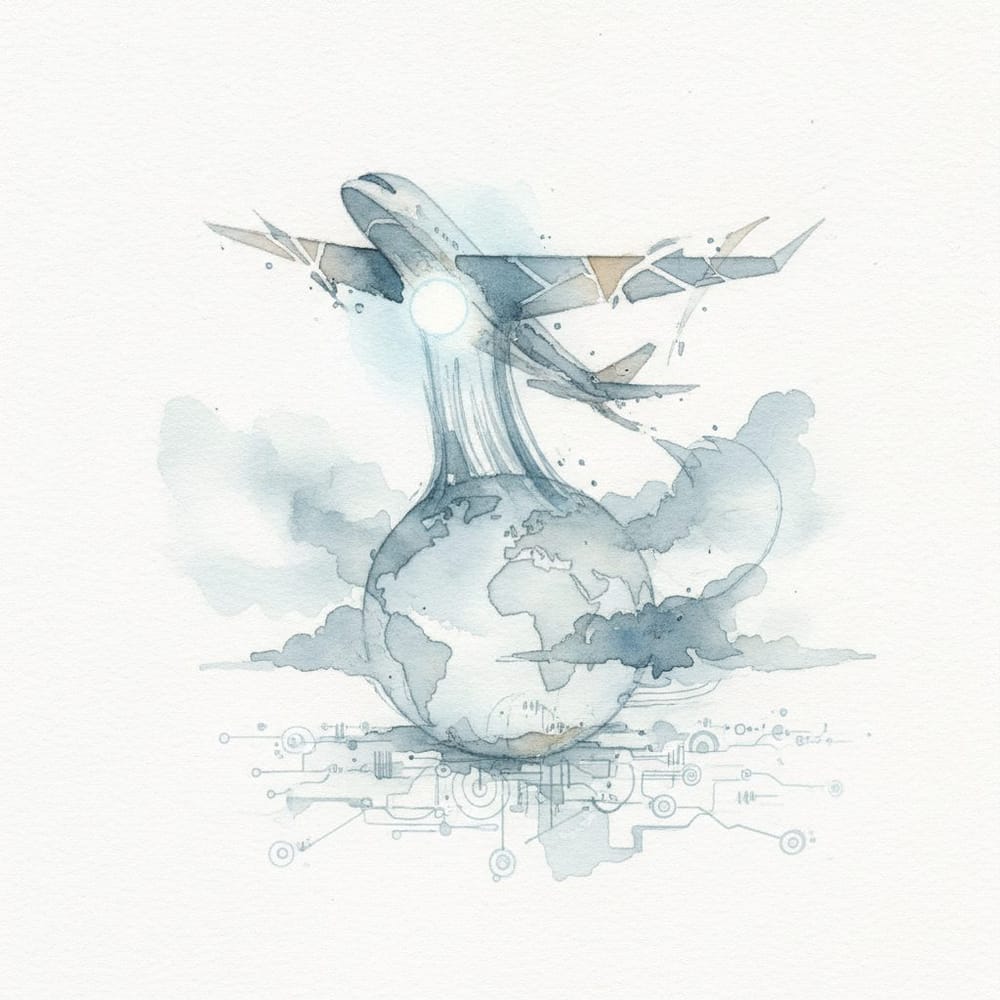
2.4 million tonnes. That is the global production of sustainable fuels for aviation expected in 2026, according to IATA. In other words, 0.8% of current worldwide kerosene consumption. To achieve net zero by 2050, this production will need to be multiplied by 200, reaching 500 million tonnes annually. The aviation sector has built 65% of its decarbonization trajectory on this technology. Yet projects are struggling to get off the ground and costs are skyrocketing.
The aerospace industry has put itself in a difficult position: it has promised carbon neutrality by betting heavily on sustainable aviation fuels (SAF), without the industrial infrastructure keeping pace. More than 40% of production projects planned for 2030 risk being cancelled or postponed, according to the latest IATA estimates. This technological impasse could drive up ticket prices and threaten the connectivity of regional airports.
The Essentials
- Global SAF production will reach 2.4 million tonnes in 2026, representing 0.8% of aviation fuel consumption
- The net zero 2050 target requires 500 million tonnes annually, a 200-fold increase
- More than 40% of SAF production projects planned for 2030 risk cancellation, according to IATA
- Sustainable fuels represent 65% of the global aviation sector’s decarbonization strategy
- SAF price remains 3 to 5 times higher than fossil kerosene
A Sector That Bet Big on an Embryonic Technology
Commercial aviation made an audacious gamble in 2021: achieve carbon neutrality by 2050 by relying 65% on sustainable aviation fuels. This strategy, adopted by the International Civil Aviation Organization (ICAO), places SAF at the heart of the sector’s energy transition, far ahead of energy efficiency gains (20%) and carbon offset technologies (15%).
SAFs are produced from renewable raw materials: waste cooking oils, animal fats, algae, forest waste, or dedicated crops. Unlike automotive biofuels, they can be blended with traditional kerosene up to 50% without modification of existing engines. Certain synthetic fuels even allow complete replacement.
The commitment seemed credible. Airlines multiplied purchase announcements: United Airlines ordered 1.5 billion gallons over 20 years, Delta Air Lines 1 billion. The European Union imposed progressive quotas: 2% mandatory SAF in 2025, 70% by 2050. The United States offers tax credits of $1.75 per gallon.
The problem: the production industry did not keep pace. Global SAF refining capacity stagnates around 600,000 tonnes annually, according to IEA data. Announced projects represent 30 million tonnes of capacity by 2030, but fewer than half have secured definitive financing.
A Supply Chain Crumbling
The reasons for this industrial breakdown accumulate. First, raw materials are lacking. Waste cooking oils, the primary source of current SAFs, represent only 2% of the potential needed by 2050. Energy crops compete with food production. Algae, promised for 15 years, remains at an expensive experimental stage.
Next, conversion technologies struggle to scale industrially. The Fischer-Tropsch process, which transforms waste into synthetic fuel, requires investments of 500 million to 1 billion euros per refinery. Yields remain low: 3 tonnes of biomass are needed to produce 1 tonne of SAF.
Production costs range between 3 and 5 times the price of fossil kerosene. One tonne of SAF costs between 1,500 and 2,500 euros compared to 400 euros for kerosene. This price difference makes SAF dependent on public subsidies and regulatory mandates.
The sector also suffers from a certification problem. Each new production process must be validated by ASTM International, a process that takes 5 to 7 years. Only 8 processes have been certified since 2009, limiting the diversity of supply sources.
More concerning: 40% of production projects announced for 2030 show signs of financial weakness. Shell postponed its Rotterdam project. BP slowed its SAF investments. Even the most advanced projects, such as Neste’s in Finland, primarily produce for road transport, which is more profitable.
Europe Pushing Into a Void With Its SAF Mandate
The European Union attempted to force supply through demand. Its ReFuelEU Aviation regulation requires fuel suppliers to provide at least 2% SAF at all European airports starting in 2025, 6% by 2030, reaching 70% by 2050. Financial penalties can reach 15,000 euros per tonne short.
This regulatory approach produces perverse effects. Airlines develop avoidance strategies: refueling outside Europe when possible, concentrating long-haul flights on a few exempt hubs. Air France-KLM relocated some of its intercontinental flights to Istanbul and Dubai to circumvent European requirements.
The mandate also creates unfair competition between airports. Those unable to secure SAF supplies see their costs explode, threatening their attractiveness. Frankfurt Airport pays for its SAF 40% more than expected, a difference passed on to airlines and then to passengers.
Europe currently produces more than 1 million tonnes of SAF per year, mainly in the Netherlands and Finland. To meet its 2030 targets, it should multiply this production by approximately 3 times. This scaling remains a major industrial challenge within the allotted timeframe.
This situation echoes the energy impasse facing the AI race, an electrical battle that gas is winning: a sector betting everything on a technological transition without ensuring the infrastructure follows.
The Bill Will Be Paid by Passengers and Regions
The foreseeable failure of SAF will have concrete consequences for air mobility. First, prices. Airlines are already passing the cost of sustainable fuels onto tickets through “environmental surcharges.” Lufthansa charges between 1 and 72 euros depending on the destination. Air France-KLM applies a fuel tax of 1 to 24 euros per flight.
These surcharges particularly threaten regional aviation and short routes, already weakened by competition from railways. A Paris-Toulouse flight with 20% SAF would cost 15 to 30 euros more per passenger. Enough to permanently shift these routes to rail or cause them to disappear.
Regional airports are the most vulnerable. Their traffic volumes do not justify installing dedicated SAF infrastructure. They will either have to import this fuel at inflated prices or watch their airline customers move to less constrained bases. Toulouse-Blagnac Airport estimates an annual SAF surcharge of 50 million euros by 2030.
The aerospace industry is exploring last-minute alternatives. Airbus is accelerating its hydrogen research with three aircraft concepts for 2035. Boeing is investing in short-distance electric aviation. But these technologies cannot replace SAF for long-haul flights for 15 to 20 years.
Some experts advocate for pricing realism: significantly increase ticket prices to finance R&D and reduce demand. A Paris-New York flight could cost 500 euros more starting in 2030 if the SAF target were maintained. Enough to transform aviation into a luxury service.
Asia Pursues Differentiated Strategies
While Europe gets bogged down in its SAF obligations, Asia is developing more pragmatic approaches. China is investing massively in synthetic fuels based on green hydrogen, with 12 pilot projects launched since 2022. Sinopec plans 2 million tonnes of SAF production by 2030, primarily for its domestic market.
Japan is betting on microalgae and industrial collaboration. Japan Airlines and ANA jointly fund three experimental refineries. The goal: 10% SAF in the fuel mix by 2030, without binding regulatory requirements.
Singapore plays the regional SAF hub card. Changi Airport is developing a logistics platform to redistribute sustainable fuels throughout Southeast Asia. Neste is investing 1.4 billion euros there in a dedicated refinery, in partnership with local airlines.
This industrial geography will reshape global air traffic flows. Asian hubs, less constrained by regulations and better supplied, could capture an increasing share of intercontinental traffic at the expense of European airports.
When the Industry Admits Its Miscalculation
Facing this impasse, the aerospace industry is beginning to revise its ambitions. IATA quietly lowered its SAF production forecasts for 2030: from 30 million tonnes announced in 2021 to 20 million today. Even this revised figure seems optimistic given the projects actually financed.
Willie Walsh, IATA’s director general, acknowledged it in October 2024: “We underestimated the complexity of scaling up SAF production industrially. The 2030 targets will not be met.” This statement marks a turning point in a sector accustomed to ambitious technological promises.
Boeing is adjusting its product strategy. The American aircraft manufacturer is slowing development of engines optimized for 100% SAF and accelerating that of hybrid-electric versions for short and medium-haul flights. Airbus maintains its hydrogen projects but postpones their commercialization from 2035 to 2040.
Private investors are turning away from the riskiest SAF projects. Funds specializing in renewable energies now prefer financing offshore wind or solar, with more predictable returns on investment. The SAF sector raised $3.2 billion in 2023 compared to $8.1 billion for electric renewables.
This broad revision of SAF ambitions raises a strategic question: should unrealistic decarbonization targets be maintained at the risk of discrediting the entire aviation energy transition? Or should a slower but more industrially sustainable pace be accepted?
The answer will determine the future of air mobility over the next 20 years. Between more expensive and less frequent flights, and an industry that acknowledges its current technological limits to better prepare for the next transition.