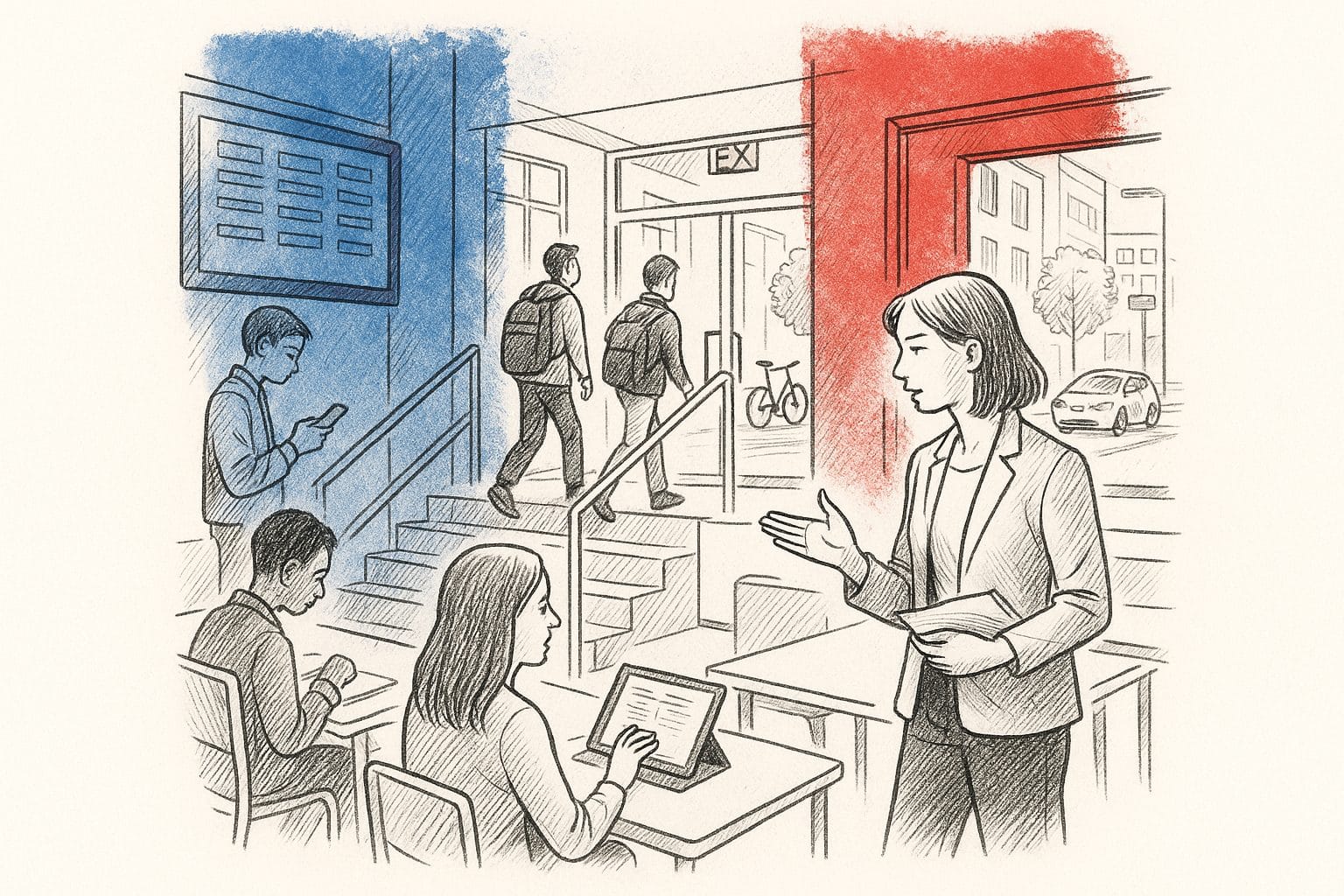
Approximately 4,600 American schools studied with data from 2014 to 2026, zero measurable improvement in academic results or attention. The largest study ever conducted on phone bans in classrooms has just delivered its findings: confiscating mobile phones does not improve student performance, but transforms their relationship to well-being in unexpected ways.
Phone bans at school were supposed to restore attention, reduce harassment, and improve results. After approximately 12 years of experimentation (2014-2026) in roughly 4,600 American schools, researchers from Stanford, Duke, Michigan, and Penn have now settled the matter: this disciplinary policy does not solve any of the problems it claimed to address. But it reveals another, deeper issue regarding how adolescents construct their psychological balance.
The Essentials
- No measurable effect on academic results, attention, or harassment after analyzing approximately 4,600 American schools between 2014 and 2026
- Student well-being drops sharply in the first year of the ban, then rises above the initial level after three years
- Disadvantaged schools show slightly positive results, but not statistically significant
- 77% of American school districts have adopted phone restrictions since 2020
An unprecedented methodology to settle a polarized debate
The team led by Stanford economist Thomas Dee and Texas A&M economist Mark Hoekstra analyzed approximately 12 years of data from roughly 4,600 American schools. Their study, published by the National Bureau of Economic Research in May 2026, tracks the evolution of academic results, attention measures, disciplinary incidents, and reported well-being in these schools that adopted total or partial phone ban policies.
The methodology exploits natural variations in the adoption of these policies between districts to isolate their effects. Some schools banned phones as early as 2014, others waited longer, creating a natural control group. Researchers cross-referenced this data with standardized test results, federal school climate surveys, and incident reports.
The verdict is unequivocal regarding the stated objectives of these policies: no statistically significant improvement in mathematics or reading test scores, no reduction in harassment incidents, no measurable attention gains according to dropout or classroom engagement indicators.
Well-being follows an unexpected curve over three years
But the study reveals an unanticipated effect on a different dimension. Student-reported well-being—measured by standardized surveys on stress, anxiety, and school satisfaction—follows a U-shaped trajectory over three years.
The first year of the ban causes a 12% drop in well-being indicators. Students report more stress, less school satisfaction, and greater anxiety related to separation from their phones. This deterioration persists through much of the second year.
Then the trend reverses. After three years, reported well-being exceeds the pre-ban level by 8%. Students report less notification-related anxiety, better sleep quality, and more direct social relationships during breaks.
This curve suggests a complex adaptation process that researchers describe as a “withdrawal followed by recomposition of social habits.” Students progressively develop new strategies for stress management and social interaction that no longer depend on screens.
Disadvantaged schools show weak positive signals
Analysis by socioeconomic quintile slightly nuances these overall results. In the 20% of most disadvantaged schools, researchers observe a slight improvement in mathematics results—3% on average—and a modest reduction in disciplinary incidents.
These gains remain statistically non-significant at the scale of the full study, but point toward a hypothesis that the authors explore: in environments where access to high-end phones created visible social tensions, the ban could reduce certain sources of distraction and conflict.
Conversely, in advantaged schools, no positive effect is detectable. Students in these schools already had alternative strategies for stress management and more structured family support, making the ban less transformative.
Thomas Dee notes that “the differentiated effect according to social background suggests that phones amplify pre-existing inequalities rather than create them.” In disadvantaged environments, the ban levels out an additional inequality factor; in advantaged environments, it changes little.
A disciplinary policy to address a public health issue
These results question the very logic of phone bans as a solution to attention and academic performance problems. Mark Hoekstra, co-author of the study, observes that “we used a disciplinary tool to address what looks more like a public health issue.”
Problematic screen use among adolescents involves neurological and behavioral mechanisms that are not resolved by simple confiscation for eight hours a day. Students go home and find their screens again, often with compensatory intensity in the evenings and on weekends.
Several districts have begun experimenting with alternative approaches focused on digital literacy rather than outright bans. The Seattle school district launched in 2025 a program teaching notification management and screen time, inspired by behavioral therapy methods. Initial results, still preliminary, show a voluntary reduction in screen time of 23% among participants.
Similarly, some French schools are testing “screen-free hours” negotiated with students rather than imposed, accompanied by structured alternative activities. These experiments are based on the principle that autonomy in screen management develops through learning, not through constraint.
The tech industry under pressure for structural solutions
The study comes as pressure intensifies on platforms to design less addictive interfaces for minors. Instagram announced in January 2026 teen accounts with limited notifications by default. TikTok is testing automatic reminders after 30 minutes of use for those under 16.
These initiatives respond to growing demand for regulation that considers screen addiction as a product design problem, not merely an individual discipline issue. California voted in 2025 a law requiring platforms to offer “well-being” modes for minor accounts, with less stimulating algorithms and spaced-out notification cycles.
But the effectiveness of these measures remains to be proven. Adolescents quickly develop workaround strategies, and less regulated competing platforms often capture diverted attention. The problem likely requires a systemic approach combining regulation, education, and evolution of social norms.
Rethinking school as an ecosystem of well-being rather than a control zone
The Stanford study suggests that school can play a role in building a healthier relationship with screens, but not through simple bans. Schools where students best develop digital autonomy are those offering engaging alternatives: sports, clubs, creative projects, non-digital social spaces.
The long-term effect on well-being observed in the study could result from this recomposition of social activities rather than from the absence of phones per se. Students learn to rediscover pleasure in interactions not mediated by screens, but this process takes time and requires support.
Several French academies have been experimenting since 2025 with “digital well-being schools” that integrate screen education into the general curriculum, just like physical education or civic education. The objective is to give students the tools to understand attention mechanisms and develop their own regulation strategies.
These experiments start from the observation that today’s adolescents will grow up in a hyperconnected world. Rather than temporarily protecting them from this reality, school could help them negotiate it autonomously and consciously.
The question is no longer whether phones should be banned at school, but how to build an educational environment that develops the skills necessary to live healthily with attention technologies. The American study shows that adaptation is possible, but it comes through learning, not through constraint.
Sources
- Scientific American - School Cell Phone Bans May Boost Student Well-Being but Not Test Scores, New Study Suggests
- National Bureau of Economic Research - “The Effects of School Cell Phone Bans on Student Outcomes”
- Federal American school climate survey - Department of Education 2024
- NBER Working Paper 35132 - Main study
- NBC News - Study coverage
- K-12 Dive - Details on participating universities
- NEA Today - National statistics