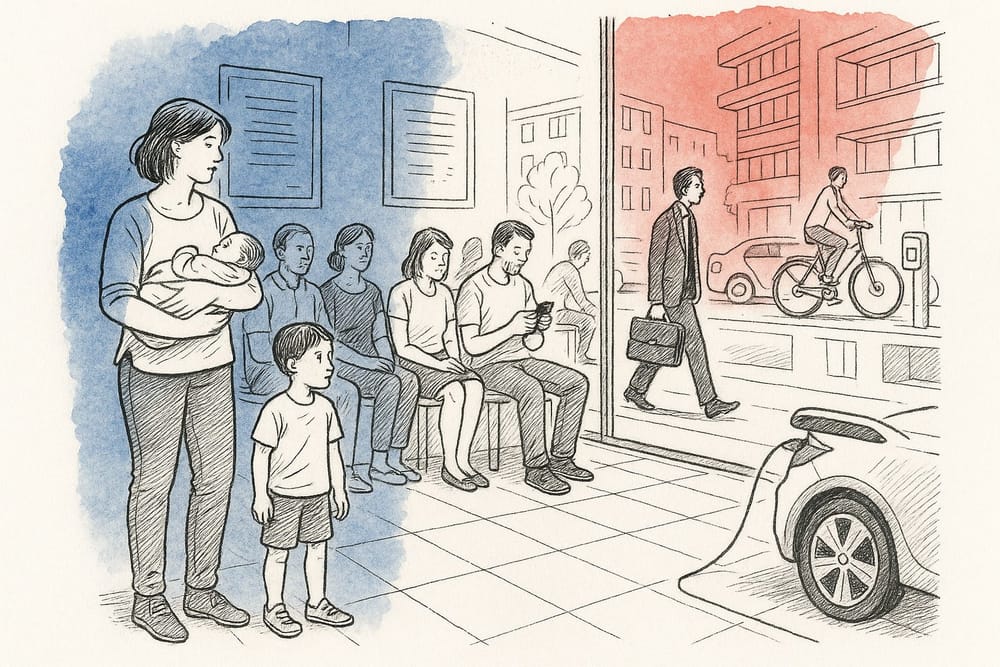
Every year, French companies receive 69.8 billion euros in payroll tax cuts, with no conditions on wages or training [12]. At the same time, a child born into a modest family has 18% fewer chances of accessing early childhood education before age three [11]. The 2027 choice is clear: transfer wage-setting decisions to professional branches and fund a real right to early childhood care for those most excluded from it.
Six Generations to Reach the Average
Social mobility exists in France, but it stalls at the lower rungs. A man whose father was a manager is 3.1 times more likely to become a manager himself than the son of an employee or skilled worker [1]. A woman whose mother was a manager is 2.5 times more likely [1]. These figures come from INSEE’s 2024 Employment Survey.
In 2024, 37% of sons whose fathers were employees or unskilled workers became skilled employees or workers themselves [1]. Only 13% of them reached management status [1].
The OECD estimates it would take six generations in France for a modest family to reach average income [2]. France ranks in an intermediate position among developed countries.
The weight of assets matters at least as much as occupational status. In 2022, 24% of children from the top 10% of families by asset income experienced upward mobility [2]. In the bottom 50% of families by asset income, this rate falls to 10% [2].
Children of homeowners had a 15% chance of experiencing upward mobility, compared to 8% for children of public housing tenants [2]. These figures are from a survey published in May 2022. Access to homeownership itself has closed off for the poorest since then.
In 1973, 32% of young modest households owned their homes [9]. By 2013, only 16% did [9]. Over the same period, the proportion rose from 36% to 44% for the wealthiest quarter [9].
The Great Inheritance Wave That Locks in Trajectories
Assets concentrate and transmit to themselves. In 2021, 76% of people in the wealthiest 10% of households remained in that group three years later [8].
In 2024, 41% of French households had already inherited [3]. Only 15.4% of inheritances exceeded 100,000 euros per heir [3]. In 60% of households that had inherited, the household reference person was 60 or older [3]. Inheritance typically arrives after the structuring choices—housing, education, career launch—have already been made or missed for lack of starting capital.
The dynamic is accelerating. The annual inheritance flow is projected to rise from 464 billion euros in 2025 to 677 billion in 2040, according to projections available between 2024 and 2026 [7]. The share of transmissions in the French economy would grow from 16.1% of GDP to 20.2% over the period [7].
Inherited wealth represented 35% of total assets in France in the early 1970s [7]. It now represents 60% [7]. The total annual flow of asset transmissions already exceeds 15% of GDP, or roughly 300 billion euros [6]. A very large share escapes the tax administration’s scrutiny [6].
Hippolyte d’Albis notes, in his Economics of Life Stages published in March 2026, that contemporary debates focus on public transfers between workers and retirees [13]. They neglect private transfers—family aid and deferred inheritances—whose redistribution is highly unequal [13]. This work on transmissions extends the rebalancing between capital and labor addressed in the post “Redistribution Chases a Mechanism That Widens the Gap at the Source.”
What Aging Changes in the Budgetary Equation
At the end of 2024, France had 68.6 million inhabitants [5]. People aged 65 and older represented 21.8% of the population, compared to 16.3% in 2005 [5].
Spending linked to seniors now exceeds 40% of public spending [5]. Pension spending alone reaches 14% of GDP in 2025, above the eurozone average of 11.5% [4]. The COR projects this share will remain around 14% until 2030, then reach 14.2% in 2070 [4].
These figures weigh on every budgetary decision. D’Albis distinguishes two questions too often conflated [13]. The first is intergenerational balance. The second is the social return on public spending. Data on early childhood and education pinpoint the exact place where this return is highest.
The Mechanism That Has Closed the Elevator for Thirty Years
Social mobility depends on education, and education begins before school. The OECD’s Starting Strong report, published in January 2025, finds that the most disadvantaged children rarely benefit from existing childcare and education services [11]. A child from a modest family has 18% fewer chances of accessing early childhood education before age three [11].
Downstream, French employment policy built a second blocking mechanism. Bruno Palier and Clément Carbonnier, in work published in 2022, document a coherent strategy over thirty years: produce the same output with fewer people, relocate, outsource, compress costs [10]. This strategy created low-wage traps. Payroll tax cuts are regressive with salary, which incentivizes companies to keep wages below the exemption thresholds.
The public cost of this choice is measurable. In 2022, general payroll tax cuts in the private sector reached 69.8 billion euros [12]. This represented 10.5% of private sector payroll and 2.6% of GDP [12].
The effectiveness of these measures on employment has eroded. Available evaluations through 2024 show that after their initial implementation, payroll tax cuts created virtually no new jobs [12]. The evaluation of the CICE (Competitiveness and Employment Tax Credit) established that sums received were not passed on to low wages. On average, 50% of the money received went to raising high salaries [12]. The remaining 50% was distributed to shareholders [12].
Palier and Carbonnier conclude, in their 2022 work, that one could step out of this logic and aim for everyone to do quality work [10]. Funding cheap labor for decades costs the state a fortune, without raising qualifications or reducing starting inequalities [10].
Assets determine trajectories upstream, and the low-wage trap blocks them downstream. These two mechanisms reinforce each other. The system’s orientation matters more than its raw generosity.
Transfer Wage Decisions to Branches and Fund Universal Access to Early Childhood
The 69.8 billion euros in payroll tax cuts are currently distributed automatically according to a degressive national schedule [12]. The proposed 2027 choice consists of transferring to professional branches the decision over wage structure and training investments. This is where the real choice between labor cost and skills upgrading is played out, not in a schedule administered by the Finance Ministry with no counterpart.
This transfer of authority has two direct effects. It ends the possibility for a distribution or personal services company to compress wages below exemption thresholds while capturing public rent. Palier and Carbonnier established, in 2022, that 50% of the CICE fed into high salaries and shareholders, not low wages [10]. It makes negotiation over qualifications real in each branch, because it carries direct financial stakes.
A substantial portion of the resource thus freed goes toward an enforceable right to early childhood care for the bottom two-fifths by income. The OECD documents, in January 2025, an 18-point access deficit for these children [11]. This is the place where social return is highest and where starting inequality is decided.
The cost is real. Companies whose model rests on subsidized low wages will have to move upmarket or reduce margins. The state abandons a convenient steering tool, through which it intervened in wage formation without ever naming it. As long as the value of work is decided in a tax schedule rather than in branch negotiations, work remains the adjustment variable for asset returns, and the elevator stays closed to those who start without capital.
Sources
[1] INSEE, “Social Mobility,” France, Social Portrait, 2024 Employment Survey, https://www.insee.fr/fr/statistiques/8612526?sommaire=8612596 (accessed 09/08/2026).
[2] INSEE, “A New Measure of Intergenerational Income Mobility in France,” INSEE Analyses no. 73, May 2022, https://www.insee.fr/fr/statistiques/6441712 (accessed 09/08/2026).
[3] INSEE, “Intergenerational Transmissions in 2024: Gifts, Inheritances and Aid,” INSEE Results, Life History and Wealth Survey 2023–2024, April 2026, https://www.insee.fr/fr/statistiques/8960217?sommaire=8960228 (accessed 09/08/2026).
[4] Pension Steering Council (COR), Annual Report: Developments and Prospects for Pensions in France, June 2025, https://www.cor-retraites.fr/sites/default/files/2025-06/RA_2025_def_publi.pdf (accessed 09/08/2026).
[5] Court of Audit, synthesis on demographic aging and public finances, December 2025, https://www.silvereco.fr/vieillissement-la-cour-des-comptes-alerte-sur-une-bombe-a-retardement-pour-les-finances-publiques/ (accessed 09/08/2026).
[6] Council of Economic Analysis (CAE), “Rethinking Inheritance,” CAE Notes no. 63, 2021, https://shs.cairn.info/revue-notes-du-conseil-d-analyse-economique-2021-9-page-1?lang=fr (accessed 09/08/2026).
[7] Jean-Jaurès Institute / Senate, Facing Inheritance Inequality, November 2024, and senate bill proposal, June 2026, https://www.jean-jaures.org/wp-content/uploads/2024/11/Rapport_IGS.pdf and https://www.senat.fr/leg/exposes-des-motifs/ppl25-190-expose.html (accessed 09/08/2026).
[8] INSEE, “Over Twenty Years, Asset Inequalities Have Grown Linked to Housing Price Rises,” Household Income and Wealth, 2024 edition, https://www.insee.fr/fr/statistiques/7941439?sommaire=7941491 (accessed 09/08/2026).
[9] INSEE, “Rising Inequality in Homeownership Access Among Young Households in France, 1973–2013,” 2018, https://www.insee.fr/fr/statistiques/3622011 (accessed 09/08/2026).
[10] Bruno Palier, Clément Carbonnier, Women, Youth and Children First, PUF, 2022; Bruno Palier, Christine Erhel (eds.), Work Better, PUF, 2025.
[11] OECD, Starting Strong VIII: Reducing Inequalities by Investing in Early Childhood Education and Care, January 2025, https://www.oecd.org (accessed 09/08/2026).
[12] France Strategy, Antoine Bozio and Éric Wasmer, Report on Payroll Tax Cut Policies, October 2024, https://www.strategie-plan.gouv.fr/files/2024-11/rapport_vffff_241003.pdf (accessed 09/08/2026).
[13] Hippolyte d’Albis, Economics of Life Stages: Ending the Generational War, Odile Jacob, March 2026, https://www.odilejacob.fr/catalogue/sciences-humaines/economie-et-finance/economie-des-ages-de-la-vie_9782415007249.php (accessed 09/08/2026).