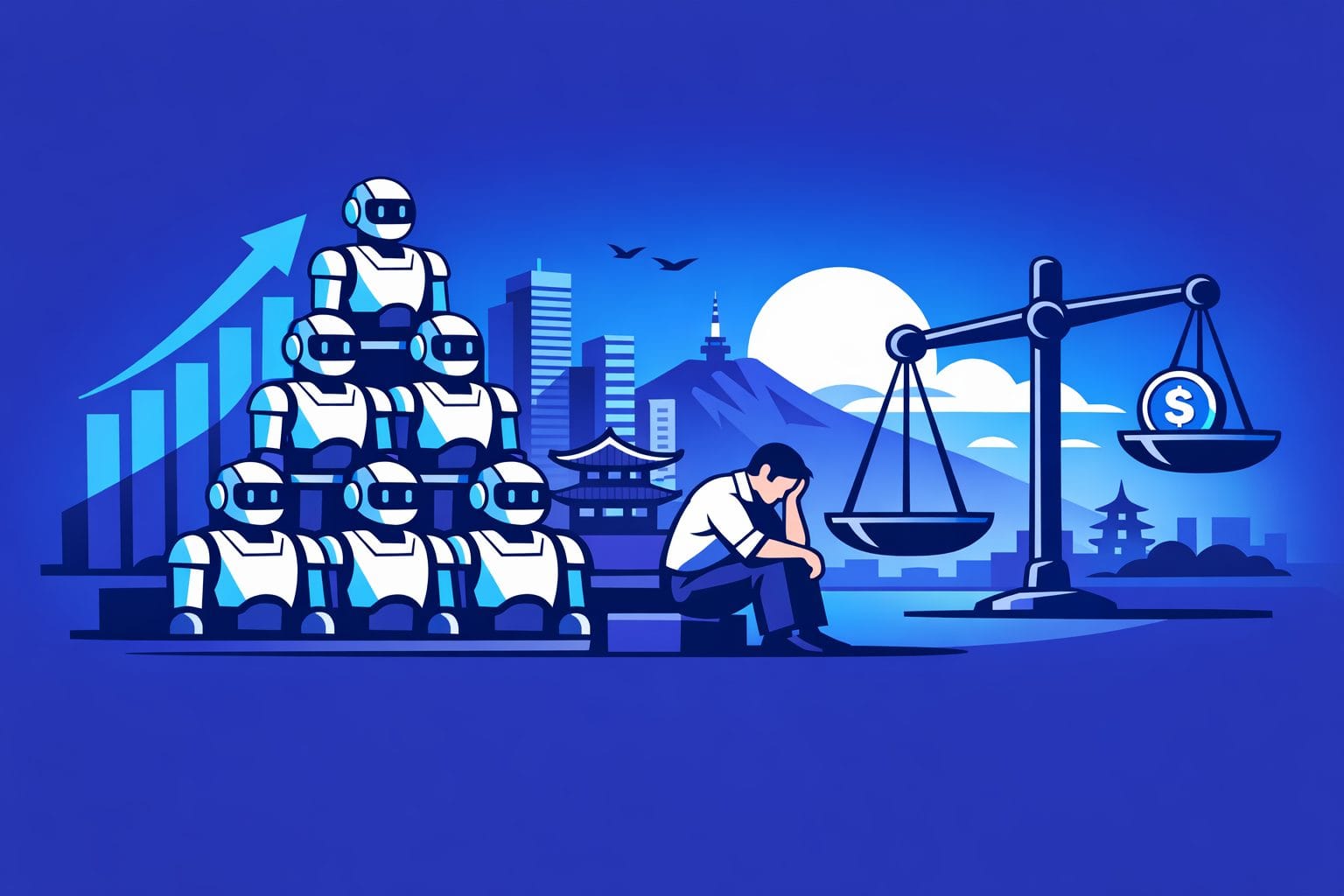
Some companies deploy AI models without having defined how their teams will monitor them, correct them, or refuse to use them. In Manage the Machine, published by Basic Venture / Hachette in September 2026, this context raises questions about team control over decisions delegated to models. The book proposes a framework to address this, starting with a question posed in the opening pages: who decides, who controls, who can say no.
The Essentials
- Goldman proposes that rules of delegation, control, and appeals be established before AI models are deployed, not after.
- The absence of these rules raises stakes around professional judgment and the role of skilled employees facing deployed systems.
- The proposed framework has eight components, including “Trust, but Verify,” “The Judgment Premium,” and “Ethical Guardrails at Scale.”
- Paul Osterman had described this risk for low-skilled work; Goldman applies it to knowledge work, where the stakes of capturing judgment are hardest to see.
- The OECD has documented since 2024 the risks of surveillance and intensification tied to AI at work; its comparative data on the intensity of algorithmic management were published in 2025 and do not specifically target skilled employment.
Who is Paula Goldman
Paula Goldman spent fifteen years at the intersection of technology and corporate governance. A former head of responsible AI policy at Salesforce, she oversaw ethics protocols and deployment procedures for AI tools used by millions of employees in regulated sectors. She left Salesforce in 2024 to write this book, and the experience shows: Manage the Machine comes from a practitioner who saw executives deploy models without doctrine, then manage the consequences. The book is neither a political manifesto nor a technical guide. It is a treatise on work organization for the age of generative AI models.
The Thesis: Organization Before Tools
The heart of the book rests on a single proposition: Goldman presents AI at work as an issue of leadership, collaboration, and human judgment, beyond technical mastery alone. Goldman observes that many companies invest more in models, integrations, and technical training than in defining the rules governing their use. The unanswered questions are these: who can delegate what to a model, who oversees the results, who has the right to contest a decision generated by a system.
These questions are often addressed after deployment, when habits are formed and room for maneuver shrinks.
Goldman identifies what she calls recurring gaps in AI governance. She distinguishes several forms. Implicit delegation describes cases where an employee adopts an AI tool without the company having formalized which decisions could be entrusted to it. Shadow supervision describes cases where a manager is officially responsible for model outputs, but without criteria or time allocated to verify them. Erosion of recourse describes cases where the lack of formalized contestation rights makes it hard to report a model error.
These three forms compound. Goldman shows their effects in sectors like law, human resources, and medical diagnosis: in some cases, professional expertise has been replaced not by AI, but by compliance with AI, which is different and graver.
The Three Pillars of the Framework
Goldman structures her response around several axes: calibrated trust, assignment of responsibility, and right of contestation.
The first pillar is calibrated trust. Trust in an AI model must be a deliberate act, not a habit. Each task delegated to a model should be the subject of an explicit decision: has this model been evaluated on this task, with this data. Goldman proposes an escalation protocol with several levels, including autonomous use, light supervision, and strict supervision, which managers define before deployment and revisit regularly. The goal is to make adoption a traceable choice rather than an invisible drift.
The second pillar is assignment of responsibility. Goldman insists: when a model produces an erroneous or biased output, someone must answer for it. Not the model vendor, the organization that deployed it. This requires putting in place an architecture including a named owner, a documented chain of responsibility, and a review process. In practice, many organizations have not built this architecture.
The third pillar is the right of contestation. Goldman devotes a chapter to what she calls the “right to structured disagreement”: the capacity of each employee using a model to flag an output deemed false, biased, or inappropriate. Goldman argues that formalizing this right helps teams preserve their capacity for critical judgment, which improves error detection.
Without such a mechanism, model errors can pass unnoticed.
Goldman’s Debt to Osterman, and Her Own Contributions
Readers familiar with Paul Osterman’s work on labor markets will recognize an old problem in new clothing. In his research on the transformation of employment, Osterman documented how companies progressively outsourced and precarized work by shifting responsibilities without transferring resources. The employee remains on the front lines, but the decisions that structure his or her work escape them.
Goldman transposes this analysis to knowledge work in the age of AI models. The analogy is precise: a lawyer validating contracts generated by a model without time to read them thoroughly, or a doctor whose treatment protocol is pre-filled by a clinical decision algorithm, finds themselves in a structurally close position to Osterman’s subcontractor. Responsibility remains, the means of control have shrunk. Goldman raises a dimension that Osterman’s work did not cover: the erosion of judgment has a cognitive dimension as much as an organizational one. Repeated validation without verification can affect professionals’ capacity to exercise critical judgment.
This is a long-term effect, slow, hard to measure, and one organizations have no immediate incentive to prevent.
The OECD has begun to document this phenomenon. Its Employment Outlook 2026 indicates that in services, algorithmic management and restructuring can increase psychological burden and reduce worker autonomy. The report presents measures of regional exposure to generative AI, not an indicator of algorithmic control advancing with model deployment. Goldman proposes a framework centered on human judgment while the OECD signals that algorithmic management can degrade certain working conditions.
Goldman takes seriously a competing reading. Tyler Cowen and economists working on technological adoption and human-machine complementarity argue that labor markets naturally produce their own adjustments: professionals who learn to supervise models develop new skills, organizations that deploy AI poorly lose quality and correct course. In this reading, formalized rules risk slowing adoption without solving problems that regulate themselves through competition and experience. Goldman notes that spontaneous adjustments are possible when errors are visible and generate swift consequences.
In sectors like law, medicine, or finance, evaluating AI outputs presents a complexity that slows error identification and correction. It is in these contexts that formalized rules become important.
Blind Spots
Manage the Machine is a management book, and it has management’s limits. Goldman primarily treats organizations with enough resources to designate responsible parties, build protocols, and revise assignments quarterly. For SMEs, freelancers, and budget-constrained organizations, the framework is difficult to transpose without adaptation. Goldman acknowledges this limit in one page in the second-to-last section, which is insufficient. SMEs, which adopt AI differently from large structures, would have merited a distinct section.
The union question is also outsourced. Goldman frames the right of contestation as a problem of management culture, to be solved through internal protocols. She discusses almost nothing about collective bargaining mechanisms that could anchor these rights in agreements rather than internal charters. In sectors where unions have real presence—healthcare, public sector, industry—this omission is notable.
Finally, Goldman assumes that managers implementing her framework act in good faith. She poorly documents situations where governance protocols become themselves instruments of facade compliance, adopted to satisfy auditors or regulators without changing actual practices. AI at work often advances through individual initiatives rather than organizational policy, and this reality does not match the top-down model Goldman describes.
Interest in Reading
Goldman wrote the book that HR departments were still reading in 2025 in the science fiction section: an operational guide to organizing human-AI collaboration before habits take hold. The argument on precedence—rules before deployment, not after—is probably the book’s most important contribution, and the hardest to get organizations under pressure to adopt quickly to accept.
The three-pillar framework assumes conditions many organizations do not meet. It nonetheless poses a precise question: who, in your organization, has the right to say no to AI, according to what procedure, and with what consequences if no one listens. Companies unable to answer this question face a governance problem. Manage the Machine provides them tools to begin addressing it.
Goldman devotes few pages to what professionals lose when they stop performing certain tasks because a model does them better. Yet this is a major long-term stake: an organization must preserve the critical skills it will need to supervise, correct, and eventually replace the models it uses today. The rules Goldman describes constitute a starting point for addressing it.
Bibliographic Information
Manage the Machine: How to Harness Human-AI Collaboration at Work
Paula Goldman
Basic Venture / Hachette
September 15, 2026
Sources
- Paula Goldman, Manage the Machine: How to Harness Human-AI Collaboration at Work, Basic Venture / Hachette, 2026, paulagoldman.ai/book
- Paul Osterman, Disposable Workers: The Transformation of Employment, MIT Sloan, mitsloan.mit.edu/ideas-made-to-matter/disposable-workers-transformation-employment
- OECD, Employment Outlook 2026, oecd.org