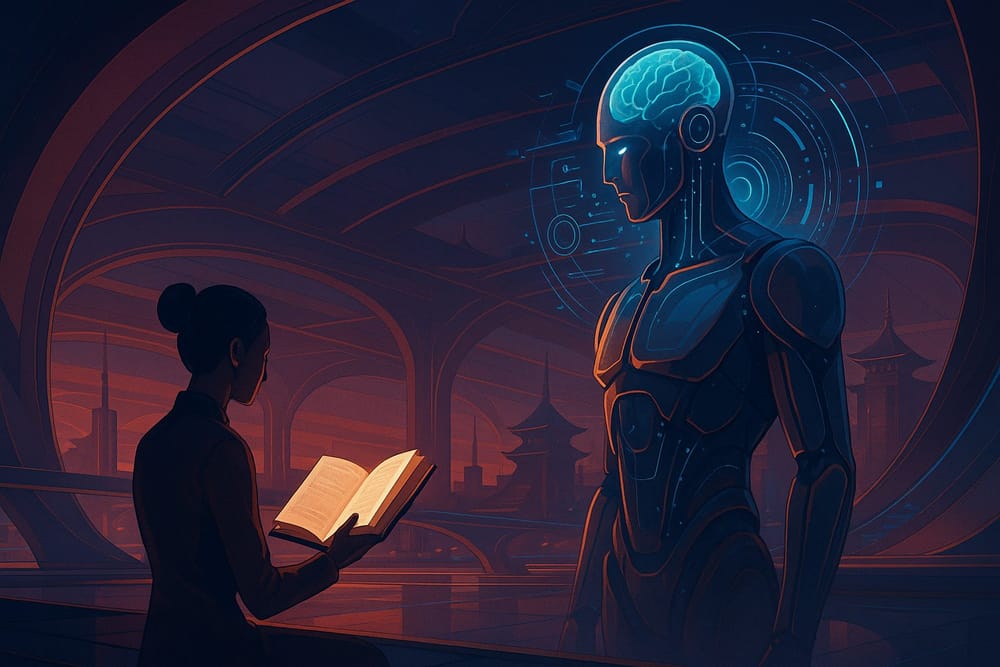
WhatsApp can propose a text response drafted by AI in a conversation. Certain platforms display a warning before publication to encourage the user to modify a potentially offensive comment. This filtering seems harmless. Nadia Guerouaou analyzes how this filtering institutes an affective norm, which she designates by the name “technomorality.”
The essentials
- Certain generative AIs and editing functions can propose or apply, at the user’s request, modifications to text, image, or voice; Guerouaou analyzes this process as a manifestation of “technomorality.”
- Interviews with transfeminine creators have documented a perception of reduction of their identity to the attributes that TikTok appears to favor, consistent with the thesis of algorithmic affective normalization.
- The author anchors her analysis in cognitive neuroscience: emotions expressed retroact on emotions felt, which makes algorithmic filtering a lever for internal reconfiguration.
- The author notes that regulation does not exhaustively address the question of emotions tolerated by platforms, but it already contains rules on certain uses of emotion recognition and inference.
A researcher at the intersection of neuroscience and digital technology
Nadia Guerouaou is a researcher in cognitive neuroscience, specializing in interactions between technology and brain functioning. She has devoted several years to observing how digital interfaces modify processes of attention, memorization, and emotional expression. She brings experimental protocols, neuroimaging data, and a method that carefully distinguishes what is measured from what is interpreted. Our Brain Under Influence, published by Eyrolles on February 26, 2026, is her first book for a general audience. It appears at a moment when the deployment of large language models in everyday tools—messaging applications, word processors, and social networks—makes the subject urgent.
The thesis: an affective norm without deliberation
Certain AI functions intervene during drafting or after an initial expression by the user, notably to propose rewrites. Guerouaou carefully distinguishes two levels in the functioning of these processes.
The first is formal: the AI reformulates an aggressive message into a polite one, proposes a calmer voice, attenuates the tonal markers of frustration. The second is structural: by repeating this filtering at each interaction, the system structures a space of emotional expressibility whose boundaries are designed by companies but also framed by rules, internal policies, authorities, and transparency obligations.
The central term of the work, “technomorality,” designates precisely this object. This notion covers an ethical and normative dimension in the treatment of emotions, with observable effects on certain registers of expression. These values are legitimate in certain contexts and problematic in others. Certain registers of expression, including political anger and collective protest, play a role in democracies and can be limited according to the design of moderation algorithms.
Guerouaou emphasizes that these systems perform emotional arbitrations that escape collective deliberative mechanisms.
The neuroscientific argument that grounds this thesis deserves examination. Research in embodied cognition, particularly the work of Lisa Feldman Barrett on emotion construction, shows that emotional expression is not the simple reflection of a preexisting inner state. It participates in its construction. Inhibiting or reformulating the expression of an emotion is associated with prefrontal activations; effects on the amygdala and insula vary across studies. The effects of algorithmic filtering on subjective experience remain to be demonstrated for each device and use.
The flattening of TikTok: when data confirms the mechanism
Guerouaou relies on a corpus of empirical studies, including work on the evolution of expressiveness on TikTok. According to certain observations, we find what is called a “flattening,” that is, a possible reduction in the emotional range in certain content. Some content shows an apparently narrower emotional range, with less biting irony, less explicit anger, less affective ambiguity. TikTok recommendations are personalized based on multiple interaction and content signals; a general convergence of expressed emotions toward algorithmically valued profiles is not demonstrated.
Emotional filtering is documented for certain vocal and visual systems, while writing assistants propose rewrites or tone changes. The difference between a short-video platform and a large public language model is one of degree. In these different systems, emotional filters present varying degrees of transparency for users.
The argument becomes particularly strong when Guerouaou crosses it with adoption data. Writing assistance tools are now integrated into software used by hundreds of millions of people—Grammarly, Copilot, Gmail suggestions, automatic drafters on social networks. At this scale of adoption, a bias in the selection of acceptable emotions could influence forms of collective expression. The author does not conclude there is a conspiracy. She observes an architecture whose collective effects raise questions about social impact.
A real tension that the book leaves open
The work is solid in its diagnosis. It is less so in its resolution. Guerouaou poses the problem of emotional governance with precision, but remains cautious about remedies. This reserve is scientifically honest—one does not prescribe public policy from a neuroscience laboratory—but it leaves the reader with unresolved discomfort.
The most acute tension concerns the alternative. Reducing algorithmic emotional correction would present distinct risks and benefits: it could restore wider expressiveness, but also facilitate hate, harassment, and affective misinformation. Daron Acemoglu and Simon Johnson, in their work on technology and power, have shown that choices in digital architecture reflect power relationships between those who design them and those who experience them. This framework illuminates the question of which actors calibrate emotional filters, what their objectives are, and what revision mechanisms are available.
This is the book’s main blind spot. Guerouaou describes “technomorality” as a design problem that escapes collective deliberation, but explores little the possible avenues for governance of algorithmic affective norms. Recent work on algorithmic auditing, notably discussions around the European Digital Services Act and transparency obligations on recommendation systems, nonetheless outline a real regulatory space, even if imperfect. Their absence from the book leaves a void.
Guerouaou primarily treats Western platforms and English-language models. Chinese AI systems, Ernie Bot and ByteDance assistants, operate under different regulatory constraint and with affective norms that reflect another political order. The comparison is mentioned only in passing, when it would merit an entire chapter of its own: applied to these systems, “technomorality” becomes explicitly a question of sovereignty.
Governing affective norms toward 2035
The question Guerouaou poses exceeds the present. If generative AIs integrate widely into everyday tools, emotional filtering could gradually become an infrastructure little visible to its users. Two trajectories emerge depending on how regulators seize the subject before the infrastructure is fully installed.
On TikTok in the European Union, moderation and recommendation systems evolve under a major regulatory framework, notably the Digital Services Regulation. Models trained on similar data and optimized for similar objectives risk converging toward narrow emotional registers. Collective expressiveness could become impoverished, without explicit decisions in that direction having been made. Democracies risk seeing certain registers of political expression contract, particularly forms of protest or collective grief, which raises questions about their institutions. Developments observed on TikTok merit particular attention as possible indicators of broader trajectories.
In the second, regulators seize the subject before the infrastructure is fully installed. The European Digital Services Regulation already imposes audit obligations on recommendation systems. Researchers are working on protocols to measure emotional diversity in content generated or assisted by AI. Smaller alternative platforms with community governance are experimenting with models of deliberative moderation. None of these signals is sufficient on its own, but their possible convergence would outline a space of collective governance of digital affective norms.
What separates these two trajectories is less a single political decision than an accumulation of diffuse technical and regulatory choices. The requirement for transparency on the emotional parameters of models, independent audit of emotional biases, integration of affective diversity as a criterion for evaluating systems—these measures exist as proposals in several expert reports. The question is whether they enter legislative processes before habit renders the infrastructure invisible. On this point, Guerouaou’s book would have benefited from being more prescriptive. It chooses the researcher’s caution.
That is respectable. It is also, perhaps, what makes it a diagnosis rather than a program.
The subject joins a broader tension already explored regarding automation and redistribution of technological progress gains: who decides the parameters of systems that reconfigure conditions of collective life, and according to what criteria. Governance of industrial robots and that of emotional filters pose the same structural question, with different objects.
Interest of the book
Our Brain Under Influence addresses several audiences simultaneously, and that is one of its strengths. Readers interested in neuroscience will find a rigorous update of knowledge on emotion construction and its plasticity in the face of technological environments. Those following the debate on AI regulation will find a more precise conceptual framework than usual discussions on misinformation or privacy: “technomorality” is a new, usable analytical object. Readers simply curious to understand what happens when they use a voice assistant or an automatic corrector will find accessible explanations, anchored in concrete experiences.
The book builds a bridge between the neurology of emotion and the sociology of platforms. These two literatures have coexisted for years without truly intersecting. Guerouaou makes them dialogue methodically, and this dialogue produces verifiable hypotheses, which is rare in a general-audience essay on AI.
The book offers neither political roadmap nor easy reassurance. It closes on an open question: how could communities reclaim control of affective norms set by proprietary systems. Guerouaou provides the conceptual tools to carry this debate beyond research laboratories.
Bibliographic Information Title: Our Brain Under Influence. How Generative AIs Shape Our Emotions Author: Nadia Guerouaou Publisher: Eyrolles Editions Publication date: February 26, 2026
Sources
- Nadia Guerouaou, Notre cerveau sous influence, Éditions Eyrolles, February 2026, https://www.editions-eyrolles.com/livre/notre-cerveau-sous-influence
- Gillespie et al., studies on expressiveness flattening on TikTok, 2022–2026 (cited in Guerouaou)
- Daron Acemoglu and Simon Johnson, Power and Progress, 2023
- European Digital Services Regulation (DSA), obligations applicable to the first VLOPs/VLOSEs since late August 2023; general application of the regulation since February 17, 2024