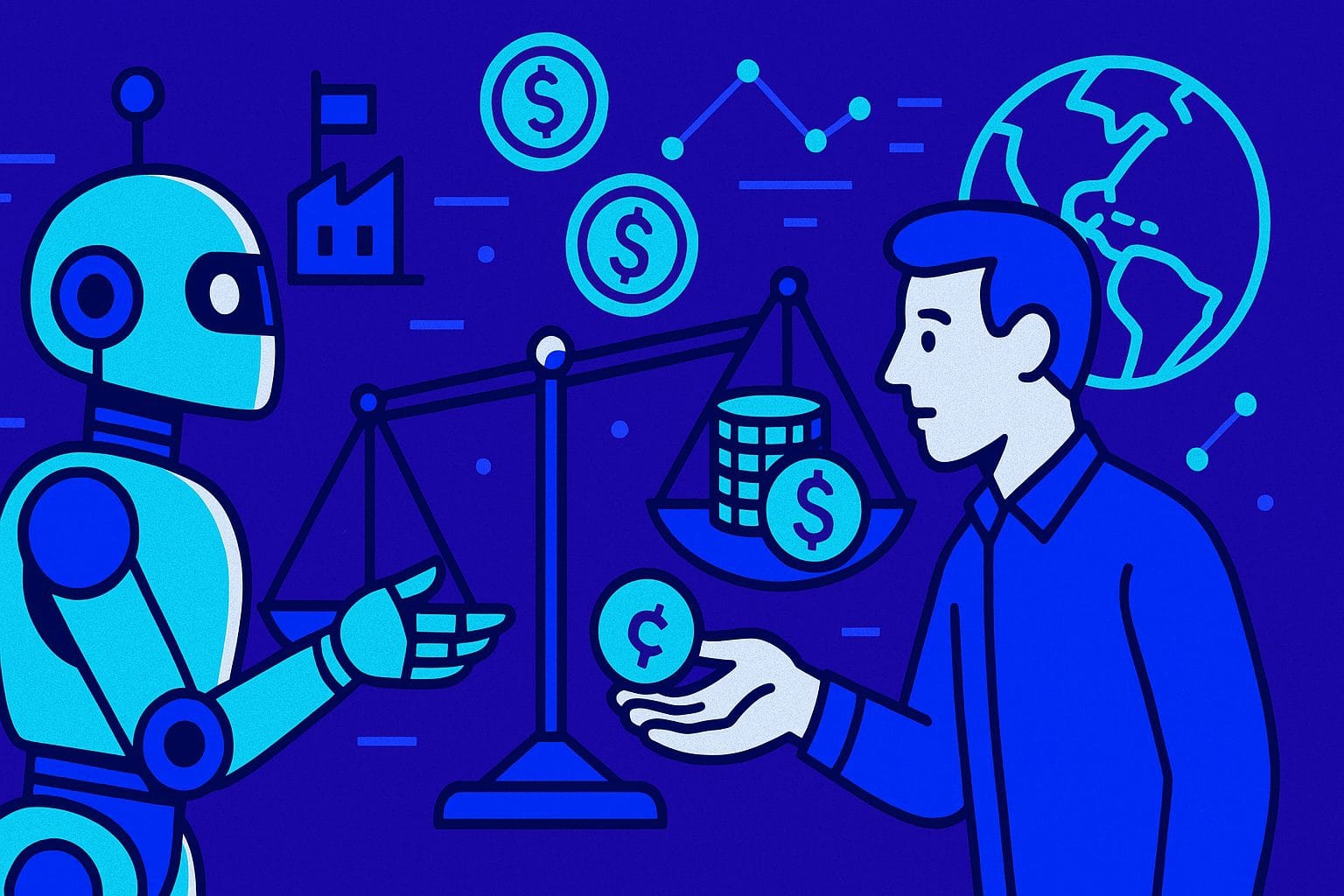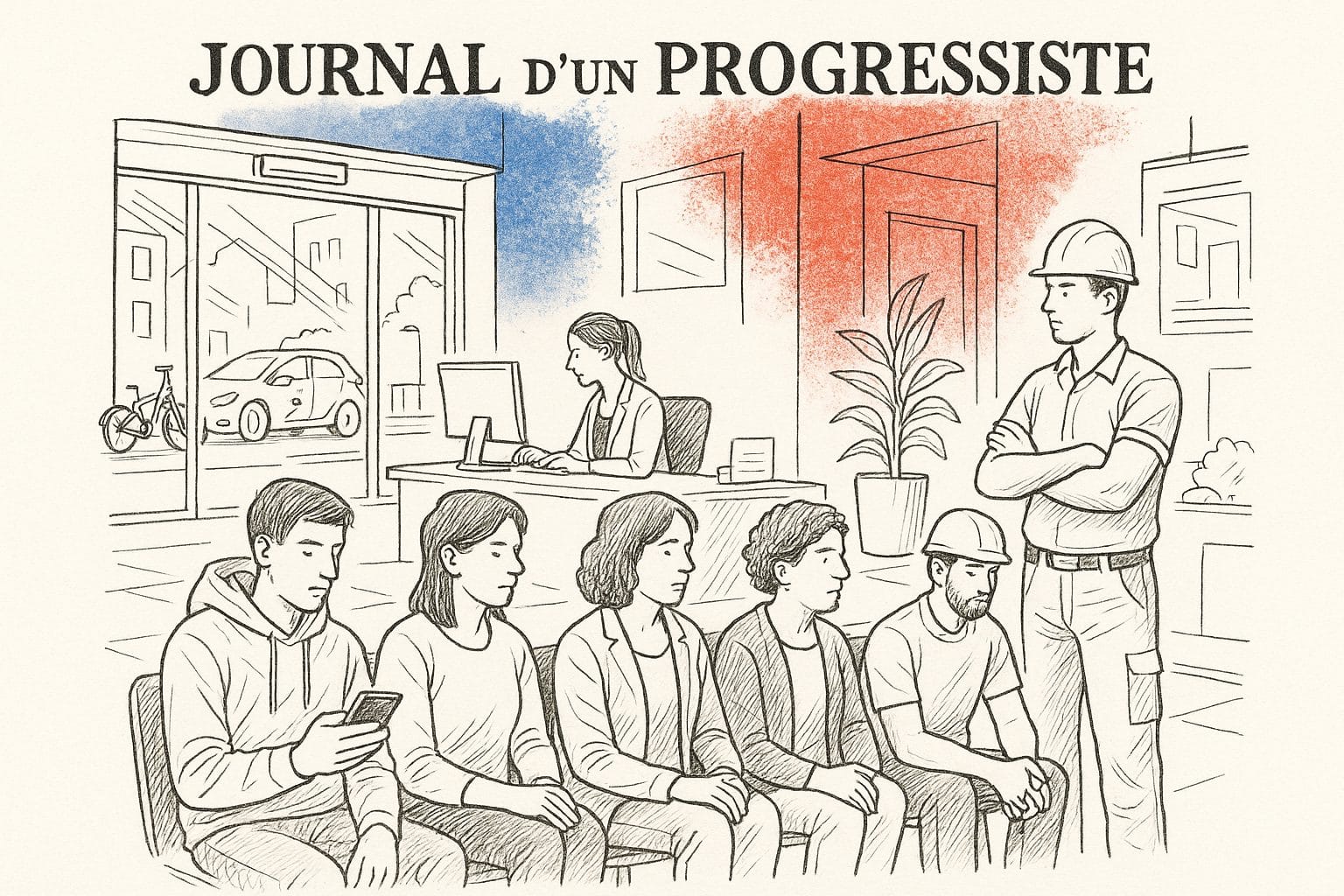
Artificial intelligence affects jobs differently depending on the tasks performed. The OECD indicated in the Employment Outlook 2023 that approximately 27% of employment in OECD countries involved occupations presenting the highest risk of automation, including AI; this is neither data limited to Europe nor data from the Employment Outlook 2026. Sources from the European Commission and the OECD show that several cognitive and skilled professions are heavily exposed; the ECB finds that occupations most exposed to AI include relatively more skilled workers, without establishing an overall higher risk for all highly skilled workers. AI can shift the lines of vulnerability toward certain cognitive tasks and certain skilled workers, while maintaining significant inequalities according to qualification level, sector, and access to training.
The Essentials
- 27% of European jobs are in a zone of serious exposure to AI, according to the OECD Employment Outlook 2026, and it is qualified positions that concentrate the highest risk.
- The ECB confirms that AI presents a higher risk for highly qualified jobs, reversing the received idea of automation that targets first repetitive manual tasks.
- In France and Belgium, 1 professional in 2 has adopted AI in less than a year, a sign that absorption is possible, but it remains conditional on access to training and resources to change working methods.
- National architectures of continuing education, their financing, their accessibility, their speed of adaptation, become the true differentiating factor between European economies.
- The open question for the decade is whether Europe can build a system of continuous reskilling before the wage polarization between skilled workers who adapt and skilled workers who are blocked becomes irreversible.
The Reversal That Data Confirms
For years, the debate on automation revolved around one image: the robot replacing the factory worker on the assembly line. Generative AI imposes a different image. The professions most exposed are those that concentrate high-value-added cognitive tasks, writing, analysis, complex information processing, consulting. These professions contain many tasks exposed to AI; effective adoption and gains in productivity or cost must be documented separately by profession and by organization.
The ECB published in 2026 an analysis of hiring by eurozone companies and, separately, a study of AI effects on the American labor market. Other work, notably from the JRC, finds higher exposure of many cognitive and skilled professions. Exposure is strongly linked to the cognitive content of tasks; it does not mechanically reduce to salary or social status. An accountant exposed to automated tax return processing software is more exposed than an electrician whose work requires physical presence and the ability to adapt to field conditions that algorithms cannot yet replicate.
This reversal has logic. Generative AI is, fundamentally, a tool for processing and producing text, code, and formalized reasoning. It excels in structured environments where inputs are defined and outputs are evaluable. The jobs that concentrate these characteristics are precisely those long considered best protected by their qualification level. They are no longer, or at least, not in the same way.
Rapid Market Adaptation
The Improof source mentions AI adoption in work by professionals in Luxembourg and Belgium. This figure deserves precise reading. It does not say that the transition is painless. It indicates that adoption can be rapid, but that its conditions vary according to organizations and sectors.
Luxembourg and Belgium share high densities of qualified employment in finance, law, business services, and European institutions. These sectors have a common characteristic: their employers have the means to invest in skills development, and their employees have the cognitive resources to absorb new tools quickly. Rapid adoption in these markets reflects less a particular cultural virtue than a structural advantage.
Less well-endowed workers and companies may have fewer adaptive capacities, but their level of exposure is not necessarily identical to that of their better-endowed peers. Daron Acemoglu and Simon Johnson develop this point in Power and Progress: technological progress distributes its gains widely only on condition that institutions constrain it to do so. Left to itself, it tends to concentrate benefits among those already in position to capture them. The role of institutions therefore becomes central.
Training Systems Facing a Challenge of Speed
The architecture of continuing professional education varies between European economies, and these structural differences can influence adaptive capacities to AI.
The Nordic countries, Denmark, Finland, Sweden, have systems of permanent publicly financed education, accessible to working adults, and designed for short adaptation cycles. The rate of adult participation in continuing education there is regularly among the highest in the OECD. These systems were built during the time of major industrial restructurings of the 1990s and 2000s: they were not designed with AI in mind, but their architecture is compatible with the speed of adaptation it requires.
In several economies of continental and southern Europe, continuing education systems may encounter difficulties responding to demand. In the EU, SMEs train their employees on average less than large companies; access for the self-employed and the complexity of financing must be documented separately by country. The OECD article on stratification of employment linked to AI, already analyzed on these pages, showed that this inequality of access to training tends to reproduce and amplify pre-existing inequalities.
Speed is the critical parameter. A training system designed for long reconversion cycles can hardly respond to a labor market where tools evolve rapidly. Some companies can adopt AI quickly. Public training institutions reason in budget years. This temporal gap constitutes a structural challenge for European governments, which have addressed it unevenly.
The Liberal Argument and Its Real Limits
A competing reading of this issue exists, and it deserves to be taken seriously. Tyler Cowen, and more broadly the liberal tradition of innovation economics, emphasizes that periods of technological disruption ultimately create more jobs than they destroy. The long history of technical progress speaks for this thesis: agricultural mechanization, the industrial revolution, the computerization of the 1980s all caused massive job destruction before generating larger and better-paid labor markets.
According to this reading, public intervention in training risks slowing adaptation rather than accelerating it, by freezing skills into rigid certifications instead of letting markets form new combinations. At this stage, companies heavily engaged in AI are more likely to recruit according to ECB survey, but this does not allow us to infer a net causal effect of AI on total employment.
Current data justify monitoring transitions and inequalities linked to AI, but do not yet demonstrate a generalized irremedial depreciation of the human capital of displaced workers. Generative AI particularly exposes certain cognitive tasks performed by skilled workers, but the net effect on their employment and earnings depends on complementarity, substitution, and work organization. The gains from automation do not necessarily benefit displaced workers; transition, training, and social protection policies may be necessary.
The OECD Employment Outlook 2026 examines notably local disparities and returns on training; it does not document this precise claim about the direction of exposed workers.
Public investment in training is not an alternative to the market: it is the condition for the market to function. Without it, human capital remains immobilized where it is found, while opportunities concentrate elsewhere.
Before Wage Polarization Becomes Irreversible
Europe might have a window to act before the fracture between skilled workers who adapt and skilled workers who are blocked translates into lasting wage polarization.
Two trajectories are taking shape for the decade 2025-2032, without either being inevitable.
In the first, the Nordic countries and the Netherlands have high rates of participation in adult education; the direct effects of these architectures on adjustment to AI remain to be demonstrated. Exposed workers reposition on tasks complementary to AI: supervision, contextual judgment, interface with clients and non-standardized situations. Productivity and median wages can evolve favorably, while the transition remains difficult on an individual level.
In economies where continuing education remains insufficient, gaps between workers can persist. Workers possessing skills specific to AI can benefit from wage premiums; wage effects for all exposed workers to date remain limited and cannot be simply attributed to the quality of training systems. Skilled workers who are blocked may encounter difficulties renewing their skills due to lack of resources or access.
This polarization feeds identifiable political frustration. The people concerned are not factory workers, but middle managers, self-employed professionals, teachers and civil servants, that is, the upper middle classes whose stability has long constituted the cement of European representative democracies.
This second scenario is not a prophecy. But it has a logic that current data render plausible. France Stratégie, in its work on automation and territories, already documents regional divergence dynamics that could be amplified by the effect of AI: exposure and institutional capacities vary greatly between territories according to their sectoral structure, their occupations, and their local training systems.
The signals to monitor in the coming years are the evolution of adult participation rates in continuing education in continental European countries, the speed at which national certification systems integrate AI skills, and the capacity of SMEs to access publicly financed training schemes. If these indicators stagnate by 2027-2028, the window for action probably closes before political debate has grasped the measure of the problem.
The work of Acemoglu and Johnson allows us to state clearly that this window is institutional and political as much as technical. Technologies do not choose their uses by themselves: the rules of the game, who finances training, who has access to it, who controls AI tools in organizations, determine whether the transition is shared or captured. Europe has built, over seventy years, welfare states capable of absorbing massive industrial shocks. The open question is whether these institutions can reform fast enough in the face of the speed of AI-related developments.
Measures Already Undertaken by the Most Advanced Economies
A few experiments underway deserve close monitoring, not as models to copy, but as tests whose results will illuminate the decade.
Continuing education schemes can offer short modules on AI intended for working individuals. The objective is to allow employees to develop their skills on digital tools without loss of income. This scheme relies on robust social dialogue infrastructure, unions, employers and the state co-finance and co-manage, which does not exist in the same form elsewhere in Europe.
Portable training credit systems can attach training rights to the individual and allow their use with different public and private providers. The idea is to break the rigidity of traditional schemes that link access to training to salary status in a given company. The self-employed and certain SME workers are often less covered by traditional training mechanisms; their exposure to AI varies according to occupation and sector.
These experiments have a common point: they start from the observation that continuing education can no longer be a benefit reserved for employees of large companies that have the means to finance it. Technical exposure depends largely on tasks, but actual exposure and adaptive capacities also differ according to the size and resources of the company.
Sources
- Primary source: Improof, AI and the labor market
- OECD, Employment Outlook 2026, Organisation for Economic Co-operation and Development
- European Central Bank, study on AI and skilled employment in Europe, 2026
- France Stratégie, work on automation and territories, 2025-2026
- Daron Acemoglu & Simon Johnson, Power and Progress: Our Thousand-Year Struggle Over Technology and Prosperity, PublicAffairs, 2023