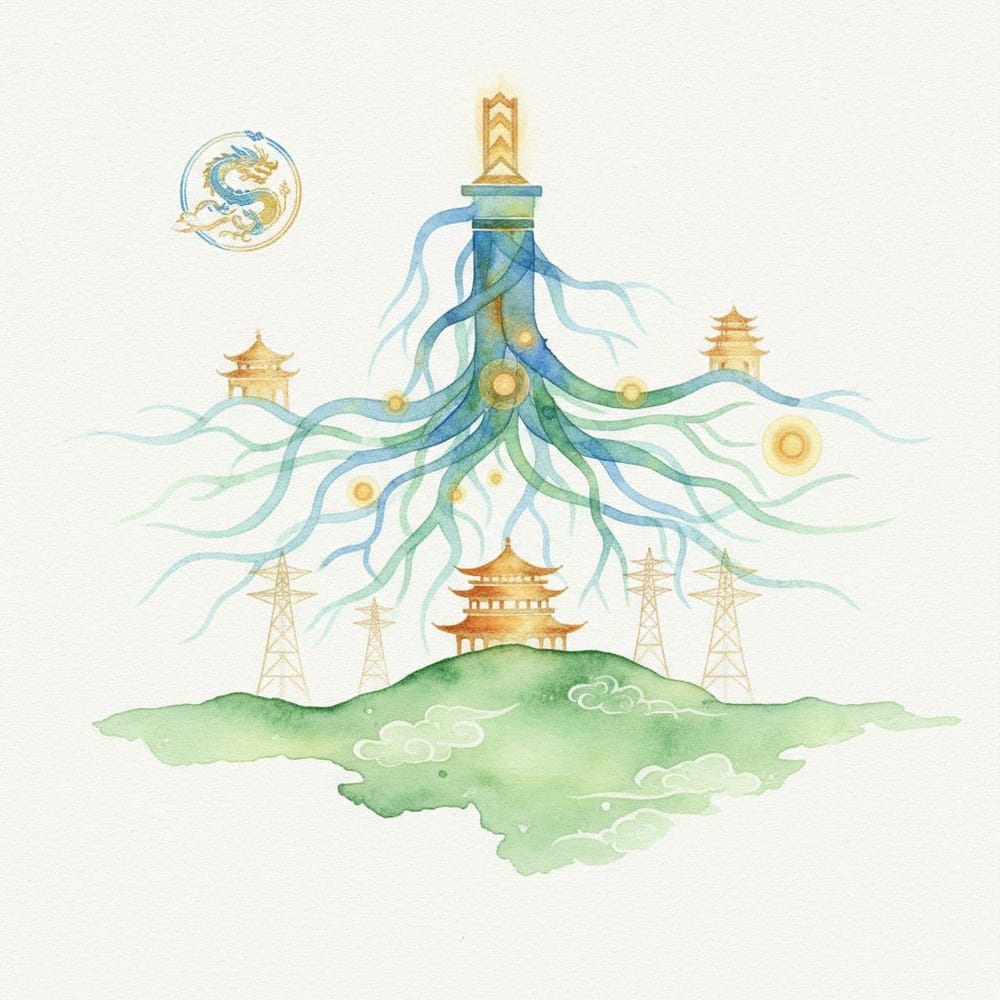
One country is deploying 52,300 kilometers of ultra-high-voltage transmission lines capable of transporting 300 gigawatts of electricity over thousands of kilometers. That is approximately 75 to 80% of the world’s installed nuclear capacity—which stands between 376 and 400 GW according to the IAEA and World Nuclear Association—transported by a single national grid. No other country has attempted anything remotely comparable. Yet, according to Dialogue Earth, each new corridor built to transport wind power from Xinjiang or solar energy from Yunnan to the industrialized eastern coast comes with significant additional coal capacity at both ends. The most ambitious electrical grid in human history is also, for now, one of the greatest machines for locking in fossil fuels ever constructed.
Understanding this paradox means understanding something essential about how technological progress occurs—and the conditions that cause it to go off track.
The Essentials
- China’s UHV program comprises 45 operational lines representing 52,300 km and 300 GW of transport capacity; 15 new lines are planned between 2026 and 2030, representing a 35% increase in capacity.
- According to Dialogue Earth, construction of future wind and solar bases connected via UHV by 2030 would require a total of 104 GW of additional coal capacity at the starting point of the corridors, across the entire program.
- Five-year investment in the network reaches 580 billion dollars, up 40% from the previous period.
- If coal lock-in is not broken before 2030, China will have built a world-class energy transport infrastructure serving a carbon trajectory incompatible with limiting warming to 1.5°C.
- The lever exists: imposing a renewable energy production floor on new corridors would transform the grid into a transition accelerator rather than a fossil fuel anchor.
A Network Built on Thirty Years of Institutional Continuity
The story of UHV—Ultra High Voltage—begins in the early 2000s, when engineers at State Grid Corporation of China make a simple diagnosis: China’s energy resources are in the west and north, its industrial centers are in the east and south. Connecting the two requires lines capable of transporting electricity at 1,000 kilovolts in direct current over 3,000 to 5,000 kilometers with minimal losses. The technology existed in theory; no one had deployed it at this scale.
What follows illustrates rare institutional capacity. The first pilot projects are launched in 2006. The first commercial line enters service in 2010. Since then, the program has never been interrupted, reduced, or reoriented by a change in government, financial crisis, or shift in public opinion. By 2026, 45 lines are operational. By 2030, 60 will be.
Carl Benedikt Frey, in his work on the conditions that stop and restart technological progress, poses a central question: why do some societies manage to maintain innovation trajectories over decades while others abandon them halfway? His answer points to the stability of political coalitions around technologies being deployed. In Europe, each new high-voltage transmission line navigates an average of seven years of authorization procedures and administrative appeals. The France-Spain interconnection project through the Pyrenees took nineteen years from conception to partial operation. In China, the average time between decision and operation of a UHV corridor is four years.
The difference is not technical. It is institutional. And it is real.
Coal Lock-In, or How an Asset Creates Its Own Market
But institutional continuity is not a virtue in itself. It depends entirely on what it perpetuates.
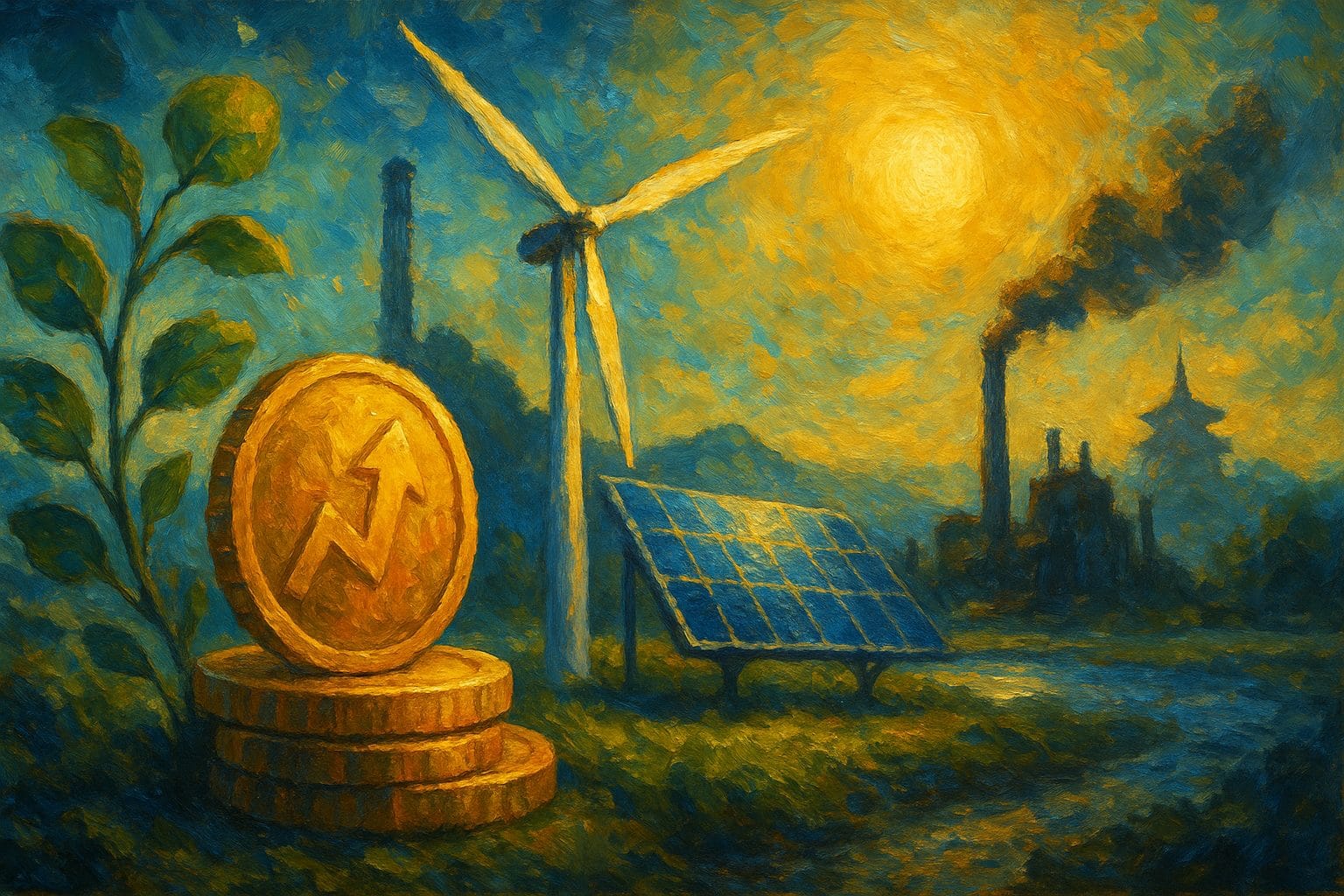
Here is the mechanism that Dialogue Earth analysts have documented with precision. When a new UHV corridor is planned, the provinces concerned—the producing one and the receiving one—anticipate a surge or decline in energy flow. In both cases, local operators and provincial governments have responded the same way for twenty years: they build coal plants. At the production end, to guarantee the corridor operates at full capacity and generates revenue for the province. At the receiving end, to ensure local grid stability in case of supply disruption. According to Dialogue Earth, all future wind and solar bases to be connected via UHV by 2030 would require a total of 104 gigawatts of additional coal capacity at the starting point—a figure concerning the program as a whole, not each corridor individually.
This figure warrants attention. 104 gigawatts across the entire program is considerable capacity: by comparison, France has approximately 155 to 157 GW of total installed electrical capacity from all sources according to RTE’s end-of-2024 report. It is the result of a logic of incentives perfectly coherent at the local scale and perfectly disastrous at the national and global scale.
Economists call this a stranded asset in the making. Coal plants built today have lifespans of thirty to forty years. If they operate until their natural end, they will emit quantities of CO₂ incompatible with any serious decarbonization trajectory. And once constructed, they create their own political logic: the workers operating them, the local governments collecting taxes from them, the banks that financed them—all become actors resisting closure. This is what climate political science researchers call dual coal lock-in: coal locks in both physically, through constructed assets, and politically, through the coalitions of interests it generates.
Tim Lenton, whose work on positive and negative tipping points in socio-technical systems is authoritative, underscores that these locks have a particular property: they are asymmetrical in time. Building takes four years; deconstructing a political coalition around a sector takes a generation. If China deploys its fifteen new UHV lines between 2026 and 2030 with the same coal accompaniment as before, it will have locked in a carbon trajectory for the 2030-2060 years. At that point, Beijing’s carbon neutrality commitments for 2060 will mechanically become impossible to meet without forced plant closures—with all that implies in terms of social costs and political resistance.
What the Network Already Transports—and What It Could Transport
It would be inaccurate to present the UHV program as simply a vector for coal. Reality is more nuanced, and data from the past decade shows real inflection.
On corridors placed in service since 2018, the proportion of renewable energy transported has increased. Certain lines, like the Qinghai-Henan corridor opened in 2020 over 1,563 kilometers, transport electricity sourced more than 50% from hydroelectric and solar power. The Yazhong-Jiangxi line, nearing completion, was designed from the outset to primarily transport hydroelectric power from Sichuan to the coasts. These are concrete signals that the infrastructure can serve the transition—and that it is beginning, in certain cases, to do so.
China is today the world’s leading market for solar and wind energy. In 2024, it installed approximately 357 GW of photovoltaic solar capacity, nearly 60% of the global total, according to IEA-PVPS data—overwhelming dominance, even though the rest of the world installed approximately 245 GW over the same period. The problem is not renewable production—it is exploding. The problem is the governance of what fills the corridors. As long as provincial incentives do not change, coal will remain the default filling fuel.
The issue, therefore, is not whether to build these lines or not. It is deciding what passes through them.
The Lever That Exists and Is Not Being Activated
Dialogue Earth analysts and several IEEE researchers have identified a precise mechanism to break coal lock-in without dismantling the UHV program: imposing a renewable energy production floor on each new corridor, expressed as a guaranteed percentage of energy transported on an annual basis.
The principle is simple. Today, producing provinces build coal because wind does not always blow and sun does not always shine—and they need to guarantee stable corridor utilization to monetize the infrastructure. A renewable floor reverses the equation: it constrains simultaneous development of storage capacities (large-scale batteries, pumped hydro) and requires accepting variable corridor utilization, remunerated differently by hour. This is not utopia: it is the model beginning to emerge on certain European corridors, and that Australia is experimenting with on a smaller scale in its inter-state interconnections.
For this lever to be activated, the central government must impose a rule that provincial governments have no incentive to apply spontaneously. This is where the institutional strength of the Chinese system—its capacity to maintain trajectories over thirty years—could turn into an advantage. If Beijing decides that the 15 new lines for 2026-2030 will come with a renewable floor, no one can oppose it. The question is whether central political will overcomes provincial interests on which local stability depends. In 2025, the answer remains uncertain—but regulatory signals sent in the 14th five-year energy plan indicate Beijing is aware of the problem.
What Europe Misses While Looking Elsewhere
The Chinese paradox interests Europe not from simple comparative curiosity, but because it points to a symmetrical and inverse failure.
China has solved the long-term planning problem but stumbles on the problem of local incentives. Europe has rather well-aligned local incentives—renewables are competitive, private investors are present, grid operators want to deploy—but stumbles on the long-term planning problem. As the network of transmission system operators (ENTSO-E) regularly notes, interconnections between member states progress at a rate two to three times slower than energy transition requires.
The irony is cruel: Europe does not need to build 52,000 kilometers of new lines. It needs to unblock authorization procedures that delay already-decided projects by seven to ten years. Administrative reform—not massive investment—would deliver, in terms of renewable transport capacity unlocked, more than ten years of new lines. This is what an 2024 report by the Agency for the Cooperation of Energy Regulators (ACER) highlighted: half of interconnection projects listed in the European network development plan are blocked not by financial constraints, but by national or local opposition procedures.
On this point, the Chinese lesson is uncomfortable. It says that the capacity to maintain a technological trajectory over thirty years is not a luxury of authoritarian regime: it is a structural condition for infrastructure progress. Carl Benedikt Frey framed it differently: technologies that reorganize economic space always create immediate losers and delayed winners. Political systems that manage this temporal asymmetry—by compensating today’s losers without yielding to their veto—are those that succeed in transition. Systems that fail abandon the trajectory halfway. Europe is, on this point, in a fragile situation.
2030 as a Tipping Point
The fifteen UHV lines China plans to place in service between 2026 and 2030 represent a 35% increase in national transport capacity. With 580 billion dollars investment over the five-year period, it is the largest grid expansion ever achieved in such a short timeframe.
These fifteen lines are also a window. If built with the same provincial incentives as before, they will anchor significant additional coal capacity by 2035—a prospect current trends make plausible. These plants, once operational, will be committed assets for thirty to forty years. At that point, meeting the 2060 carbon neutrality target would require massive forced closures in the 2040-2050s, with social and economic costs no government will want to bear.
If, conversely, Beijing activates the renewable floor lever on these fifteen corridors, the same network becomes a transition multiplier: it makes profitable the construction of solar and wind capacity in regions previously too distant from consumption centers, it creates demand for large-scale storage, it encourages provincial operators to develop flexibility solutions rather than build coal.
The difference between these two trajectories hinges on regulatory decisions to be made, or not, between 2025 and 2027. It is a short horizon for such a long-term stake. And that is precisely what makes Beijing’s next signals on UHV corridor governance as important to follow as any international climate agreement.
China has built the infrastructure. It has not yet decided what passes through it. This decision still belongs to the present.
Sources
- Dialogue Earth — “Done right, China’s UHV grid can help phase out coal rather than lock it in”: https://dialogue.earth/en/energy/done-right-chinas-uhv-grid-can-help-phase-out-coal-rather-than-lock-it-in/
- International Energy Agency (IEA) — World Energy Outlook 2024 and global solar deployment data: https://www.iea.org/reports/world-energy-outlook-2024
- ENTSO-E — Ten-Year Network Development Plan (TYNDP): https://www.entsoe.eu/publications/tyndp/
- IEEE Spectrum — Technical reports on China’s UHV lines
- Enerdata — Data on installed electrical capacity and Chinese grid investments
- Carl Benedikt Frey — The Technology Trap: Capital, Labor, and Power in the Age of Automation (Princeton University Press, 2019)
- Tim Lenton et al. — “Quantifying the human cost of global warming” and work on socio-technical tipping points (Nature Sustainability)
- ACER (Agency for the Cooperation of Energy Regulators of the EU) — Annual report on energy markets 2024
- Global Energy Monitor Wiki — Ultra-High-Voltage (UHV) Power Transmission System in China: https://www.gem.wiki/Ultra-High-Voltage_(UHV)_Power_Transmission_System_in_China
- Official SASAC — State Grid 15th Five-Year Plan: http://en.sasac.gov.cn/2026/01/22/c_20333.htm
- Enerdata — 15 new UHV lines 2026-2030: https://www.enerdata.net/publications/daily-energy-news/china-plans-15-new-ultra-high-voltage-transmission-lines-2030.html
- World Nuclear Association — Performance Report 2024: https://world-nuclear.org/our-association/publications/world-nuclear-performance-report/global-nuclear-industry-performance
- RTE — France Electrical Review 2024: https://analysesetdonnees.rte-france.com/en/annual-review-2024/keyfindings
- IEA-PVPS Snapshot 2025 — Global Solar 2024: https://iea-pvps.org/snapshot-reports/snapshot-2025/
- European Commission EUR-Lex — Grids Package 2025: https://eur-lex.europa.eu/legal-content/EN/TXT/HTML/?uri=CELEX%3A52025PC1007
- Climate Action Tracker — China 2060 Carbon Neutrality Target: https://climateactiontracker.org/countries/china/net-zero-targets/
- People’s Daily Online — 45 operational UHV projects: https://en.people.cn/n3/2025/1030/c90000-20383967.html