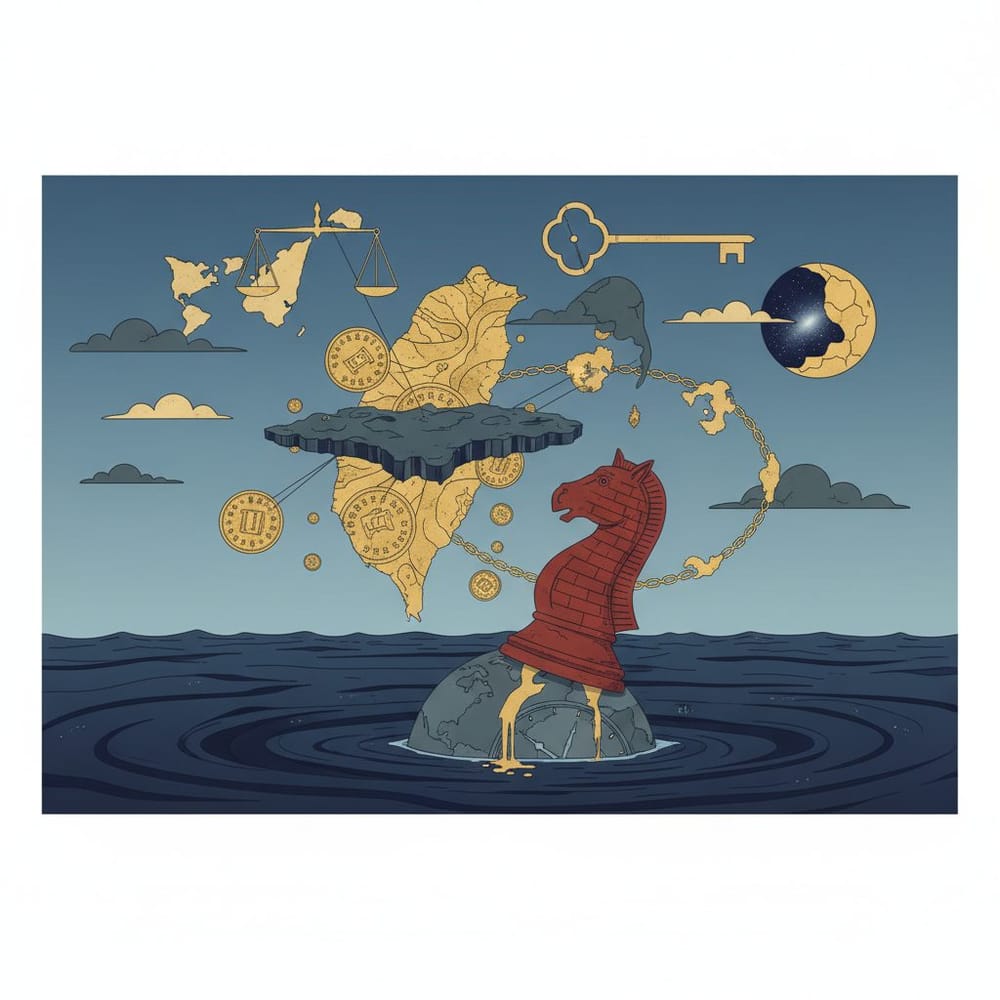
$17 billion in Chinese agricultural purchases against $14 billion in suspended American arms sales to Taiwan. This arithmetic reveals how Xi Jinping succeeded in imposing his terms in negotiations with Trump.
The Mar-a-Lago summit of May 15, 2026 marks a major geopolitical turning point: for the first time, Washington accepts the Chinese conceptual framework of “constructive strategic stability” and transforms Taiwan into an economic adjustment variable. American concessions far exceed the announced commercial gains.
The Essentials
- $17 billion in annual Chinese agricultural purchases guaranteed through 2028
- $14 billion in arms sales to Taiwan suspended by the Trump administration
- Xi Jinping imposes his terminology of “constructive strategic stability” in official communiqués
- $245 billion in Sino-American trade exchanges planned for 2027, a record level since 2018
Xi Jinping Succeeds in His Semantic Gambit
The Chinese victory begins with words. For the first time since Nixon, an American president officially adopts Beijing’s terminology in a joint communiqué. The phrase “constructive strategic stability” appears in White House documents, whereas it was previously rejected as a euphemism masking Chinese hegemonic ambitions.
This semantic capitulation is not insignificant. Since 2021, Chinese diplomats have hammered home this concept to reframe Sino-American relations: goodbye to the “strategic competition” dear to Washington, hello to “constructive coexistence” where the United States implicitly recognizes Chinese spheres of influence. The fact that Trump adopts this formulation signals a major conceptual shift.
The negotiators from Zhongnanhai transformed what was initially presented as a trade agreement into political recognition. The suspension of arms sales to Taiwan, announced as a “temporary confidence-building measure,” de facto validates the Chinese framework: Taiwan becomes a bilateral Sino-American issue rather than a question of democratic collective security.
$31 Billion in Asymmetrical Concessions
The arithmetic of the deal reveals a glaring imbalance. China commits to $17 billion in additional agricultural purchases—principally soybeans, wheat, and pork—spread over three years. In exchange, Washington suspends $14 billion in arms sales already approved by Congress: Patriot missiles, F-16V fighters, and electronic warfare systems destined for Taipei.
These $14 billion represent only the visible part. The suspension also includes military technological cooperation programs valued at an additional $4 billion by Pentagon analysts. Taiwan thus loses access to anti-missile jamming technologies and next-generation coastal defense systems.
The asymmetry becomes stark when examining the nature of the commitments. Chinese agricultural purchases remain commercial: Beijing buys what it needs to feed 1.4 billion inhabitants. American concessions are geopolitical: they directly weaken Taiwan’s deterrent capacity against the 2,000 ballistic missiles pointed at the island from the mainland.
This disproportion is explained by American economic urgency. With an agricultural deficit of $23 billion in 2025 and Midwest farmers in difficulty, Trump prioritizes immediate electoral gains over long-term strategic considerations.
Taiwan Discovers Its New Exchange Value
Taipei learns of its sidelining through American media. No prior consultation, no triangular negotiation: the island of 23 million inhabitants becomes an adjustment parameter in a Sino-American bargain that exceeds it.
Taiwanese President Lai Ching-te denounces a “dangerous precedent that transforms democratic security into a commercial currency.” Her government estimates an 18-month delay in the modernization of its defensive capabilities. Deliveries of Harpoon missiles and HIMARS systems, crucial in the face of a possible Chinese invasion, are postponed indefinitely.
This instrumentalization of Taiwan reveals the evolution of the balance of power in the Pacific. Washington now treats the island as a negotiable card rather than as a democratic partner to protect. The contrast is striking with the era when American arms sales were presented as “moral obligations” toward a threatened democracy.
Regional allies, Japan and South Korea foremost, observe this precedent with concern. If Taiwan can be sacrificed for $17 billion in agricultural purchases, what guarantee do they have that their own strategic partnerships will withstand American commercial appetites?
China Consolidates Its Diplomatic Advantage
Beijing transforms every American concession into validation of its long-term strategy. The suspension of arms sales reinforces the Chinese narrative that Taiwan is an “internal affair” that outside powers should not influence through military transfers.
The Chinese Ministry of Foreign Affairs praises “Washington’s constructive approach that prioritizes mutually beneficial cooperation over interference in China’s internal affairs.” This rhetoric, echoed by state media, retroactively legitimizes all the pressure exerted on democracies that sell arms to Taipei.
The domino effect is already beginning. The Netherlands postpones delivery of conventional submarines ordered by Taiwan. Germany suspends exports of maritime surveillance radars. Each European country fears becoming the next sacrifice on the altar of appeased Sino-American relations.
This normalization of Taiwan as an adjustment variable marks a conceptual turning point. China succeeds in transforming what was an ideological conflict—democracy against authoritarianism—into a pragmatic negotiation where everything can be bought and sold. The island loses its status as a democratic symbol to become a negotiable geopolitical asset.
Washington Assumes the Strategic Cost of Its Economic Choices
The Trump administration justifies these concessions by the urgency of rebalancing the American trade balance. With a $382 billion deficit against China in 2025, the White House prioritizes tangible gains over geostrategic considerations.
This accounting logic neglects the hidden costs of the deal. Every month of delay in Taiwan’s military modernization increases the chances of success for a Chinese fait accompli operation. Pentagon analysts estimate that the island will lose its “credible deterrence window” by 2028 if arms deliveries remain suspended.
The American paradox becomes glaring: Washington spends $850 billion on its military budget while sabotaging the defense of its democratic allies for a few billion in agricultural exports. This strategic myopia offers Beijing exactly what it seeks: the fragmentation of the Pacific’s democratic alliance.
Europe observes this evolution with attention. If the United States can trade Taiwan for soybeans, nothing guarantees that NATO will not become negotiable in the face of Russian energy supplies. The Taiwan precedent weakens the entire architecture of Western collective security built since 1945.
The $245 Billion Reshaping the Global Order
Beyond immediate figures, this summit codifies a redistribution of geopolitical cards. The $245 billion in Sino-American trade exchanges planned for 2027 exceed the 2018 level, erasing four years of trade war. This economic normalization is accompanied by a tacit acceptance of the Chinese fait accompli in its zone of influence.
The agreement goes well beyond Taiwan. It implicitly validates the Chinese strategy of “economic red lines”: Beijing can now threaten to close its markets whenever a democratic country sells arms to its contested neighbors. This commercial weapon proves more effective than all diplomatic protests.
For Xi Jinping, this success confirms the wisdom of his strategic patience. Rather than risking a costly military conflict, China obtains through commercial negotiation what its missiles would not have guaranteed: the progressive isolation of Taiwan and recognition of its spheres of influence by Washington itself.
“Constructive strategic stability” thus becomes the new paradigm of Sino-American relations: a balance where China consolidates its regional positions in exchange for measured economic concessions. Taiwan pays the price of this imposed stability.