In 2024, wind and solar represent on average 29% of the EU’s electricity, with a monthly peak of approximately 33% in April. Certain individual European countries exceed 40% or even 60%, but not aggregated Europe. Yet a large-scale outage in a region dominated by renewables can cause the network frequency to collapse in less than ten seconds. Not for lack of watts. For lack of software.
This shift, from megawatts to algorithms, is one of the least visible stakes of the energy transition. And it has a precise geography: Shenzhen, Hefei, Beijing.
The Essentials
- “Grid-forming” inverters are now the cornerstone of network stability with high renewable penetration, replacing the mechanical inertia of steam turbines with programmed synthetic stability.
- Sungrow, Huawei Digital Power, BYD and Tsinghua and Shandong universities concentrate the bulk of global patents on VSG (Virtual Synchronous Generator) technology, the heart of grid-forming control.
- Documented frequency incidents in Australia, Spain and the United Kingdom have highlighted the growing dependence of modern networks on these software layers.
- Europe has the climate objectives but not the intellectual property or trained technicians to design, certify and audit these systems. Training and certification centers are emerging in 2026, but the delay is structural.
Ten years ago, network engineers measured the strength of an electrical system in gigawatts of installed power and seconds of mechanical inertia. The heavier the turbines, the faster they spun, and the more naturally the network absorbed shocks: a sudden outage, an unexpected consumption spike, a storm that cuts a line. The physics of large steel rotors compensated for human error and climatic variability. This mechanical cushion, no one had designed it. It was simply there, a legacy of a hundred years of thermal electricity.
This cushion is disappearing. Each solar panel, each wind turbine connected via an electronic converter reduces the total rotating mass of the network. A region producing 70% of its electricity from solar on a July day looks, from the network’s perspective, like a room furnished with paper cushions. Even the slightest unamortized disturbance can trigger a cascade of load shedding in seconds.
The solution exists. It’s called a “grid-forming inverter.” And that’s where geopolitics enters physics.
What Mechanical Inertia Hid
A stable electrical network is one whose frequency stays close to 50 Hz in Europe, 60 Hz in the United States. The mechanical inertia of steam turbines, nuclear power plants, large hydroelectric complexes acts as a natural shock absorber: if consumption suddenly increases, the rotors slow slightly, release kinetic energy and give operators time to react. This delay, measured in seconds, is what distinguishes a robust network from a fragile one.
When intermittent renewables gain ground, they bring with them conventional inverters, known as “grid-following.” These devices merely synchronize their output to the existing network frequency. They follow it, they don’t hold it. In a network dominated by solar or wind, this model creates a circular dependence: everyone follows everyone else, nobody stabilizes. In case of a major outage, the frequency can collapse before even protection systems have time to react.
The incident of August 9, 2019 in the United Kingdom illustrated this brutally. An offshore turbine (Hornsea, ~737 MW) and a gas-fired power plant (Little Barford, ~244 MW) tripped simultaneously, leading to an initial production loss of approximately 1.38 GW, widened to some 2,100 MW by including non-compliant distributed generation disconnection. Approximately 973 MW of demand had to be shed via the LFDD mechanism, cutting power to a million homes. Ofgem’s investigation concluded that the cause was the simultaneous loss of these two major plants exceeding available reserve, combined with the disconnection of distributed generation whose protections were not compliant with required parameters. National Grid confirmed that inertia levels were adequate at the time of the incident: so it was not low inertia that amplified the cascade, but rather the combination of these production losses exceeding planned reserve margins. It wasn’t a classic outage. It was a preview of what an insufficiently dimensioned reserve network could do.
The Inverter That Simulates a Turbine
The technical response is elegant. Rather than recreating physical inertia by installing useless rotating masses, engineers have developed inverters capable of simulating software the behavior of a synchronous turbine. These “grid-forming” inverters continuously detect the network’s state and proactively adjust their output without waiting to be guided. They form the frequency rather than follow it.
The heart of this technology is called Virtual Synchronous Generator, or VSG. The algorithm mathematically reproduces the equation of a steam turbine rotor: virtual inertia, synthetic damping, response to disturbances. When frequency drops, the inverter instantly injects additional power, exactly as a rotor slowing down would do by releasing its kinetic energy. The difference: all this happens in a microprocessor, in a few milliseconds.
The first “black start” trials, that is, restarting a network from zero without external power supply, conducted with grid-forming inverters in Australia and the United Kingdom between 2021 and 2023, validated technical feasibility. In Australia, operator AEMO conducted tests in the Tasmania network, achieving stability during scenarios of complete loss of conventional generation. This is concrete proof: a 100% renewable network can be stable, provided its inverters are capable of holding the network, not just powering it.
Sungrow, Huawei, BYD: Control Through Patents
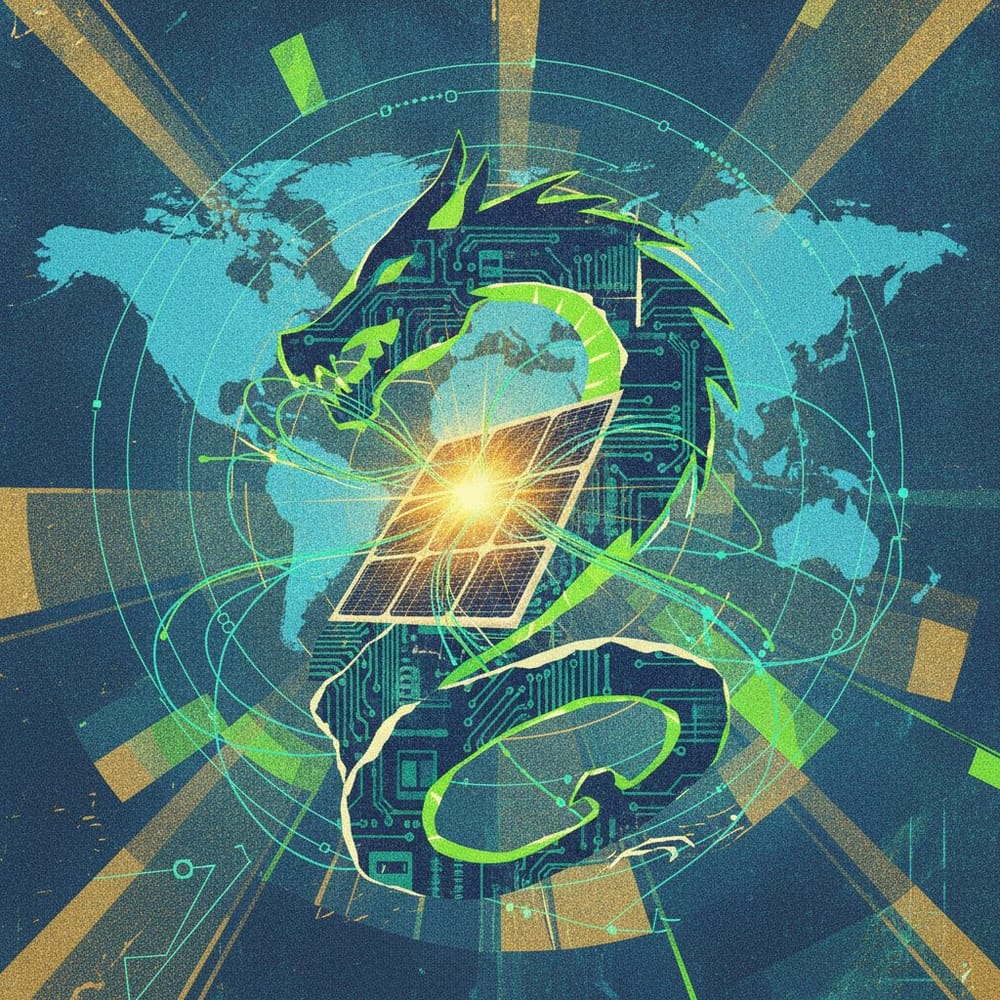
This is where technological dependence becomes strategic. Patents on VSG algorithms and grid-forming architectures are massively concentrated in China. According to Wood Mackenzie data, Huawei is the world’s leading inverter manufacturer across all categories with approximately 30% of global market share, with Sungrow occupying second place. Together, the two companies hold 55% of the global market. Huawei Digital Power, division of the Shenzhen giant, thus occupies first place worldwide — and not second as one sometimes reads. BYD, known for its batteries and electric vehicles, has developed an energy division that produces its own grid-forming inverters. Alongside these industrialists, Tsinghua and Shandong universities have published significant volumes of fundamental research on VSG control, feeding a patent pipeline that consolidates China’s lead on the software layer.
This concentration is not the result of an industrial accident. It reflects deliberate strategy. China has massively subsidized its photovoltaic sector since the 2000s, which gave it sufficient deployment volume to accumulate network experience without equivalent elsewhere. Engineers at Sungrow and Huawei solved stability problems in Chinese provinces already producing 60 to 80% of their electricity from solar at the time Europe was still debating its 2030 objectives. Practical experience is itself an intellectual property asset.
For European network managers, this creates an uncomfortable situation. Installing Chinese grid-forming inverters to stabilize European networks solves the physical problem. But it transfers control of the critical software layer to actors whose decisions depend, ultimately, on a foreign government. The question is not hypothetical: in 2022, the European Commission began examining risks related to Huawei components in critical infrastructure, an approach that first applied to telecommunications but whose logic naturally extends to electrical networks.
Europe’s carbon tax already creates asymmetric tensions in global energy supply chains. The grid-forming inverter adds a layer of technological dependence that tariffs alone will not resolve.
The Shortage of Technicians and the Blind Spot of Training
Behind the patent problem lies a more immediate one: Europe lacks technicians capable of designing, configuring, certifying and auditing grid-forming inverters. This deficit is structural and underestimated.
A grid-forming inverter is not equipment you install and forget. Its behavior depends on VSG parameters: virtual inertia, damping, response time, interaction with other network sources. Poor configuration can worsen oscillations instead of damping them. In a complex network with dozens of interconnected sources, the coexistence of multiple inverters from different manufacturers, with different proprietary control algorithms, can create unpredictable interactions. Engineers managing these systems must master both network physics, power electronics and control theory. This combination is rare.
European university curricula in electrical engineering and electrical engineering train engineers on conventional networks with mechanical inertia. The rise of grid-forming inverters is still treated as an advanced research topic, not as a basic operational skill. The labor market reflects this lag: job postings for engineers specialized in grid-forming control have multiplied since 2023, without training supply following.
In 2026, initiatives are emerging. The network of European transmission system operators ENTSO-E has launched working groups on the technical requirements for grid-forming inverters, with a view to defining common interconnection standards. A few specialized training centers, notably in Denmark and Germany, have integrated dedicated modules into their electrical engineering programs. Technical University of Munich and the Swiss Federal Polytechnic School of Lausanne have published certification curricula for active engineers. These initiatives remain modest compared to the scale of planned deployment.
The Levers Exist, One Must Simply Activate Them
It would be inaccurate to conclude that Europe is condemned to dependence. Several mechanisms can reverse or at least contain the dynamic.
The first is standardization of interfaces. If European network managers impose strict interconnection standards that precisely describe how a grid-forming inverter must behave in defined disturbance scenarios, the competitive advantage of Chinese manufacturers on the proprietary software layer diminishes. A binding interconnection standard forces all suppliers to respect externally defined behaviors, reducing differentiation margins through opaque algorithms. The European Commission, via the Network Code on High Voltage Direct Current (HVDC), has already set precedents for technical standardization imposed on equipment connected to networks. The same logic can apply to inverters.
The second lever is shared certification. Today, compliance tests for grid-forming inverters are fragmented between member states, with requirements varying from one network operator to another. A shared European certification center, modeled on what exists for aeronautical equipment with EASA, would make it possible to create a unified market for compliance and finance the technical expertise necessary to audit control algorithms. This is public spending that creates real sovereignty.
The third is funding research into alternatives. ABB, Siemens Energy and Schneider Electric have active divisions in power electronics and are investing in grid-forming inverters. Their ability to compete with Sungrow and Huawei on volumes and prices in the short term is limited. But on control quality, algorithmic transparency and integration with European network management systems, they have assets that public buyers can explicitly value in tender criteria. Public markets, when they integrate verifiable technological sovereignty criteria, can orient demand more effectively than R&D subsidies alone.
The Australian experience is instructive. The Australian market, which concentrates some of the world’s most acute stability problems due to its geography and high renewable penetration, has produced technical standards and certification requirements among the most advanced. Manufacturers like SMA Solar Technology, of German origin, have developed competitive grid-forming solutions partly because the Australian market required performance that only the best could achieve. Demanding demand creates quality supply.
What the European Network Will Have to Decide Before 2030
The deadline is not far off. Directive RED III sets a binding target of 42.5% of final energy consumption from renewable sources by 2030, coupled with an indicative target of 45% — which is not binding but constitutes an expressed political horizon. In several member states, Germany, Spain, Denmark, the renewable share in electricity production already reaches levels sufficient for network stability to become an immediate operational issue, not a concern for planners.
The paradox of the current transition is that the countries most advanced in solar and wind are also those accumulating fastest a dependence on the control layer. Spain, which has exceeded 60% renewables in its electricity production on certain days in 2024, is deploying inverters whose critical algorithms are largely written in Shenzhen or Hefei. The decision was not made consciously. It happened by default, at the pace of tenders won by the cheapest manufacturers.
This type of dependence on critical infrastructure, Europe learned at its expense with natural gas. The difference with Russian gas dependence is that algorithmic dependence is less visible, more distributed, and harder to disengage once installed. You don’t replace a control algorithm integrated into ten thousand inverters spread across a territory in a few seasons.
The good news is that awareness is growing. ENTSO-E’s work on grid-forming standards, the Commission’s reflections on extending the critical infrastructure security framework to network equipment, the first specialized training programs: the tools exist. The financing of offshore wind showed that objectives without visibility on actual costs can lead to budgetary dead ends. The stability of renewable networks risks producing the same disillusionment if technological dependence is not integrated into calculations from now on.
The question facing European decision-makers by 2030 is not whether to make the transition. It is to decide who writes the interoperability rules of tomorrow’s network. This choice is being made now, in tenders, technical standards and university curricula. Not in speeches about sovereignty.
Sources
- Beyond Tomorrow / ScienceDirect — Grid-Forming Inverters: Renewables Integration and Black Start Trials: https://beyondtmrw.org/article/grid-forming-inverters-renewables-integration-black-start-trials
- Ofgem — 9 August 2019 power outage report, Office of Gas and Electricity Markets, 2019: https://www.ofgem.gov.uk/publications/investigation-9-august-2019-power-outage
- AEMO — Black system South Australia 28 September 2016 and reports on grid-forming trials in Tasmania, Australian Energy Market Operator
- ENTSO-E — Grid-Forming Working Group, technical publications 2024-2026, European Network of Transmission System Operators for Electricity
- Wood Mackenzie — Global Inverter Market Share Report, 2023-2024 data: https://www.woodmac.com/press-releases/global-pv-inverter-shipments-grew-by-10-in-2024-to-589-gwac/
- European Commission — Directive RED III (2023/2413), 2030 renewable targets: https://energy.ec.europa.eu/topics/renewable-energy/renewable-energy-directive-targets-and-rules/renewable-energy-directive_en
- Red Eléctrica de España (REE) — electricity production reports 2024: https://www.ree.es/en/press-office/press-release/news/press-release/2025/01/renewable-energies-generated-56-per-cent-spains-electricity-mix-2024
- Ember — European Electricity Review 2025 (annual wind+solar EU parts): https://ember-energy.org/latest-insights/european-electricity-review-2025/2024-at-a-glance/
- UK Government E3C — GB Power Disruption Interim Report 2019: https://assets.publishing.service.gov.uk/media/5d96100340f0b61743bd4cc3/20191003_E3C_Interim_Report_into_GB_Power_Disruption.pdf
- PatSnap — Grid Forming Inverter Technology Landscape 2026: https://www.patsnap.com/resources/blog/articles/grid-forming-inverter-technology-landscape-2026/
- ESS News — BYD HaoHan et GC Flux grid-forming inverter (2025): https://www.ess-news.com/2025/09/19/byd-unveils-worlds-largest-14-5-mwh-dc-energy-storage-system/