Europe Transforms Its Rules Into an Economic Weapon Through Shared Infrastructure
Small European businesses now have access to shared solutions that significantly reduce regulatory compliance costs. A silent revolution that inverts Brussels’ punitive logic.
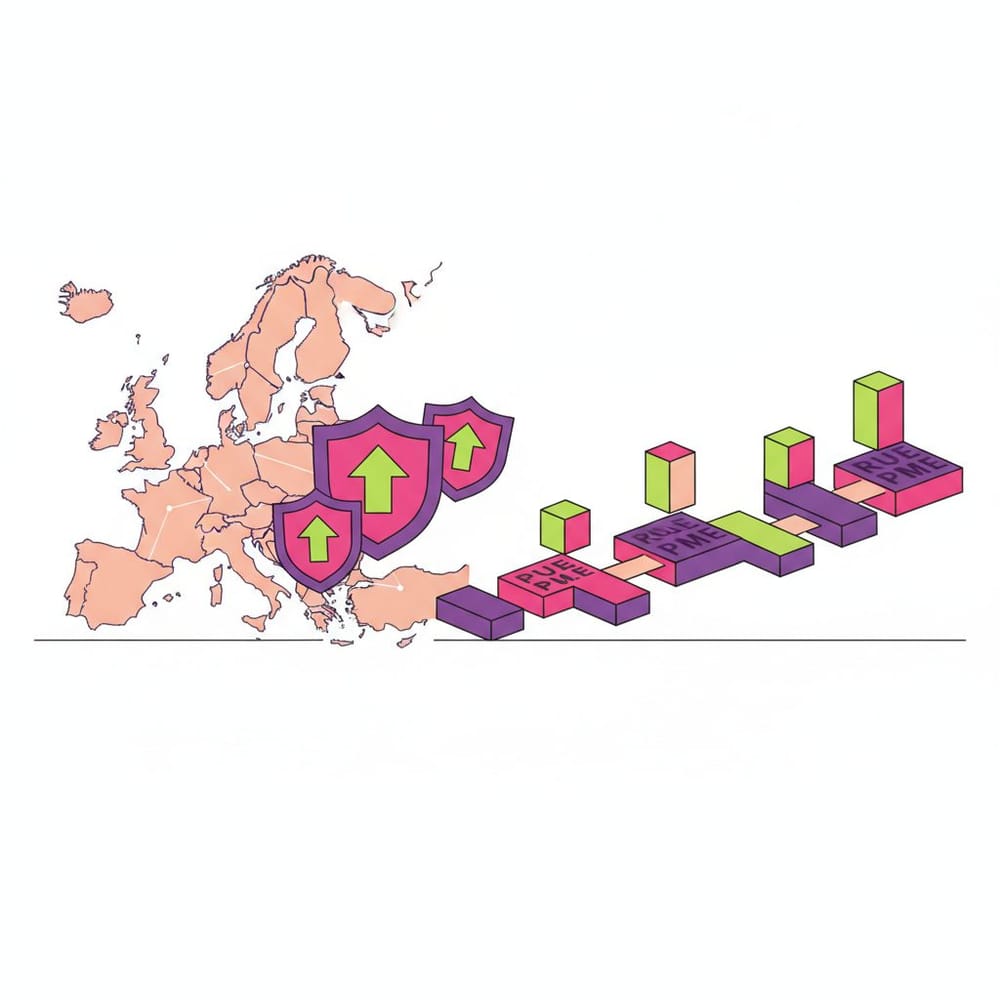
The European Union is experimenting with an unprecedented strategy: transforming its binding standards into competitive advantages by creating the digital infrastructure that enables compliance with them. Rather than leaving companies to fend for themselves against battery passport requirements or carbon footprint calculations, Brussels is pooling technological costs. The bet: making Europe the easiest continent in the world to meet the highest standards.
The Essentials
- 55% of the effort to implement European battery passports concerns data management, but SMEs have access to shared solutions
- The EuroHPC initiative puts 8 exaflops of computing power at the disposal of European businesses for €1.3 billion in public investment
- The “rule + infrastructure” model is expanding to digital product passports that will come into force in 2026
- The United States and China resist European standards but could adopt the infrastructure developed by the EU
Technical Pooling Breaks the SME’s Impossible Equation
European battery regulation illustrates this change in approach. Digital battery passports become mandatory in February 2027, and every battery sold in Europe will need to carry a digital passport detailing its carbon footprint, chemical composition, and traceability. For an SME manufacturing electric bikes, calculating the carbon footprint of a lithium-ion battery previously required hiring a specialized engineer or paying consultants at €800 per day.
The analysis by the Battery Pass consortium changes the game. Of the twelve implementation stages for a battery passport, more than half involve information management: collecting data from suppliers, formatting it according to European standards, securing it via blockchain, generating QR codes. Repetitive technical tasks that lend themselves perfectly to pooling.
Result: European battery manufacturers now have access to a shared platform that automates these processes. The unit cost of a battery passport has fallen from €150 for internal development to €15 through the shared solution. For a manufacturer producing 10,000 batteries per year, the savings exceed one million euros.
This approach is spreading rapidly. Digital Product Passports, which will affect all manufactured products sold in Europe from 2026 onward, follow the same logic. Rather than requiring each company to develop its own carbon footprint calculation tools, the EU is financing shared infrastructure accessible via API.
High-Performance Computing Becomes a European Public Service
Europe is pooling its computing to catch up with AI giants with the EuroHPC initiative, but the ambition goes beyond artificial intelligence. The eight European supercomputers, representing 8 exaflops of raw power, also serve to automate regulatory compliance.
Life cycle analysis calculations, which determine a product’s environmental footprint, require considerable computing resources. Modeling the climate impact of a smartphone requires analyzing 1,400 components and their interactions across 30 production stages. A calculation that took three weeks on an SME’s servers runs in two hours on EuroHPC infrastructure.
The €1.3 billion public investment in EuroHPC thus generates an unexpected leverage effect. European companies pay €0.12 per hour of high-performance computing, compared to €2.50 with AWS or Google Cloud for equivalent capacity. A cost advantage that more than compensates for additional regulatory constraints.
More than 3,200 companies already use EuroHPC services for their compliance calculations, according to 2024 data. The automotive, textile, and electronics sectors account for 70% of usage, proof that the infrastructure goes beyond the traditional scope of academic research.
European Standards Export Their Infrastructure
The Brussels Effect, theorized by Anu Bradford, describes how European standards impose themselves globally through market mechanics. But this mechanism encounters limits when faced with American and Chinese resistance. Washington refuses to adopt the GDPR, Beijing bypasses European cybersecurity standards. The infrastructure approach changes the equation.
American companies exporting to Europe discover that using European compliance tools costs less than developing their own. Tesla uses the Battery Pass platform for its vehicles sold in Europe, despite the absence of equivalent obligations in the United States. Ford and GM are negotiating access to EuroHPC to calculate the carbon footprint of their electric vehicles.
This dynamic accelerates with Chinese companies. BYD, the battery giant, integrates European passports into its global production chain rather than maintaining two parallel systems. The same logic applies to CATL, which represents 37% of the global battery market: European infrastructure becomes the de facto standard.
The effect is already measurable. In 2024, 23% of EuroHPC users are non-European companies, compared to 8% in 2022. Revenues generated by these external users fund the expansion of capacity, creating a virtuous circle.
China Replies, America Temporizes
Europe’s strategy does not go unnoticed. China announced the LineShine project for 2026 with a target of 2 ExaFLOPS. The stated objective: to offer Chinese companies infrastructure for compliance in export markets, including European ones.
Beijing goes further by developing alternative standards. The China Carbon Passport, a direct competitor to the European system, uses different calculation methodologies that systematically favor Chinese producers. A standards war that now plays out on the terrain of digital infrastructure.
The United States adopts a wait-and-see strategy. The National Science Foundation finances high-performance computing projects, but without an integrated vision of regulatory compliance. American companies remain dependent on private or European solutions for their exports. A situation that questions Washington, as the Biden administration multiplies environmental standards.
The stakes go beyond technology. Compliance infrastructure becomes an instrument of soft power. The country that provides carbon footprint calculation tools influences evaluation methods, and therefore results. Europe is gaining an edge by offering free what others charge a premium for.
Brussels Tests the Limits of Its Model on AI
The European AI Act, which came into force on August 1, 2024, with progressive application, constitutes the next test. Evaluating the risks of an artificial intelligence system according to European criteria requires specialized infrastructure: test benches, secure environments, automated audit tools. The EU is launching the AI Testing Infrastructure in 2025, a network of centers of excellence accessible to companies.
The initial €800 million investment aims to create fifteen European centers capable of certifying AI compliance in less than six weeks, compared to six months currently. Technology SMEs have access to the same tools as Google or OpenAI to test their algorithms. A leveling up that could reshape the AI innovation landscape.
But resistance is organizing. American tech giants are multiplying pressure on the Biden administration to challenge the AI Act before the WTO. Argument: European infrastructure constitutes a hidden subsidy that distorts competition. A legal precedent that will determine the future of the European model.
Silicon Valley is simultaneously developing its own AI evaluation standards, incompatible with European criteria. A fragmentation that complicates the task of global players, but paradoxically strengthens the attractiveness of European infrastructure for actors seeking interoperability.
Infrastructure as a New Geopolitical Frontier
The “rule + infrastructure” model transforms the nature of regulatory competition. Europe no longer merely imposes standards: it provides the means to comply with them efficiently. An approach that reverses the burden of proof and places its competitors on the defensive.
The effect is measured in investments. European companies devote a significant share of their revenue to regulatory compliance, but this gap with their American counterparts is explained by access to shared infrastructure, which divides fixed costs by four to ten depending on sectors.
This transformation inspires other regions. Japan is studying a similar system for its industrial cybersecurity standards. India is developing computing infrastructure dedicated to environmental impact assessment of textiles. Even South Africa is experimenting with pooling mining compliance costs.
Europe is methodically building an ecosystem where respecting its rules becomes simpler and cheaper than elsewhere. A strategy of attraction that could prove more effective than traditional sanctions. What remains to be seen is whether infrastructure will resist the competitive pressure from American and Chinese tech giants, who have no intention of letting Brussels alone redefine the rules of the global game.