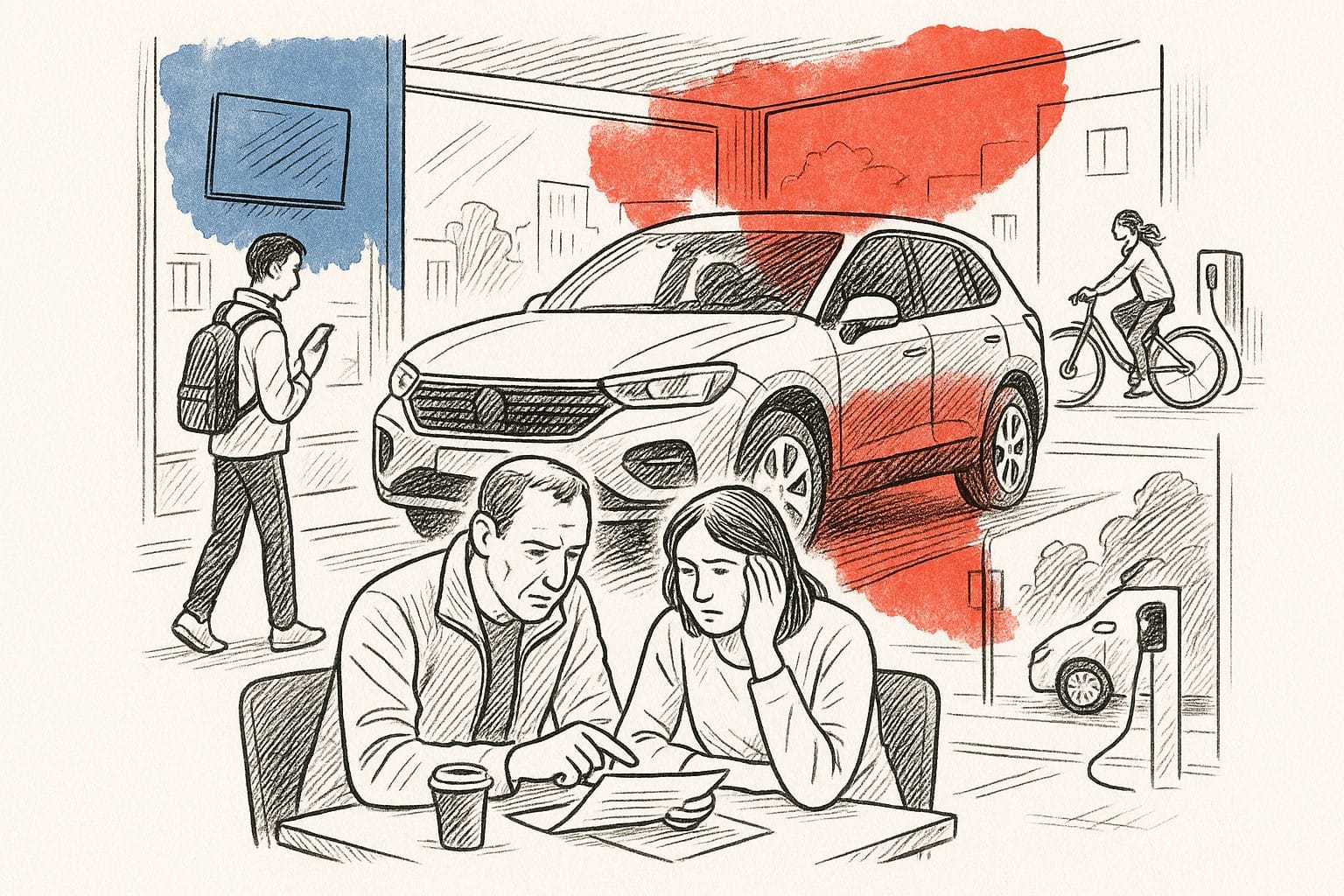
29% of European parcels now avoid your front door. This proportion, measured by GLS Group on its European network, marks a silent shift in continental logistics. In twenty-four months, the number of automated lockers and pickup points has doubled to reach 130,000 collection points. 35% of Europeans regularly use this delivery method, reshaping urban geography without public debate or centralized planning.
This transformation reveals two opposing European models. The East is betting on consumer autonomy with dense infrastructure: Poland has 67 pickup points per 10,000 inhabitants. The West remains dependent on home delivery: France has fewer than one for the same population. The choice goes beyond technical convenience — it structures logistics employment, urban emissions, and city organization.
The essentials
- 29% of GLS Europe B2C parcels pass through lockers or pickup points, compared to 15% two years ago
- The non-home European network has doubled in 24 months to reach 130,000 points
- Poland has 67 pickup points per 10,000 inhabitants, France has fewer than one
- 35% of Europeans regularly use non-home delivery
The parallel network emerging without planning
Non-home delivery infrastructure is expanding according to purely market logic. Amazon is investing heavily in its automated lockers, installed in train stations, shopping centers, and gas stations. DHL is developing its Packstations network in Germany and extending it toward Eastern Europe. GLS relies on existing retail to create pickup points, transforming tobacco shops and convenience stores into logistics terminals.
This growth escapes urban authorities. Unlike public transport infrastructure, no public planning guides the deployment of pickup points. Operators choose their locations based on profitability, creating dense zones and logistics deserts. The resulting geography reflects private commercial strategies rather than territorial planning needs.
Automated lockers are installed in transit areas: 24% of GLS points are located in gas stations, 18% in shopping centers, 16% near public transport. This distribution favors peri-urban zones where cars dominate. Dense city centers and working-class neighborhoods remain less equipped, despite higher parcel density.
The European geographic divide is widening
Eastern Europe is far ahead of the West in adopting non-home delivery. Poland is developing a model of logistics autonomy: Allegro, its local Amazon, installs lockers in every residential neighborhood. Poczta Polska, the public postal operator, is multiplying automated machines in train stations and post offices. The network reaches a density of 67 points per 10,000 inhabitants.
This lead is explained by earlier structural choices. Eastern Europe rebuilt its logistics after 1989 by directly integrating new technologies. Post-communist cities have less dense urban fabric than Western historic centers, facilitating locker installation. Logistics labor remains cheaper, making home delivery less competitive against pickup points.
France illustrates Western backwardness with fewer than one point per 10,000 inhabitants. La Poste is slowly developing its Pickup lockers, hindered by resistance from traditional tobacconists and regulatory complexity. Amazon is installing its lockers at a trickle, favoring Germany and Nordic countries. This pace difference will create lasting gaps between European zones.
Germany occupies an intermediate position with DHL massively equipping residential areas. But adoption remains uneven: Eastern Länder are adopting lockers faster than Bavaria or North Rhine-Westphalia. This geography reproduces the continent’s historical economic divisions.
Logistics employment is restructuring around sorting centers
Non-home delivery radically transforms logistics work organization. Home delivery drivers are gradually disappearing, replaced by drivers who supply pickup points. One truck serves fifty lockers versus fifteen addresses in conventional delivery. Productivity soars, employment contracts.
DHL announces the elimination of 3,000 delivery driver positions in Germany by 2026, offset by 800 jobs created in automation maintenance and regional hub management. Global trade is reorganizing without decoupling, but this reorganization profoundly modifies local employment chains.
Sorting centers gain strategic importance. They centralize parcel processing before distribution to pickup points, requiring more skilled teams to manage traceability and customer returns. These jobs, better paid than delivery work, concentrate on urban peripheries. Logistics employment geography is shifting from neighborhoods to industrial suburbs.
European unions are raising alarms about this silent transformation. Ver.di in Germany and FO in France denounce the precariousness of independent delivery drivers, replaced by employees in sorting centers but in insufficient numbers to compensate. Automation is progressing faster than professional retraining.
European cities facing an unacknowledged choice
Non-home delivery is redesigning urban space without democratic debate. Automated lockers occupy public space — sidewalks, station forecourts, parking lots — according to private agreements with infrastructure managers. Municipalities discover this transformation after the fact, confronted with a fait accompli.
Amsterdam is attempting to regain control by regulating automated locker installation. The city requires a permit for any installation on public space and limits their number per neighborhood. This approach remains exceptional: most European cities are subject to private network installations.
The environmental impact divides urban planners. Non-home delivery reduces transport emissions: one truck supplying lockers emits 60% less CO2 than equivalent home delivery rounds. But it encourages urban sprawl by favoring peripheral zones accessible by car. The overall carbon balance depends on implantation choices.
Historic city centers are losing their logistics attractiveness. Narrow streets and traffic restrictions complicate locker installation. Traditional shops serving as pickup points are closing, replaced by concept stores and restaurants. This evolution accelerates gentrification by eliminating popular proximity services.
Consumer autonomy against personal service
Non-home delivery imposes a new relationship with commerce. The consumer becomes an actor in their logistics: they travel to the pickup point, manage their time slots, handle returns directly via automated machines. This autonomization appeals to active urbanites who better control their deliveries, but excludes less mobile populations.
Elderly and disabled people remain dependent on home delivery, creating a two-speed logistics system. Operators maintain this service for premium customers or dense zones, charging more for a now-exceptional service. Territorial equality of access to logistics services is eroding.
This transformation reflects a neoliberal vision of urban logistics: economic efficiency takes precedence over social equity. Autonomous, digitally equipped consumers benefit from reduced rates and flexible services. Others pay the full price to maintain a personalized service on its way out.
Nordic countries are attempting to reconcile efficiency and inclusion. PostNord in Sweden maintains a universal public postal service while massively developing automated lockers. This hybrid approach preserves access to services for all while optimizing overall costs. It requires public funding that most European countries refuse.
Logistics as political infrastructure
Europe is building two incompatible logistics models that will shape the social organization of decades to come. Eastern Europe is betting on technological consumer autonomization, reducing service costs but demanding more individual effort. The West preserves personal service at the cost of more expensive and less ecological logistics.
This divergence goes beyond simple economic efficiency. It translates opposing conceptions of the relationship between technology and social bonds. Poland is digitalizing its public and private services to catch up on its development lag. France is protecting service employment and human relationships, even if it slows logistics optimization.
European harmonization remains unlikely. Each country develops its logistics geography according to its political priorities and urban constraints. This fragmentation limits continental economies of scale but preserves diversity of European social models.
The stakes go beyond parcel delivery. Today’s logistics choices determine tomorrow’s territorial organization: centralization or dispersal of activities, individual autonomy or dependence, system optimization or resilience. Europe is inventing its 21st-century geography one pickup point at a time, without public debate about the society it is building.