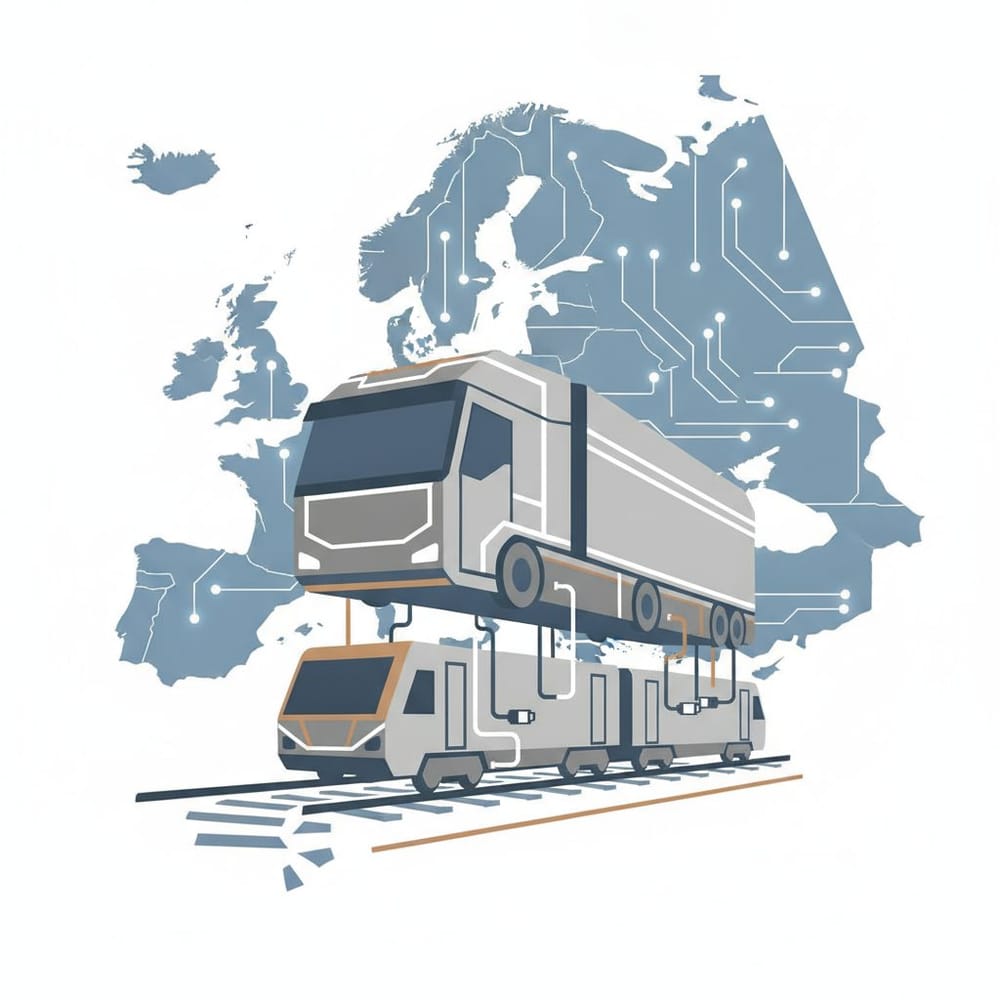
In 2024, rail’s share of freight in the European Union represents 5.4% of total freight across all modes according to Eurostat, or approximately 17% if limited to inland domestic freight alone (excluding maritime). In the 1990s, this share was significantly higher. Thirty years of modal shift policies, tens of billions of euros in infrastructure investments, and the share of rail in transported goods has continued to decline.
This fact deserves to be stated plainly, because it contradicts a central assumption of Europe’s transport decarbonization policy. The idea that rail would absorb an increasing share of long-distance freight, thereby freeing road transport from its diesel dependence, has structured the Commission’s climate plans for twenty years. A joint report published in March 2025 by the French Council of Economic Analysis and its German counterpart, the Sachverständigenrat, has quantified its limitations with unusual precision.
Key Points
- Rail’s modal share in EU freight reaches 5.4% of total freight across all modes (Eurostat 2024), or approximately 17% of inland domestic freight; in both cases, the long-term trend is one of decline since the 1990s
- The CAE and Sachverständigenrat estimate that modal shift from road to rail is mechanically capped at 6% in Germany and less than 2% in France for journeys over 300 km
- The European objective set in the Sustainable and Smart Mobility strategy is to double the volume of rail freight traffic (in tonne-km) by 2050, not its modal share
- Battery-powered electric trucks and hydrogen trucks are reaching commercial maturity within the same timeframe as these rail objectives
- The real public policy question is no longer rail versus road, but how to set the right price signal to decarbonize the entire sector
The Glass Ceiling of Modal Shift
The CAE-Sachverständigenrat report does not contest the usefulness of rail freight. It measures what political debate generally avoids quantifying: the real potential for transferring goods from road to rail under current territorial and supply chain conditions.
Their conclusions are harsh. For journeys over 300 kilometres, where rail is theoretically most competitive, the potential modal shift reaches a maximum of 6% in Germany. In France, this ceiling falls below 2%. This is not a political limit that a reform could remove in one stroke. It is a structural constraint.
Why so little? Several mechanisms interlock. Rail freight requires a minimum volume per route to make a path profitable. The productive geography of France and Germany is dispersed: industrial zones, logistics warehouses, major distribution platforms do not concentrate along historic rail corridors. The last mile remains systematically road-based, even when long-distance travel is by rail. And the densest flows are over short or medium distances, where trucks retain a flexibility advantage that no rail investment compensates.
The result is that even assuming rail policy functions perfectly, even assuming massive investments in infrastructure and rail competitiveness, the impact on road transport emissions would remain marginal at the sector level.
Thirty Years of Promises and Continuous Decline
The gap between political objectives and reality of modal shares is not new. It dates back at least to Directive 91/440/CEE, which liberalized European rail freight with the ambition of reviving its competitiveness against road. Reality took the opposite path.
In the 1990s, rail represented a significantly higher share of Union inland freight. Thirty years later, according to Eurostat, it represents only 5.4% of total freight across all modes, or approximately 17% of inland domestic freight alone. The 2000s saw some stabilization, notably driven by intermodal freight growth and the strengthening of European corridors. But the long-term trend is one of decline, disrupted only by economic crises that disproportionately affect heavy industry, historically a rail client.
The structural reasons have been documented for a long time. The European rail network remains fragmented between national systems that have never truly converged: different loading gauges, incompatible signalling systems before the progressive deployment of ERTMS, opaque track access rights often granted as priority to passenger trains on mixed-use lines. France illustrates this problem with particular acuity: SNCF Réseau manages a network where long-distance trains and regional trains consume the densest paths, leaving freight with nocturnal slots and commercial speeds that make it uncompetitive.
Private operators attempted to establish themselves in this liberalized market. DB Cargo, Fret SNCF, and also smaller players like Captrain or Rail Logistics Europe invested in niche segments. Results remain mixed. Fret SNCF underwent profound restructuring, under European constraint, in 2023-2024. DB Cargo has accumulated losses for years. The economic model of the isolated wagon, which historically allowed the assembly of complete trains from small consignments, is in near-extinction in most European countries.
The Electric Truck Changes the Terms of the Problem
While this debate repeated itself in circles, another transition was quietly preparing. The first heavy electric trucks began entering European fleets from 2023 onwards. Volvo Trucks, Daimler Truck, MAN, Scania: all major manufacturers launched production models for the heavy-goods segment. The range of the first vehicles remained limited to 300-400 kilometres, confining them to regional routes and urban freight.
This limit is receding quickly. Volvo announces models reaching 600 kilometres of range at full load for 2026. Tesla Semi, deployed in volume in the United States since 2023, claims 800 kilometres. High-energy-density batteries, coupled with fast DC charging infrastructure on motorway corridors, are progressively opening the long-distance segment.
Total cost of ownership is the real tipping-point indicator. In 2024, studies converge in placing the parity point between diesel and electric trucks somewhere between 2027 and 2030 in Europe, assuming an average industrial electricity price around 100 euros per MWh and battery prices continuing to fall according to observed trends. This is not speculative projection: it is the extrapolation of a learning curve following roughly the same logic as solar panels or light-vehicle batteries.
Green hydrogen adds to this picture for very long journeys, where the weight-to-range ratio of batteries remains penalizing. Hyundai, Toyota, and several European startups are developing fuel cell trucks. The cost of green hydrogen remains high, but the hydrogen corridors funded under the European plan are designed precisely for this segment.
The important point is not that the electric truck will “win” against rail. It is that decarbonizing road freight becomes a technically achievable project within a ten- to fifteen-year window, without needing to reconfigure the supply chain, without requiring disruption to shippers’ delivery habits, and while preserving the flexibility that defines the value of road transport.
What the Numbers Imply for Public Investments
The European Union set an objective in its Sustainable and Smart Mobility strategy published in 2020: to double the volume of rail freight traffic, measured in tonne-kilometres, by 2050. This objective concerns absolute volumes transported by rail, not its modal share. It is taken up in the Green Deal, in trans-European transport network guidelines, and in budget justifications for dozens of national infrastructure projects.
If the CAE and Sachverständigenrat are right, this objective cannot be achieved with current policies, regardless of the scale of rail investments. The 6% ceiling in Germany and 2% in France is not a target to surpass: it is an estimate of maximum potential, assuming everything goes well.
This does not mean rail investments are useless. Rail remains relevant for certain massifiable flows: transport of containers between major ports and distribution centers, bulk raw materials, dense international flows such as the Rhine-Rhone axis. It also remains the only viable option in contexts where the road is saturated and zero-emission alternatives do not yet exist at scale. In Paris, the ongoing modal rebalancing in urban transport shows that infrastructure reconfiguration can produce real effects when density and uses allow. In long-distance freight, this condition is rarely met.
The question the Franco-German report implicitly poses is more uncomfortable: do the billions programmed to increase rail freight capacity provide better returns in terms of avoided emissions than investments in electric charging infrastructure and hydrogen corridors for road transport?
This comparison is not yet being made systematically at European level. It should be. The Connecting Europe Facility, the main tool for financing transport infrastructure, still programs much of its allocation on the basis of a vision of modal shift toward rail that merits recalibration in light of this data.
Price Signal, Not Infrastructure Billions
The diagnosis of the CAE and Sachverständigenrat is not limited to modal share analysis. It leads to an economic policy recommendation: if the objective is to decarbonize freight, the most effective instrument is the price signal, not selective investment in a single transport mode.
Concretely, this means two things. First, that road transport pricing must incorporate its true carbon cost, which is not yet the case in most member states despite the extension of the European emissions trading system (ETS) to transport. Shippers comparing rail and road costs are comparing prices where one is more or less subsidized by the absence of carbon pricing.
Second, that support for electric truck adoption and investments in fast charging have potentially greater and faster impact on sector freight emissions than rail subsidies, precisely because they act on the vast majority of freight that will not pass through rail — approximately 94.6% of total EU freight according to Eurostat 2024, or approximately 83% of inland domestic freight — rather than on the share already using it.
This framing is not an attack on rail. It is an invitation to prioritize policies by their measured carbon effectiveness, rather than by their coherence with a vision of modal share that dates from an era when truck decarbonization seemed impossible. This logic, consisting of evaluating policies by their actual results rather than their intentions, is not specific to the transport sector. It joins a broader debate on public spending allocation in a constrained budgetary context, found in sectors as different as industrial policy or vocational training.
What Europe Can Still Do Right
Reappraising rail modal share objectives does not mean abandoning rail. Rail freight has solid strongholds in Central and Eastern Europe, where distances are long and industrial flows dense. Switzerland, Austria, and Southern Germany maintain significantly higher rail shares than France on certain corridors, thanks to a combination of higher road user charges on heavy goods and favorable geography.
The Swiss model deserves close examination. Switzerland has maintained a rail share of approximately 40% in freight thanks to a heavy goods fee based on services (RPLP) that internalizes some of trucks’ external costs, combined with massive investments in base tunnels at the Gothard and Lötschberg. This is not magic transfer: it is the result of fair pricing and infrastructure designed for flow massification.
The lesson is not that France or Germany should reproduce this model identically. Their logistics geographies are different. It is that modal shift policies not based on a coherent price signal have not historically worked, and nothing suggests they will work better in coming decades.
The challenge of the coming years is therefore not to choose between rail and electric road. It is to build a pricing framework allowing each mode to compete on its true costs, to concentrate rail investments where rail is competitive without subsidy, and to accompany the electric transition of road transport with the same energy as rail announcements.
A serious audit of European freight corridors, placing side-by-side the cost per tonne of CO₂ avoided via modal shift and via road electrification, would provide decision-makers with a comparison base they currently lack. Producing it before the next revision of TEN-T guidelines would be a concrete way of making transport climate policy something other than a statement of principle.
Sources
- Council of Economic Analysis (CAE) / Sachverständigenrat (GCEE), joint report on freight and transport decarbonization, March 2025: https://www.sachverstaendigenrat-wirtschaft.de/fileadmin/dateiablage/Publikationen/FGCEE/CAE_FGCEE_Joint_statement_250320.pdf
- Eurostat, freight transport statistics by mode, 2024: https://ec.europa.eu/eurostat/statistics-explained/index.php?title=Freight_transport_statistics_-_modal_split
- European Commission, Sustainable and Smart Mobility Strategy, 2020 (COM/2020/789): https://eur-lex.europa.eu/legal-content/EN/TXT/HTML/?uri=CELEX:52020DC0789
- Swiss Federal Office of Transport (OFT), rail freight statistics and RPLP
- Volvo Trucks, commercial data FH Electric range, 2024-2025
- Trans-European Transport Network (TEN-T), Regulation (EU) 2021/1153, revision in progress
- European Environment Agency (EEA) – Freight transport activity (rail decline since 1995): https://www.eea.europa.eu/en/analysis/publications/sustainability-of-europes-mobility-systems/freight-transport-activity
- ART – Rail Balance France 2024 (Fret SNCF restructuring): https://autorite-transports.fr/wp-content/uploads/2025/06/bilan-ferroviaire-france-2024_plaquette-a-mi-annee.pdf
- Destatis – Rail freight EU 2024 (inland domestic freight modal share ~17%): https://www.destatis.de/Europa/EN/Topic/Transport/gueterverkehr-eisenbahn.html
- ERA – ERTMS (signalling system incompatibility): https://www.era.europa.eu/domains/infrastructure/european-rail-traffic-management-system-ertms_en