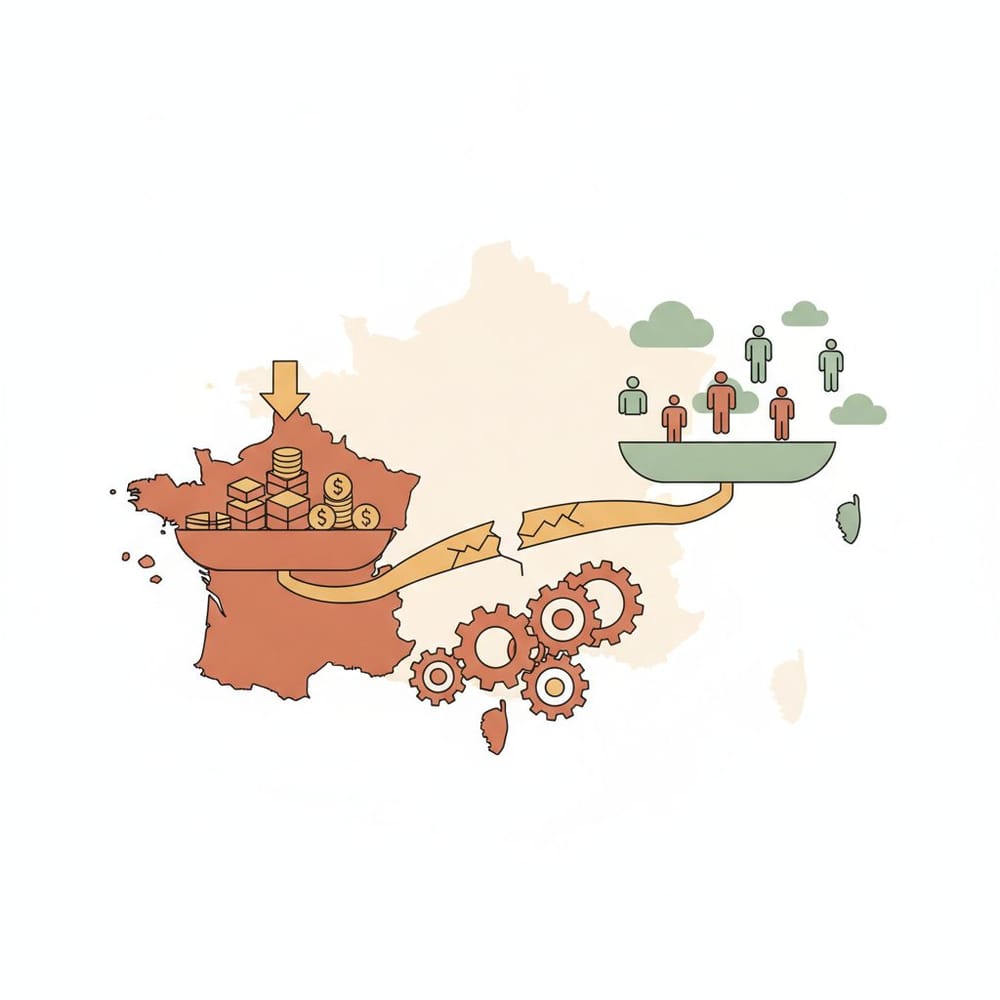
Sixty French departments out of 101 are in serious financial difficulty by the end of 2025, more than double the 29 recorded a year earlier. This spectacular deterioration reveals a fracture at the heart of the French welfare state: the local authorities tasked with the heaviest social missions — the Revenu de Solidarité Active (RSA), aid to elderly persons, child protection — no longer have the means to assume them. A paradox that questions the very architecture of decentralization.
French departments manage 35 billion euros in annual social spending, nearly half their total budgets. Yet this massive responsibility rests on eroding resources: declining property transfer taxes, insufficient equalization funds, partial state compensation. The model is buckling under the weight of its own redistributive ambitions.
Key Points
- 60 departments out of 101 in serious financial difficulty by end of 2025, compared to 29 at end of 2024
- Departments manage 35 billion euros in annual social spending, or 45% of their budgets
- Property transfer rights, the main departmental resource, falling by 15% in 2025
- The state compensates only 70% of the actual cost of RSA transferred to departments since 2004
Growing Social Missions Crush Budgets
French departments today carry social responsibilities that few territorial authorities elsewhere in Europe assume. The RSA alone represents 11 billion euros annually, social aid to elderly persons 8.5 billion, child protection 8.2 billion. These three items absorb nearly 80% of departmental social spending, with continuous progression: +4.2% per year on average since 2020.
This inflation is explained by demographic and economic dynamics largely beyond the control of local elected officials. An aging population mechanically increases needs for home care and specialized housing. Energy and food insecurity swells requests for assistance. Emergency housing places for children now cost an average of 300 euros per day, compared to 180 euros five years ago.
The paradox lies in the very nature of these expenses: they are simultaneously mandatory — departments cannot legally refuse them — and largely unpredictable in volume. A department can see its child protection spending explode by 20% in a single year following a cascade of reports, with no corresponding budget provision.
Resources Collapsing in the Face of Exploding Needs
French departments finance their social missions primarily through property transfer rights, commonly called “notary fees.” This resource, which represented 13.2 billion euros in 2024, is falling by 15% in 2025 due to the slowdown in the real estate market. Sales of existing homes, which generate the bulk of these rights, are declining by 18% year-over-year.
This dependence on real estate creates structural vulnerability. Rural departments, where transactions are fewer and cheaper, struggle more to finance their social obligations. Seine-Saint-Denis collects 2,100 euros in transfer rights per inhabitant compared to 890 euros for Creuse, while social needs there are often higher.
The global operating grant allocated by the state only imperfectly compensates for these inequalities. It represents 7.8 billion euros in 2025, stable for three years despite cost inflation. As for the departmental equalization fund, its 800 million euros annually is insufficient to correct growing territorial imbalances.
The state regularly transfers new missions to departments without corresponding funding. The RSA, decentralized in 2004, is compensated at only 70% of its actual cost according to Départements de France. The gap represents 3.3 billion euros annually charged to local authorities, equivalent to 25% of the property transfer rights collected.
French Territorial Governance Shows Its Limits
This budgetary crisis reveals the flaws in French institutional architecture. Unlike Germany, where the Länder have a share of income tax, or Italy, where regions collect a fraction of VAT, French departments depend on volatile resources disconnected from their missions.
The 2010 business tax reform worsened this fragility. Departments lost 13 billion euros in stable tax revenue, replaced by frozen state grants and cyclical property transfer rights. This substitution transformed autonomous authorities into managers of under-financed national policies.
Attempts at rebalancing hit the resistance of better-endowed territories. The departmental equalization reform project, debated since 2019, divides elected officials between contributing and recipient departments. Hauts-de-Seine or Yvelines, which collect respectively 4,200 and 3,800 euros in property transfer rights per inhabitant, oppose a mechanism that would reduce their room for maneuver.
This situation recalls the challenges other European countries have faced in decentralized management of solidarity. Spain had to partially recentralize its social policies after the 2008 crisis, for lack of sufficient regional resources. Belgium has been negotiating for fifteen years a reform of funding for its federal entities to avoid budgetary deadlock.
Departments Attempt Survival Strategies
Facing this financial constraint, departments are developing pragmatic approaches. Sixty-three of them have created “departmental solidarity centers” that group social services to reduce structural costs. The average savings reach 8% of operating expenses, or 280 million euros at the national level.
Social innovation becomes a lever for efficiency. The Nord department has been experimenting since 2023 with a “territorialized youth guarantee” system that reduces the cost of support for precarious 16-25 year-olds by 30%. Gironde is developing “mobile prevention teams” that intervene in homes before child placement, cutting the average intervention cost in half.
Digitalization of procedures also generates substantial savings. Bouches-du-Rhône saved 12 million euros in three years through digitization of RSA and APA (personalized autonomy allowance) files. The average processing time for a request drops from 35 to 18 days, improving service efficiency while reducing costs.
These innovations remain, however, limited by the national regulatory framework. Departments cannot adjust social assistance rates or condition their interventions differently. Their room for maneuver concentrates on service organization, not the core of redistributive policies.
Territorial Reorganization Looms
The current crisis could accelerate French territorial reorganization. Forty-two departments are studying reinforced joint arrangements with their neighbors to share the costs of heavy social facilities. The Ardennes and Marne are negotiating the creation of an inter-departmental public entity managing their children’s homes, maternal centers, and social assistance services.
This logic of grouping goes beyond mere economies of scale. It aims to reconstitute viable solidarity territories, capable of balancing wealthy and poor zones, dynamic spaces and declining territories. Metropolises generate the bulk of fiscal wealth but rural departments retain high social costs linked to aging and distance from services.
The state is quietly encouraging this reorganization. The 4D bill (differentiation, decentralization, deconcentration, de-complication) has authorized since 2022 transfers of competencies between voluntary authorities. Sixteen experiments are underway, seven of which concern departmental social action.
The example of Nouvelle-Aquitaine inspires other regions. Its twelve departments created a solidarity fund financed by 2% of their property transfer rights, which funds the heaviest social investments. This voluntary equalization avoids extreme disparities while preserving local autonomy.
This territorial evolution could foreshadow a deeper reform of solidarity financing in France. Several parliamentary reports advocate creating a “territorialized social VAT” that would allocate a fraction of this stable resource to authorities tasked with redistributive missions. The idea is gaining ground in political debates, driven by the budgetary urgency of departments and the example of other European countries that have taken this step.
France is discovering that decentralizing solidarity without decentralizing the means to finance it sustainably leads to deadlock. The question is no longer whether this architecture will change, but at what pace and according to what modalities French territories will reinvent their social contract.