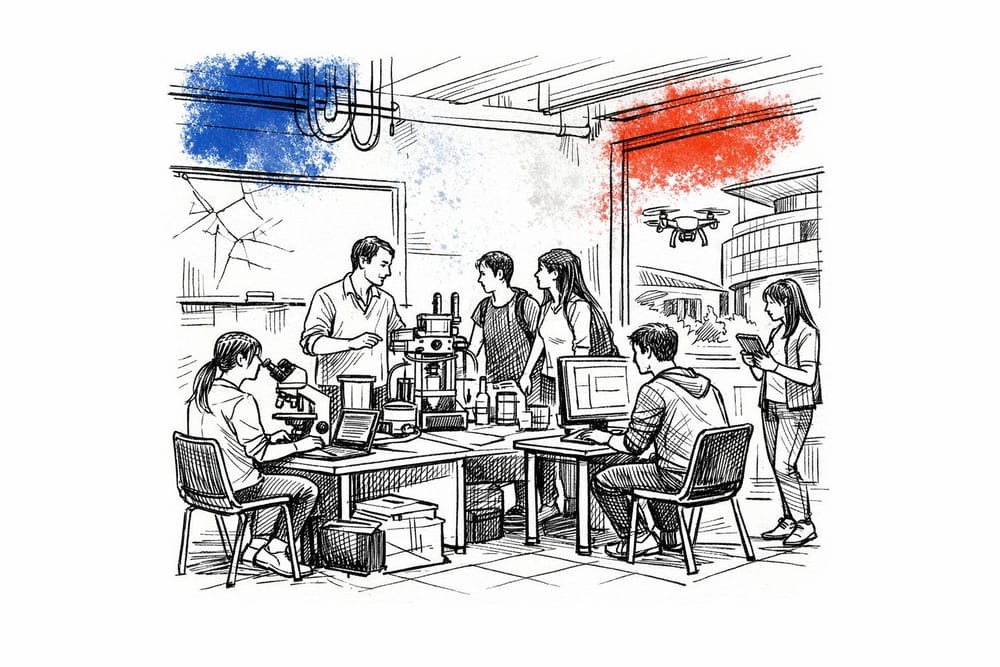
To move from an economy that imitates to one that invents, you need autonomous universities financed based on their research results. France does the opposite: it spends more where it matters least, and leaves its mass universities in a tight spot while global technological competition accelerates. This is the choice that 2027 must name: shift allocation authority from the ministry to institutions, or maintain centralized steering that guarantees equal treatment at the cost of initiative.
Why France’s position makes underinvestment particularly costly
The mechanism matters before the numbers. Philippe Aghion and Élie Cohen established in their report to the Economic Analysis Council that higher education does not have the same effect depending on the country’s technological position [4]. A country far from the frontier can learn from others and grow through imitation. A country close to it must invent. Its universities no longer merely transmit codified knowledge: they produce researchers capable of working where nobody yet has answers.
France is in this second case. The European innovation scoreboard 2025 ranks Sweden, Denmark, the Netherlands and Finland at the top; France figures in the group just behind, the “strong innovators,” with performance above the European average [9]. Close to the frontier, then, but moving away from it. Philippe Aghion stated this finding during a debate organized by Les Echos in February 2026: “plainly, there is a European technological lag.” In this lag, France illustrates a specific case: it spends more than average in education overall, but underinvests where innovation happens.
What total spending conceals
In 2024, education spending represents 6.8% of French GDP, and the state finances 55% of the total [1]. The figure looks generous. It is not in the right places.
For elementary education, France spends $10,550 per student at purchasing power parity, against an OECD average of $11,900 [2]. The gap is clear, and it matters: school inequalities widen early, and research establishes that foundational learning shapes future trajectories. Between 2012 and 2019, per-student spending in higher education fell by 0.4% on average each year [9]. During this time, preparatory classes for the Grande Écoles absorbed 19,070 euros per student, against 12,460 euros per university student, according to DEPP data in 2024 [1]. Nearly 7,000 euros annual difference, to the benefit of programs that already train the better-endowed.
R&D follows the same logic. Domestic research and development spending reached 2.18% of GDP in 2023, above the European Union average (2.14%), but well below the OECD average (2.7%) [9]. The gap comes from the private sector.
Public administrations spend 0.76% of GDP on R&D, slightly above the OECD average (0.71%); companies spend 1.44%, against 1.76% on average in the OECD [9]. Antonin Bergeaud, economist at HEC Paris, put this lag in perspective during a debate at ENS-PSL in July 2025: Israel devotes 6.3% of its GDP to R&D, South Korea 5%, the United States 3.4% [12]. France at 2.2% is not in the same category.
A model built to transmit, not to invent
The French university was designed to train civil servants and middle management. The Grande Écoles model, parallel and competing, captures the best students and the highest public credits per capita. This funding gap of nearly 7,000 euros per year is a perpetuated political choice, not an anomaly [1]. It doubles up excellence tracks while leaving mass universities stretched thin.
Neither the Grande Écoles nor universities have real budget autonomy to direct their resources toward breakthrough research. Aghion states it directly: growth based on innovation can be hindered by insufficient educational systems, limited competition, and poor public policies [4]. In France, all three conditions meet in higher education: insufficient relative funding, absence of competition between institutions for research resources, centralized steering that inhibits initiative.
The teacher recruitment crisis completes the picture. In 2024, primary school teachers earn on average 26% less than other graduates with higher education degrees; secondary teachers, 18% less [11]. Between 2015 and 2024, wage progression for new entrants reaches 8% in France, against 16–17% on average in the OECD [11]. The same logic depresses university careers and public research, shrinking the flow of researchers capable of working at the frontier.
Move universities to autonomous research contracts
The central lever consists in changing who decides how money is allocated, and on what basis.
Aghion established that the shift to an innovation economy at the frontier requires specific institutional changes: more investment in universities and R&D, more competition in markets, and more freedom for researchers [4]. This freedom designates a concrete architecture: the university recruits, pays differentiated salaries according to profiles, directs its teams toward risky themes, forms partnerships without prior ministerial validation.
In practice, this means replacing a fixed allocation calculated on student enrollment and civil service posts with a multi-year State-institution contract. Objectives cover research, technology transfer, and job placement. A variable portion of funding flows through competitive calls for projects. Institutions gain the ability to adjust compensation to attract rare profiles.
The state remains the principal funder, but allocation authority shifts from the ministry to institutions, and the calculation basis changes: from enrollment numbers to research results. Aghion mentioned the idea of a “coalition of the willing” among European countries to fund breakthrough projects on the model of the American DARPA [12]. The prerequisite is that partner universities can absorb and steer these funds. In their current form, they cannot.
This choice has an identifiable political cost. Rectorates lose oversight. Unions of teacher-researchers lose the guarantee of uniform treatment.
A portion of credits secured by the Grande Écoles enters open competition with universities. An added concentration risk: institutions already best endowed with initial capital, in Paris, Lyon, or Bordeaux, would strengthen their lead over less attractive territories. Explicit redistribution must be integrated into the contractual architecture to prevent autonomy from deepening territorial inequalities in place of reducing them. This is the choice that 2027 must name.
Sources
[1] DEPP, “La dépense nationale d’éducation en 2024,” Information Note no. 25.xx, MESR-DEPP, September 2025, https://www.ekole.fr/blog/la-depense-nationale-deducation-atteint-197-1-milliards-en-2024 (accessed 29/09/2026).
[2] OECD, Education at a Glance 2024, September 2024, https://www.oecd.org/content/dam/oecd/fr/publications/support-materials/2024/09/education-at-a-glance-2024_5ea68448/regards-sur-l-education-2024-version-abregee.pdf (accessed 29/09/2026).
[4] Philippe Aghion and Élie Cohen, Education and Growth, Report of the Economic Analysis Council, La Documentation française, 2004, http://ectslmd.free.fr/LMD/RapportCohen-Aghion.pdf (accessed 29/09/2026).
[9] MESR-SIES, State of Higher Education, Research and Innovation in France no. 19, June 2025, https://publication.enseignementsup-recherche.gouv.fr/eesr/FR/T027/les_depenses_interieures_de_recherche_et_developpement/ (accessed 29/09/2026).
[11] OECD, Education at a Glance 2025, September 2025, summary on salaries and attractiveness, https://www.letudiant.fr/educpros/actualite/les-salaires-des-enseignants-de-locde-sont-peu-attractifs-en-particulier-en-france.html (accessed 29/09/2026).
[12] Antonin Bergeaud (HEC Paris), intervention in AEF info debate “Research and Innovation: What are the levers to halt the technological lag of France and Europe?”, ENS-PSL, 9 July 2025, https://www.aefinfo.fr/depeche/734741 (accessed 29/09/2026).