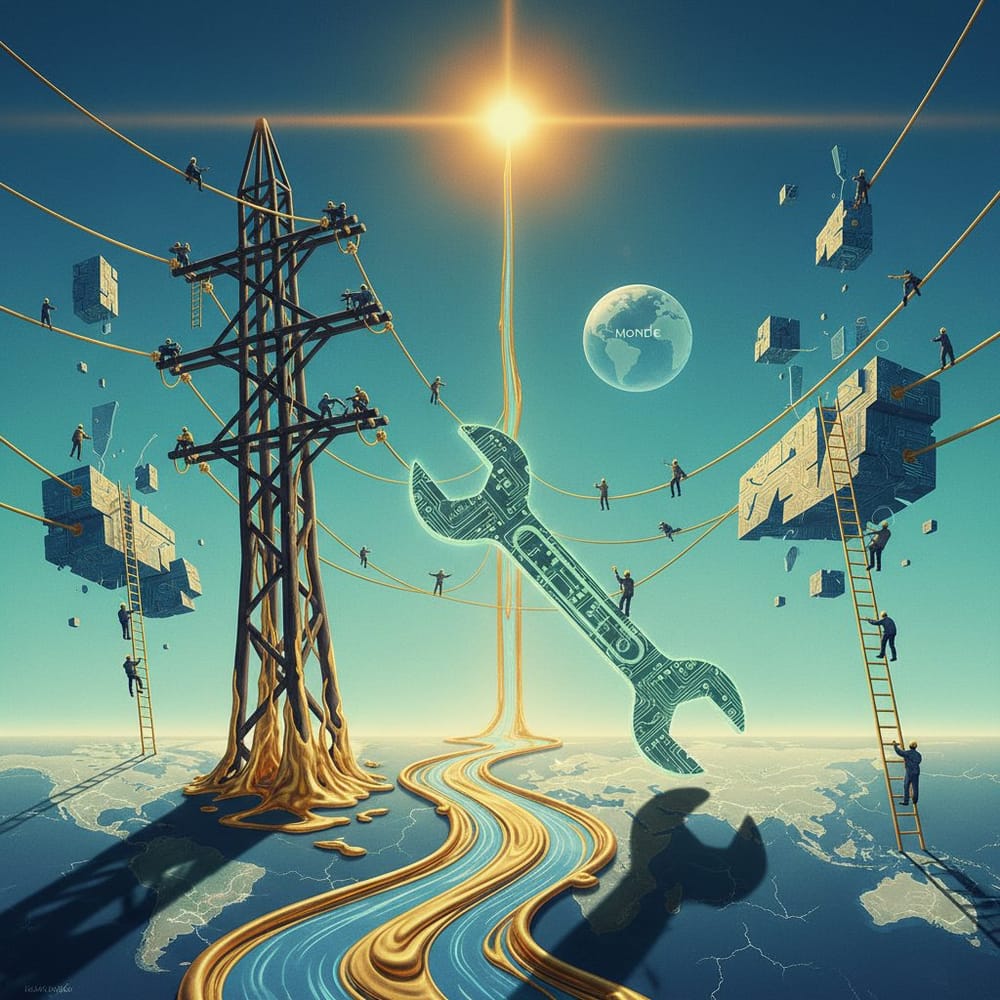
More than 60% of the 700 energy companies surveyed by the International Energy Agency in 2025 face critical bottlenecks in recruitment. This shortage of skilled workers is now slowing the massive electrification necessary for the energy transition and the development of artificial intelligence.
The digital and climate revolutions converge toward the same paradox: our most advanced technological ambitions are hitting up against the scarcity of traditional trades. This collision between high-tech and manual expertise is redefining the balance of the global labor market.
The essentials
- 60% of global energy companies struggle to recruit according to the IEA 2025
- Electrification could create 43 million jobs by 2030
- Data centers have grown by 12% per year over 5 years, approximately 75% total increase
- Europe lacks 3.5 million workers in renewable energy
Electricity needs are exploding faster than predictions
Global electricity appetite is experiencing a brutal acceleration. China will add in five years the equivalent of the EU’s electricity consumption, but it is no longer alone. The United States is forecasting a 15% increase in electricity demand by 2030, after decades of stagnation. Artificial intelligence accounts for 40% of this unprecedented growth.
Data centers now consume 460 terawatt-hours per year, or 1.8% of global electricity. This proportion will double by 2026 according to Goldman Sachs. Recent ChatGPT models use approximately the same amount of electricity as a Google search (about 0.3 Wh), but their massive proliferation amplifies overall demand.
This digital explosion coincides with the electrification of transportation and heating. 14 million electric vehicles sold in 2023 will triple by 2030. Europe wants to install 40 million heat pumps in the decade. These simultaneous transformations create an electricity demand unprecedented since industrialization.
Electricians are in short supply across all sectors
The shortage affects the entire electrical chain. Solar installers represent the fastest-growing occupation in the United States according to the Bureau of Labor Statistics, with a 52% increase projected by 2031. But training programs are struggling to keep pace. Germany lacks 200,000 electricians to achieve its renewable energy goals.
In France, the Capeb association counts 80,000 unfilled positions in building trades, of which 40% concern electrical work. Energy renovation requires specialized skills: installing charging stations, integrating solar panels, connecting domestic batteries. These technical skills require two to three years of training, which cannot be compressed.
The phenomenon extends beyond Europe. India plans to train 1 million electricians by 2030 to electrify its rural areas. South Africa estimates its needs at 300,000 additional technicians to modernize its aging grid. Even China, despite its massive training capacity, reports tensions in specialized electrical trades.
Salaries are skyrocketing and disrupting traditional hierarchies
Scarcity is driving compensation through the roof. A qualified solar electrician earns $65,000 per year in the United States, 20% more than in 2020. In Germany, offshore wind technicians earn €70,000 annually, exceeding some engineers. This inversion of traditional salary hierarchies reveals the new geography of critical skills.
Companies are multiplying signing bonuses. Tesla offers $30,000 bonuses to recruit electricians at its battery factories. EDF offers permanent contracts before the end of apprenticeship to electrical apprentices. Some American companies fully fund training, with guaranteed employment for five years.
This wage escalation is finally attracting young people. Enrollment in electrical trade schools is growing 15% per year in France since 2022. In the United States, community colleges see their electrical programs filling up. The prospect of high salaries without student debt is appealing to a generation burned by promises of the all-university route.
Automation does not replace human dexterity
Paradoxically, the age of automation reinforces the need for manual skills. Installing a solar panel on a roof requires constant adaptation, reading of complex plans, and solving unpredictable problems. These tasks resist robotization, unlike standardized office jobs that AI is massively transforming.
New electrical equipment even demands more qualification. Solar inverters integrate sophisticated software. Charging stations communicate with smart grids. The modern electrician must master electronics, information technology, and digital diagnostics, in addition to traditional skills.
This hybridization of trades complicates training. Apprenticeships now last three years instead of two. Technical centers struggle to update their equipment. Training on technologies that evolve every six months poses unprecedented pedagogical challenges. Some manufacturers are creating their own schools to control the adequacy of training to needs.
States mobilize the arsenal of accelerated training
Faced with urgency, governments activate all levers. The Biden administration is unlocking $16 billion to train 2 million energy workers by 2030. Europe is offering €35 billion in its REPowerEU plan for green skills. China is opening 500 new technical training centers per year since 2023.
These programs prioritize speed over comprehensiveness. Intensive six-month training programs are replacing traditional three-year curricula for certain specializations. Australia is experimenting with modular micro-credentials: solar panels, onshore wind, domestic batteries taught separately and then combined according to needs.
Immigration is also becoming a lever. Germany is facilitating visas for non-European electricians with accelerated diploma recognition. Canada is launching a special “green trades” program in its immigration policy. These emergency measures shake up traditional corporatism but respond to the time pressure of the transition.
The shortage is redefining industrial geography
This human constraint is already influencing industrial location choices. Battery manufacturers favor regions with developed technical schools. Tesla is installing its gigafactories near technical universities. CATL, the Chinese battery giant, is making its European investments conditional on the creation of local training centers.
Some regions are turning this constraint into a competitive advantage. Bavaria is investing heavily in its Fachhochschulen to attract Germany’s green industry. Texas is developing its energy community colleges to capture national solar investments. This race for skills is redrawing the global industrial map.
Territorial synergies are emerging. White hydrogen discovered in Moselle could benefit from the local industrial fabric and its existing technical training. Regional ecosystems combining resources, expertise, and specialized training are gaining an advantage over centralized strategies.
Global electrification thus reveals its profoundly human dimension. Beyond gigawatts and investments, it is millions of expert hands that will determine the actual pace of our energy and digital transitions.