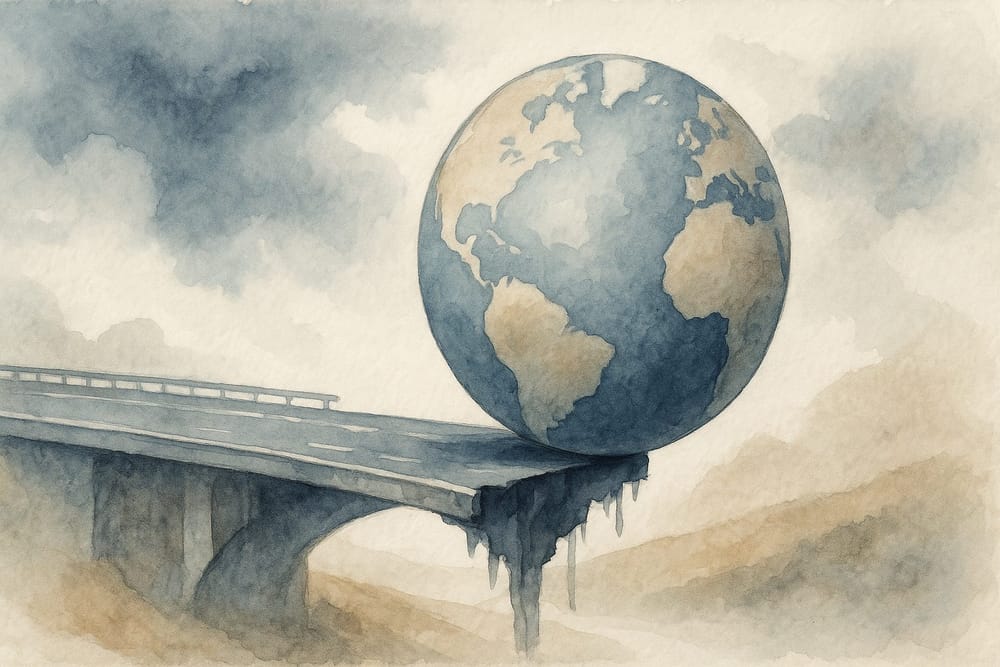
In 2026, the Panama Canal recorded increased demand for passage slots. This figure illustrates a limit of commercial resilience models: when multiple chokepoints tighten simultaneously, the remaining straits risk becoming overload points. Global maritime trade relies on a handful of passage points, each seemingly substitutable, until several close at once. Simultaneous disruptions across multiple chokepoints in 2026 demonstrated propagation effects between rerouting flows.
The essentials
- Simultaneous disruptions across multiple chokepoints trigger interactions between rerouting flows.
- Auction premiums at the Panama Canal reached elevated levels in 2026, revealing rapid market integration of scarcity (S&P Global Market Intelligence).
- Commercial traffic in the Strait of Hormuz contracted according to the WTO: disruptions rippled across other maritime chokepoints.
- The WTO’s forecast of 1.9% commercial growth for 2026, following observed growth of 4.6% in 2025, quantifies what resilience models underestimated: interdependence is a vulnerability multiplier as much as a safety net.
- By 2035, three trajectories emerge—Arctic passage, Eurasian rail, supply chain regionalization—but none alone replicates the capacity, reliability, and cost of current routes.
Four straits, one variable: simultaneity
The WTO forecasts 1.9% growth in global merchandise trade in 2026, following observed growth of 4.6% in 2025. The slowdown stems from several factors, including transport disruptions.
Global trade geography rests on four nodes. The Suez Canal carries roughly 12% of global trade. The Panama Canal connects the Atlantic and Pacific for comparable volumes. The Strait of Hormuz is the valve for Gulf oil. The Strait of Malacca is the gateway to Southeast Asia.
In isolation, each disruption is absorbable: shipowners reroute, insurers adjust, shippers pay a premium.
In 2026, all four chokepoints came under pressure: geopolitical tensions for Hormuz, climate variations for Panama, regional instability for Suez, and congestion for Malacca. This simultaneity changed the nature of the problem. Disruptions at one chokepoint generate demand surges diverted to other passages.
Classical resilience models typically treat disruptions as distinct events and do not capture interactions between chokepoints. They calculate the availability of each node separately, then infer systemic capacity from that. But saturation of one strait preloads the others.
When demand for slots at Panama increases rapidly, auction premiums rise sharply: slot supply is rigid in the short term and competition among shipowners intensifies.
The elevated price levels in 2026 reflect this supply rigidity.
Premium mechanics reveal crisis pricing
S&P Global reported capacity restrictions and increased pressure on passage slots at the Panama Canal in 2026. For a shipowner whose vessel carries raw materials or intermediate goods, this premium adds to the cost of rerouting, fuel surcharges, delay penalties, and higher insurance premiums.
The sum quickly exceeds the absorption capacity of normal commercial margins. Small operators—regional shipowners, medium-sized shippers—forgo priority passage and lengthen their routes. In doing so, they increase their fleet idle time, reduce their annual number of rotations, and compress profitability. Large operators pay the premium and pass the increase to their customers. Both mechanisms reduce the efficiency of the maritime transport system.
This pricing reveals that the system operated for decades on the assumption that alternative routes absorb shocks at reasonable cost. The 2026 simultaneous disruptions across multiple chokepoints showed that alternative routes exist, but their capacity and costs face the same physical constraints as main routes.
Interdependence as multiplier, not insurance
Edward Fishman, in his work on weaponizing economic interdependence, describes a mechanism illustrated by the 2026 maritime crisis. When critical nodes—whether financial, technological, or logistical—serve as pressure levers, their closure propagates a shock wave through the entire system dependent on them. Interdependence, perceived as a guarantee of stability because it made disruptions costly for everyone, becomes a transmission vector for the shock.
The distinction matters. Fishman analyzed primarily deliberate economic weapons: sanctions, export controls, exclusion from the SWIFT system. The 2026 maritime chokepoints are not all products of conscious strategy. The drought that reduced Lake Gatun’s level, which feeds the Panama Canal, is not a geopolitical decision. But the systemic result is identical: closure or disruption of one node can overload others, particularly when multiple chokepoints are affected simultaneously.
A competing reading deserves serious consideration. Economists like Dani Rodrik argue that the concentration of global trade on a few routes and nodes reflects a globalization that optimized costs without integrating resilience. The 2026 cascade could reveal a crisis in commercial structure itself: too concentrated, too little redundant. Solutions would then not be logistical—finding new routes—but structural: reconfiguring who produces what and where.
The two analyses need not exclude each other. Fishman describes the shock transmission mechanism; Rodrik questions the conditions for its emergence. The WTO’s 1.9% forecast for 2026 is consistent with both readings. It says the system was struck harder than expected. It does not say whether the answer is geopolitical or structural.
The forecasting limits of supply chains
Companies managing complex supply chains typically have continuity plans for one disruption at a time. A failing supplier, a closed route, a congested port: scenarios are modeled, alternatives identified, safety stocks calibrated. The 2026 cascade showed that disruptions can produce propagation effects across interconnected supply chains.
A classical risk model calculates the probability that Panama is closed, then the probability that Hormuz is closed, and treats them as distinct events. But disruptions at one chokepoint can generate demand surges diverted to other passages. The model underestimates risk when multiple disruptions affect multiple chokepoints simultaneously.
The practical consequence is visible in cost data. For Shenzhen–Rotterdam, rerouting around the Cape of Good Hope lengthens the distance by roughly 30%, from 10,000 to 13,000 nautical miles according to UNCTAD. This distance surcharge compounds with passage premiums if the shipowner tries other routes, with tariff increases in saturated ports, and with delays that desynchronize production chains. Total costs reinforce each other when multiple chokepoints are disrupted simultaneously.
For industrial shippers—electronics components, chemicals, intermediate goods—this desynchronization is sometimes more expensive than the freight premium itself. A production line halted because a batch of components is three weeks late generates losses that do not appear in maritime freight statistics but weigh on quarterly results and investment decisions.
Three trajectories for 2035, none without conditions
The 2026 situation may be transitory or structural. If geopolitical tensions and climate variations normalize, the system could regain its usual fluidity. Conversely, if multiple pressures become durable, the constraint changes character.
Three trajectories emerge by 2035, each with its own conditions.
The first is the Arctic passage. Melting ice progressively opens a route between Europe and Asia. But this route is reliable only a few months per year, it requires expensive reinforced vessels, and it depends on near-nonexistent port infrastructure. Access also depends on geopolitical considerations.
Seasonal extension of this route remains conditioned by climate evolution.
The second trajectory is the Eurasian rail. Railway corridors between China and Europe, supported by the Belt and Road Initiative, saw their volumes increase during the period of maritime disruption. Rail offers predictability that maritime no longer guarantees in periods of stress. Its limits are well known: cost higher than maritime for large volumes, limited capacity, dependence on political stability in transit countries. It suits high-value-added, low-volume goods—electronics, pharmaceuticals—not commodities and mass containers.
The third trajectory, and probably the most profound, is partial regionalization of production chains. Bringing production sites closer to consumption markets mechanically reduces exposure to distant maritime chokepoints. This is the logic of nearshoring that several companies accelerated after 2020. It does not eliminate the need for maritime trade; raw materials remain extracted where they are found, but it reduces the share of flows dependent on critical chokepoints. This trend is documented, notably in the industrial trade-offs Europe is beginning to make on its value chains.
None of these three trajectories eliminates risk alone. The Arctic depends on climate and geopolitical factors. Rail is limited in volume for mass flows. Regionalization is a long process. Their combination reduces risk exposure without eliminating it.
State levers in facing shipowners
Companies absorbed the costs of the 2026 cascade in dispersed fashion, each seeking its own solution. This dispersal is inefficient: it reproduces the same costs in parallel across many actors.
The public response to this situation employs several instruments. The first is information: real-time chokepoint monitoring systems, like those S&P Global PortWatch has developed, allow congestion anticipation a few days before it becomes critical. This information gain reduces emergency decisions, the costliest ones. The second instrument is infrastructure diversification: financing alternative port capacity, supporting cross-border rail corridors, investing in Arctic fleets. These investments are long-term and costly; they will not find private financing without stable public signals.
The third instrument is diplomatic. Several pressures on chokepoints had geopolitical origins. The resilience of global trade also depends on multilateral cooperation on international passages, a domain where current tensions complicate action. It is also the dimension Fishman emphasizes: weaponization of interdependence unlocks more easily through diplomacy than logistics.
The costs of the 2026 cascade were either visible and concentrated enough to force resilience investments, or they will be diluted in financial statements and forgotten in the next period of fluidity. The history of global supply chains shows that crisis memory is short. The geography of chokepoints remains.
Sources
- S&P Global Market Intelligence, Maritime Chokepoints Tighten, Global Supply Chain Risk Rises (April 2026)
- BCG / ION Analytics, Panama Canal auction data, median premiums and peaks 2026 (cited via S&P Global Market Intelligence)
- UNCTAD, Review of Maritime Transport 2024 (distance data and rerouting surcharge costs)
- WTO, Global Trade Outlook and Statistics, March 2026 (commercial growth revision 2025-2026)
- Edward Fishman, Chokepoints: American Power in the Age of Economic Warfare, Penguin Press, 2024