Hollywood Divides Over Creative Automation: 42,000 Jobs Lost in Two Years
42,000 jobs have disappeared from the Los Angeles entertainment industry between 2022 and 2024, representing 30% of the workforce according to the Bureau of Labor Statistics. This hemorrhaging is accelerating as studios experiment with synthetic actors promising 90% savings on salaries and generative AI automates screenplay writing in hours instead of months.
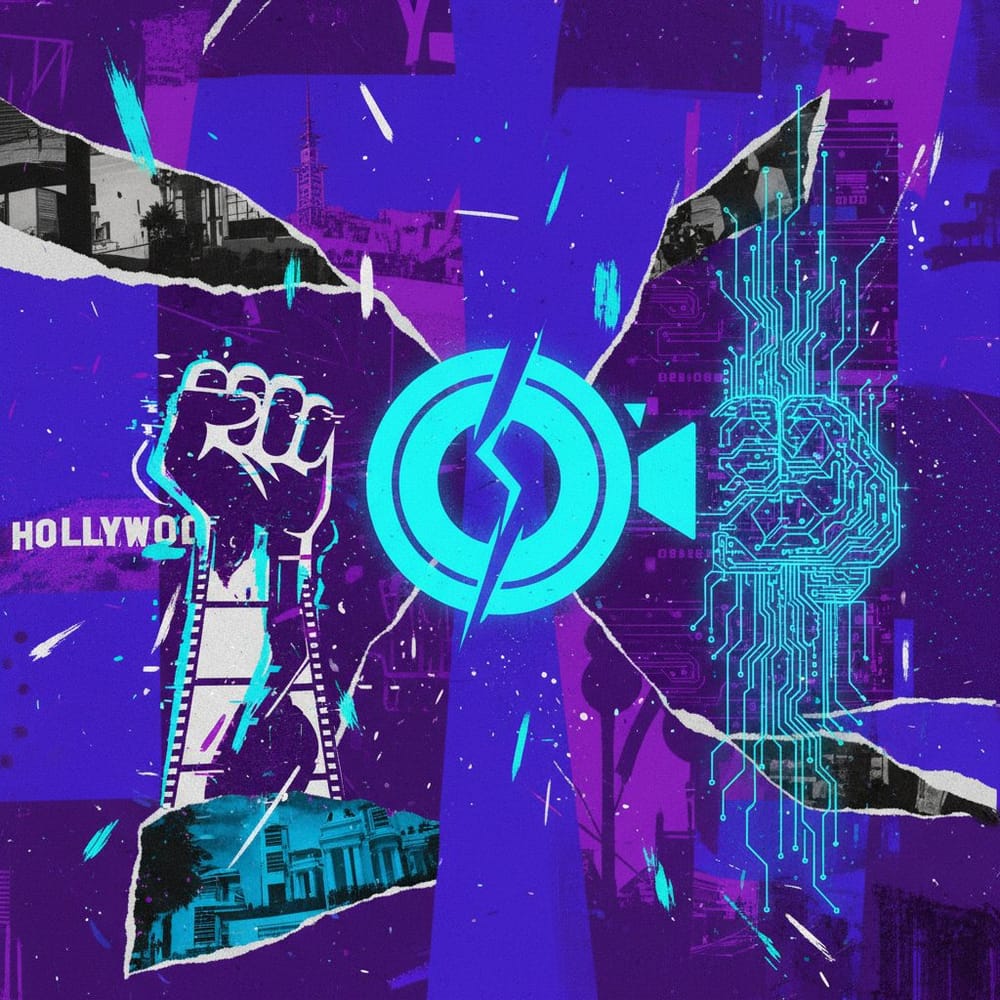
The American film industry is experiencing an unprecedented fracture. On one side, majors like Sony and Paramount are investing heavily in creative automation. On the other, unions are organizing structured resistance around preserving human work. This dichotomy is redefining the very nature of artistic creation and raises questions about authenticity in a sector that has always sold dreams and emotion.
The Essentials
- 42,000 jobs eliminated in entertainment in Los Angeles between 2022 and 2024, affecting 30% of the workforce
- Synthetic actors reduce production costs by 90% according to initial studio estimates
- SAG-AFTRA obtains contractual protections for its 160,000 members but 70% of technical jobs remain exposed
- Netflix invests $500 million in creative AI over three years to automate post-production and writing
Netflix and Sony Automate the Complete Creative Chain
Netflix announced a $500 million investment over three years to develop creative AI tools covering the entire production chain. The platform is already testing post-production automation, reducing the editing of a series from 6 months to 3 weeks. Initial results show equivalent technical quality at costs reduced by a factor of 8.
Sony Pictures has taken an additional step by deploying synthetic actors across three pilot productions. These digital avatars, created from performance captures of consenting actors, promise a 90% reduction in casting costs. The studio can now produce content 24/7 without scheduling constraints or geographic limitations.
Automated writing is simultaneously transforming writers’ rooms. Disney is experimenting with generative tools capable of producing a first screenplay draft in 48 hours, versus 3 to 6 months traditionally. These AIs rely on analysis of thousands of successful scripts to identify optimal narrative structures based on genres and target audiences.
SAG-AFTRA Secures Its Stars, Abandons Extras
The actors’ union SAG-AFTRA obtained unprecedented contractual protections during the 2023 strike. Lead actors now have veto rights over the use of their digital image and mandatory compensation for each synthetic reuse. These guarantees cover the union’s 160,000 members but effectively exclude 400,000 extras and non-union actors.
This two-tiered protection creates a new professional hierarchy. Established stars see their value reinforced by the artificial scarcity of their protected image. Emerging actors and extras face direct competition with synthetic alternatives costing 10 times less.
The Writers Guild of America (WGA) adopts a different strategy by negotiating a “creative supervisor” status for its members. Screenwriters can no longer be replaced by AI but become responsible for directing and validating automatically generated content. This evolution transforms the profession of author into a creative quality control function.
70% of Technical Jobs Vulnerable to Automation
Technical jobs represent the majority of job cuts. Editing, color grading, visual effects, and sound post-production are automating rapidly thanks to advances in specialized AI. Adobe and Autodesk are developing integrated software suites that eliminate the need for intermediate technicians on 70% of post-production tasks.
This automation particularly affects Los Angeles, which concentrated 140,000 technical jobs before the crisis. Studios are simultaneously relocating operations to states offering more advantageous tax credits, accelerating local deindustrialization. Despite its tax advantages, Georgia experienced a 40% decline in productions in 2024 compared to 2023, illustrating the sector’s volatility.
Technical service companies are adapting by repositioning their teams on supervising automated processes. Industrial Light & Magic is training its 2,000 employees to become “AI directors” capable of piloting creative algorithms rather than manually executing visual effects.
Human Authenticity Becomes a Premium Commercial Argument
Paradoxically, creative automation valorizes human authenticity as a marketing argument. A24 and Neon, art film distributors, now communicate their “100% human production” to differentiate themselves from content generated en masse by majors. This strategy targets audiences sensitive to creative craftsmanship.
AI agents move into production but four out of ten projects risk failure in other sectors, suggesting that creative automation could experience similar setbacks. Algorithmic creativity excels at optimizing existing formats but struggles to generate genuine narrative innovations.
Audiences show nuanced reception of synthetic content. Preliminary tests reveal high acceptance for automated visual effects but persistent resistance to entirely synthetic actor performances. This reluctance could limit massive adoption of digital avatars for lead roles.
Independent Studios Exploit the Technological Advantage
Creative AI paradoxically democratizes film production by drastically lowering financial barriers. Independent studios now produce feature films for $50,000 versus $5 million traditionally, by automating 80% of technical processes.
This democratization disrupts the distribution of creative power. Platforms like TikTok and YouTube see emerging creators capable of producing cinema-quality content from home. Netflix observes a sixfold multiplication of original content submissions since the accessibility of generative tools.
The creative economy polarizes between premium productions betting on human authenticity and automatically generated content produced en masse at low cost. This bifurcation echoes the evolution of the music industry where artisanal artists coexist with algorithmically generated music.
Adaptation is not limited to the United States. Bollywood is already automating 60% of its post-production while Chinese studios are developing synthetic actors specifically trained on local aesthetic canons. This global technological race accelerates the uniformization of creative standards at the expense of regional cultural specificities.
Transformation is accelerating with the arrival of GPT-5 and new multimodal models capable of simultaneously generating coherent images, sounds, and texts. By 2027, the industry could see the birth of the first entirely automated films, from writing to post-production, requiring only minimal human supervision for overall artistic direction.