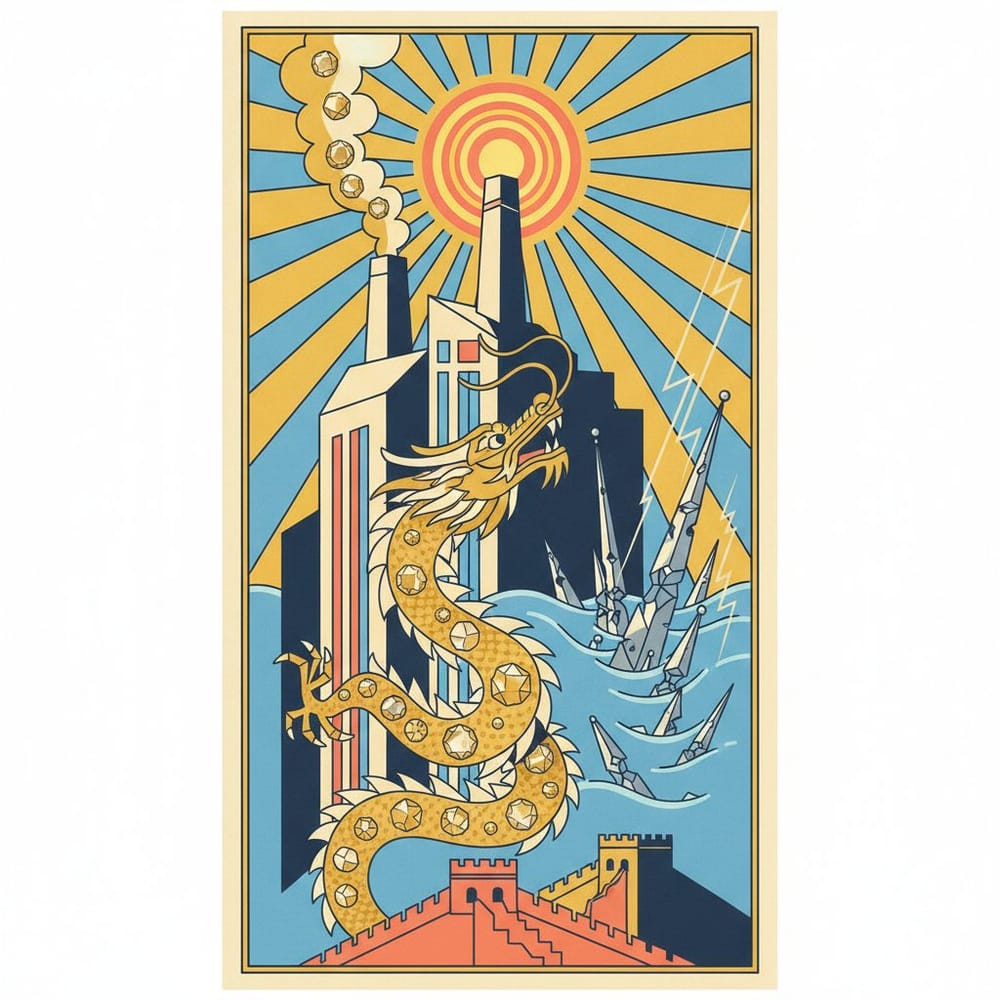
Chinese universities shape the geopolitical future of rare earths
China trains a significant number of engineers specialized in rare earths each year at several universities dedicated to these critical minerals. The West has no equivalent program.
This educational asymmetry transforms Chinese lecture halls into instruments of geopolitical domination. By massively training experts in a sector it already controls 70% of for extraction and 90% for refining, Beijing consolidates its advantage over 17 chemical elements essential to solar panels, wind turbines, and electric vehicles. While the West discovers its dependence, China prepares the next generation of its engineers to maintain this domination.
The essentials
- Several Chinese universities train a significant number of graduates per year in rare earth sciences and engineering, compared to zero dedicated programs in the West
- China controls 70% of global rare earth production and 90% of refining
- Many laboratories specialized in these minerals operate within the Chinese university system
- Rare earths are essential to green technologies: solar panels, wind turbines, electric vehicle batteries
An academic machine without Western equivalent
Beijing University of Science and Technology alone trains a substantial number of graduates per year in rare earth metallurgy. Jiangxi University produces a significant additional number. Beijing Normal University, Dalian University of Technology, and several other institutions complete this academic pipeline that produces annually more specialized engineers than the West has in total.
These programs combine inorganic chemistry, extractive metallurgy, and separation processes. Students learn to extract neodymium from bastnäsite deposits, to separate europium from terbium, to refine dysprosium to 99.9% purity. Their training covers the entire value chain, from geological prospecting to the recycling of permanent magnets.
The Institute of Applied Chemistry in Changchun, attached to the Chinese Academy of Sciences, coordinates this training with numerous specialized laboratories. Each cohort of students works on real industrial projects financed by Baogang Steel, China Northern Rare Earth Group, or Xiamen Tungsten. This proximity between university and industry ensures that academic research directly feeds commercial innovation.
The West trains generalists in a field of specialists
Western universities treat rare earths as an optional chapter in general metallurgy. École des Mines Paris devotes 20 hours of lectures to these elements in a three-year curriculum. MIT includes a 15-hour module in its materials science program. Imperial College London offers an optional quarterly seminar.
No European or North American university offers a master’s degree dedicated to rare earths. The few Western researchers specialized in this field are self-taught or trained… in China. University of Colorado employs three professors who master lanthanide separation. Aalto University in Finland has two. These trivial numbers contrast with the significant number of Chinese professors and lecturers referenced in this field.
This academic neglect reflects 30 years of Western underinvestment. When China began dominating the market in the 1990s by selling its rare earths below Western production costs, American and European universities closed their specialized laboratories for lack of market outlets. Molycorp, the last American company in the sector, went bankrupt in 2015. With it disappeared the industrial funding that fed university research.
A research ecosystem serving state industry
Chinese specialized universities collectively publish a significant number of scientific articles per year on rare earths, representing a substantial share of global production in this field. Their researchers hold a significant portion of international patents filed since 2020 on extraction and refining processes.
This intellectual output does not constitute fundamental research. Beijing University develops in-situ leaching processes to reduce the environmental impact of extraction. Jiangxi University perfects ion exchange separation techniques that make it possible to achieve purities greater than 99.99%. Dalian University of Technology works on recycling rare earths contained in end-of-life wind turbines.
These innovations directly benefit Chinese state enterprises. China Northern Rare Earth Group, which controls the Bayan Obo deposits in Inner Mongolia, employs a significant number of graduates from these universities. China Minmetals Rare Earth, a subsidiary of the giant state-owned mining company, recruits a substantial number each year. This circulation between university and industry allows China to constantly improve its processes while training the next generation of experts.
Western retaliation stumbles over the skills deficit
The United States launched a $2.9 billion investment plan in 2022 to relocate the rare earth value chain. The European Union budgeted 1.7 billion euros in its Critical Raw Materials Act. These funding efforts stumble over the absence of technical expertise.
MP Materials, which operates the California Mountain Pass mine, struggles to recruit engineers proficient in rare earth separation. The company calls on Chinese consultants to optimize its processes. Lynas Rare Earths, an Australian group that owns the only Western refining plant in Malaysia, employs 15 engineers trained in China among its 45 technical managers.
This technological dependence limits the effectiveness of Western investments. While China refines rare earths with yields exceeding 95%, new Western facilities cap out at 80%. This performance difference translates to production costs 30% higher, compromising the economic viability of relocation projects.
Educational weaponry in service of economic diplomacy
China exploits its academic advantage to strengthen its geopolitical alliances. The Belt and Road Initiative finances scholarships for African and Latin American students in its specialized universities. Brazil, Kazakhstan, and the Democratic Republic of Congo each send a number of students per year to train in China.
These graduates return to their countries with technical expertise and Chinese professional networks. When their governments launch mining projects, they naturally turn to Chinese companies and technologies. University training thus becomes an instrument of soft power that secures access to global deposits.
This strategy is bearing fruit. China now controls 70% of rare earth projects under development outside its territory. Its companies exploit deposits in Myanmar, Australia, Brazil, and Greenland. This expansion relies largely on networks of former students trained in its universities.
The West facing the dilemma of lasting dependence
Western relocation programs cannot bear fruit for 10 to 15 years, the time needed to train a new generation of engineers and build industrial facilities. Until then, dependence on China will only increase with the explosion in demand linked to the energy transition.
The International Energy Agency forecasts that global rare earth needs will triple by 2030 due to the massive deployment of renewable energy. This growth in demand will mechanically strengthen China’s position, its competitors having neither the production capacity nor the technical expertise to respond to this explosion in needs.
Faced with this reality, some Western countries are exploring educational partnerships with China. Australia is negotiating exchange programs between its universities and those in Beijing. Canada is studying the creation of jointly funded research chairs. These initiatives reflect implicit recognition that China’s advantage can only be narrowed by relying, paradoxically, on Chinese expertise itself.