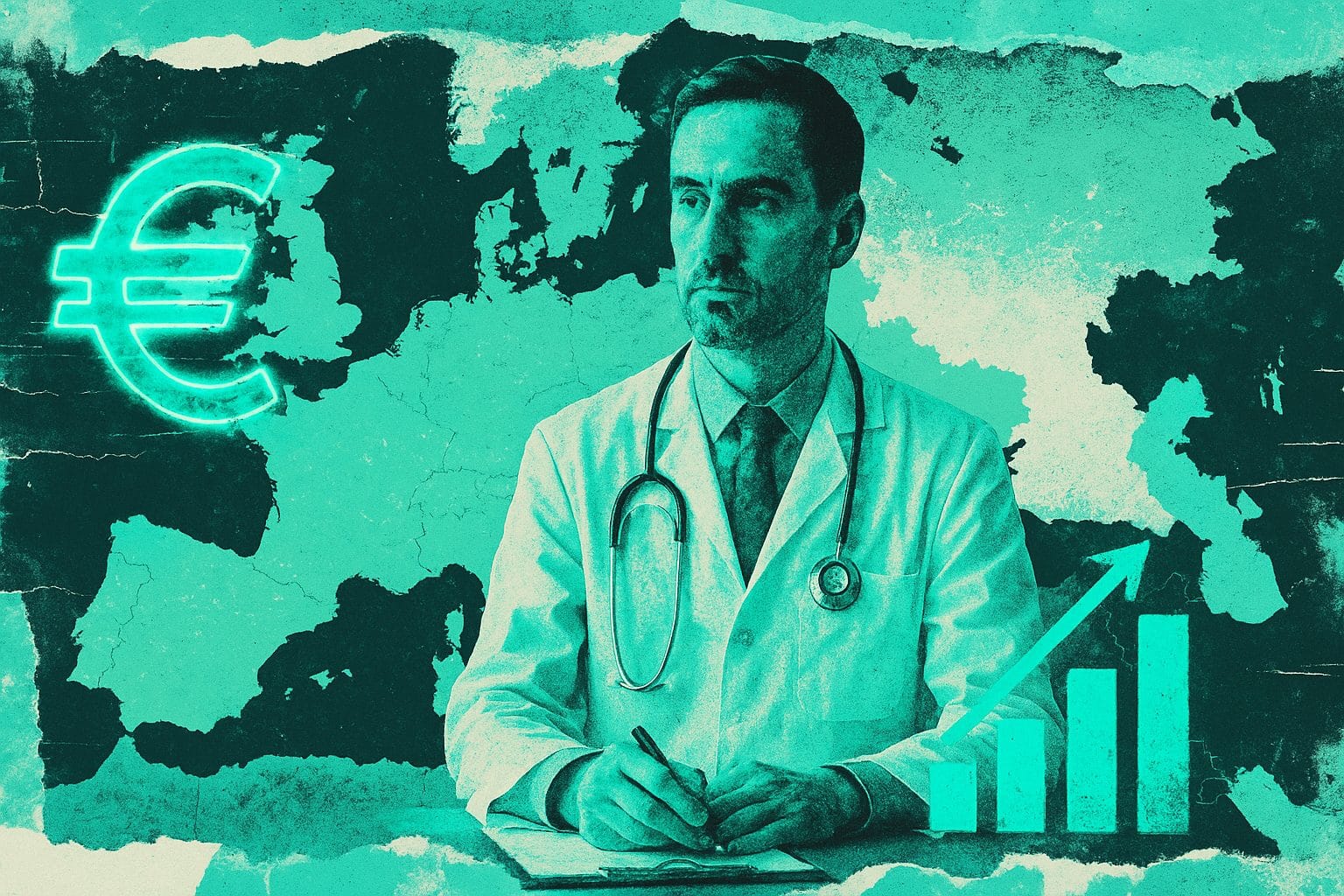
Only 42% of global deaths have sufficiently reliable information on their causes to guide public health policies. This massive statistical blindness hampers efforts against the leading causes of mortality and reveals the scale of the challenge that global health governance faces in vast regions of the world.
This lack of knowledge about causes of death particularly handicaps sub-Saharan Africa and South Asia, where death registration systems struggle to cover their populations. But emerging technological innovations are emerging to fill these critical gaps.
The Essentials
- 68% of countries register at least 90% of their deaths, but fewer than half have usable causes
- Sub-Saharan Africa shows the lowest coverage rates: 10% of deaths properly documented
- Digital verbal autopsy and artificial intelligence now allow identification of causes of death with 85% accuracy
- The WHO is launching a $280 million program to modernize civil registration systems in 75 priority countries
The Statistical Blind Spot That Weakens Global Health
The numbers reveal the scale of the problem. According to the WHO’s estimates updated in 2024, only 68% of countries manage to register at least 90% of their deaths. Worse still: among those who properly register deaths, fewer than half have information on causes precise enough to guide public policies.
This gap disproportionately affects the most vulnerable regions. Sub-Saharan Africa properly documents only 10% of its deaths with an identifiable cause, compared to 95% in Western Europe. The gap is also widening within countries: rural and poor populations are massively escaping health surveillance systems.
The consequences go beyond simple accounting. Without knowing the leading causes of mortality, governments allocate their limited health resources blindly. Bangladesh, for example, discovered in 2023 that cardiovascular diseases were killing three times more than expected in its rural areas, calling into question decades of priority investments in fighting infectious diseases.
When the Absence of Data Kills More Than Disease
The impact of this statistical blindness is measured directly in human lives. Adair-Lopez research published in 2024 demonstrates that countries with reliable registration systems reduce their infant mortality twice as fast as others. The reason lies in the precision of interventions: knowing the exact causes of death makes it possible to target investments where they save the most lives.
Ghana illustrates this mechanism. Before 2018, the country estimated that malaria caused 40% of infant mortality. The installation of a verbal autopsy system in 120 districts revealed that neonatal complications actually represented 52% of deaths of children under five. This discovery justified a massive redeployment of trained midwives: neonatal mortality fell by 31% in three years.
Conversely, ignorance of the real causes of death perpetuates wrong priorities. India long concentrated its efforts on tuberculosis, convinced that it was the leading cause of adult mortality. The gradual improvement of registration systems has been revealing since 2020 that cardiovascular diseases now kill twice as many people as tuberculosis, forcing a belated reorientation of prevention policies.
Digital Verbal Autopsy Revolutionizes Detection of Causes of Death
Facing this blindness, technological innovations are transforming mortality surveillance. Digital verbal autopsy, developed by the Institute for Health Metrics and Evaluation (IHME), makes it possible to identify causes of death without physical autopsy. A standardized questionnaire, administered via smartphone to bereaved families, feeds artificial intelligence algorithms capable of determining the probable cause of death with 85% accuracy.
This method revolutionizes surveillance in areas where doctors remain rare. In the Democratic Republic of Congo, 2,400 community agents equipped with tablets have documented 180,000 deaths since 2022, revealing that infectious diarrhea was killing 40% more children than the WHO’s projections estimated. This data justified an emergency drinking water distribution program that saved 15,000 children’s lives in 18 months.
Artificial intelligence further accelerates the process. Google Health algorithms, tested in Kenya since 2023, directly analyze audio testimonies from families in local languages. They identify key symptoms and propose a probable cause in less than 10 minutes, compared to several hours for a doctor. Accuracy reaches 89% for adult deaths and 76% for infant mortality.
Global Investment in Civil Registration Systems Finally Accelerates
International donors are finally grasping the stakes. The WHO has just launched a $280 million, five-year program to modernize birth and death registration systems in 75 priority countries. The goal: reach 90% coverage with identified causes by 2030.
The World Bank complements this effort with a $150 million fund dedicated to digitizing civil registration records. Eighteen African countries have already adopted unified platforms that connect health centers, mortuaries, and civil registry offices. Senegal, a pioneer in this approach, went from 23% to 78% of documented deaths in four years.
Public-private partnerships are multiplying experiments. Microsoft and USAID are testing a voice recognition system in Nigeria that automatically transcribes death declarations in local languages. Philips is developing wearable sensors with the African Union that detect critical vital signs and automatically alert surveillance systems in case of death.
This financial mobilization reflects a late but decisive awareness. Algorithmic management is being imposed silently in many sectors, but mortality surveillance remained surprisingly analog. Automating registration systems could close this gap in a decade.
Cultural and Political Resistance Slows Transparency
Despite these technological advances, major obstacles are slowing the improvement of surveillance. Cultural resistance first: in many societies, autopsy remains taboo and families refuse to reveal the exact circumstances of a death. In Mali, 60% of families surveyed still refuse to answer verbal autopsy questionnaires, particularly for deaths related to maternal causes or HIV.
Governments themselves sometimes slow down transparency. Documenting the exact causes of death reveals the failings of health systems and can embarrass authorities. Tanzania suspended its verbal autopsy program in 2023 after data revealed that maternal mortality was three times higher than official figures. This censorship deprives the country of crucial information to improve its rural maternity facilities.
Economic issues also complicate the picture. Precisely identifying causes of death costs between $15 and $45 per death depending on the country, or an annual budget of $2 to 6 million for a country of 50 million inhabitants. These amounts remain marginal compared to health budgets, but they directly compete with curative care in already underfunded systems.
Pandemic Surveillance Requires Reliable Mortality Data
The Covid-19 pandemic brutally revealed the geopolitical consequences of this statistical blindness. Countries unable to document their deaths lost all credibility in international bodies. Sub-Saharan Africa, which only traced 12% of its Covid-related deaths according to the WHO, found itself marginalized in discussions about vaccine and treatment allocation.
This lesson is now transforming global health priorities. The new International Health Regulations, adopted in May 2024, require all member states to document at least 80% of their deaths with identified causes by 2028. Countries that fail to achieve this objective will lose access to WHO emergency health funds.
Anticipating future pandemics depends directly on these surveillance capacities. The epidemiological models that guide global policies remain blind in regions where mortality is not documented. An emerging pandemic in Central Africa could spread for months before being detected by international systems.
Current investments in surveillance explicitly aim at this objective. The U.S. CDC funds 40 biosecurity laboratories in Africa, but their effectiveness depends on local death registration systems to detect early warning signals.
This interconnection reveals the strategic stakes of mortality surveillance. In a world where the spiral of debt interest is weakening American hegemony, the United States is banking on its technological advantage in health surveillance to maintain its influence in global health governance. The AI systems developed by American tech giants are becoming tools of health soft power.
The transformation of this blind governance into effective surveillance will determine the balance of global health powers in the coming decade. Countries that master these data systems will weigh more in international decisions than those who remain ignorant of their own mortality.
Sources
- WHO Global Health Estimates and Adair-Lopez Research 2024
- World Health Organization, Global Health Observatory
- Institute for Health Metrics and Evaluation (IHME), University of Washington
- World Bank, Civil Registration Modernization Program