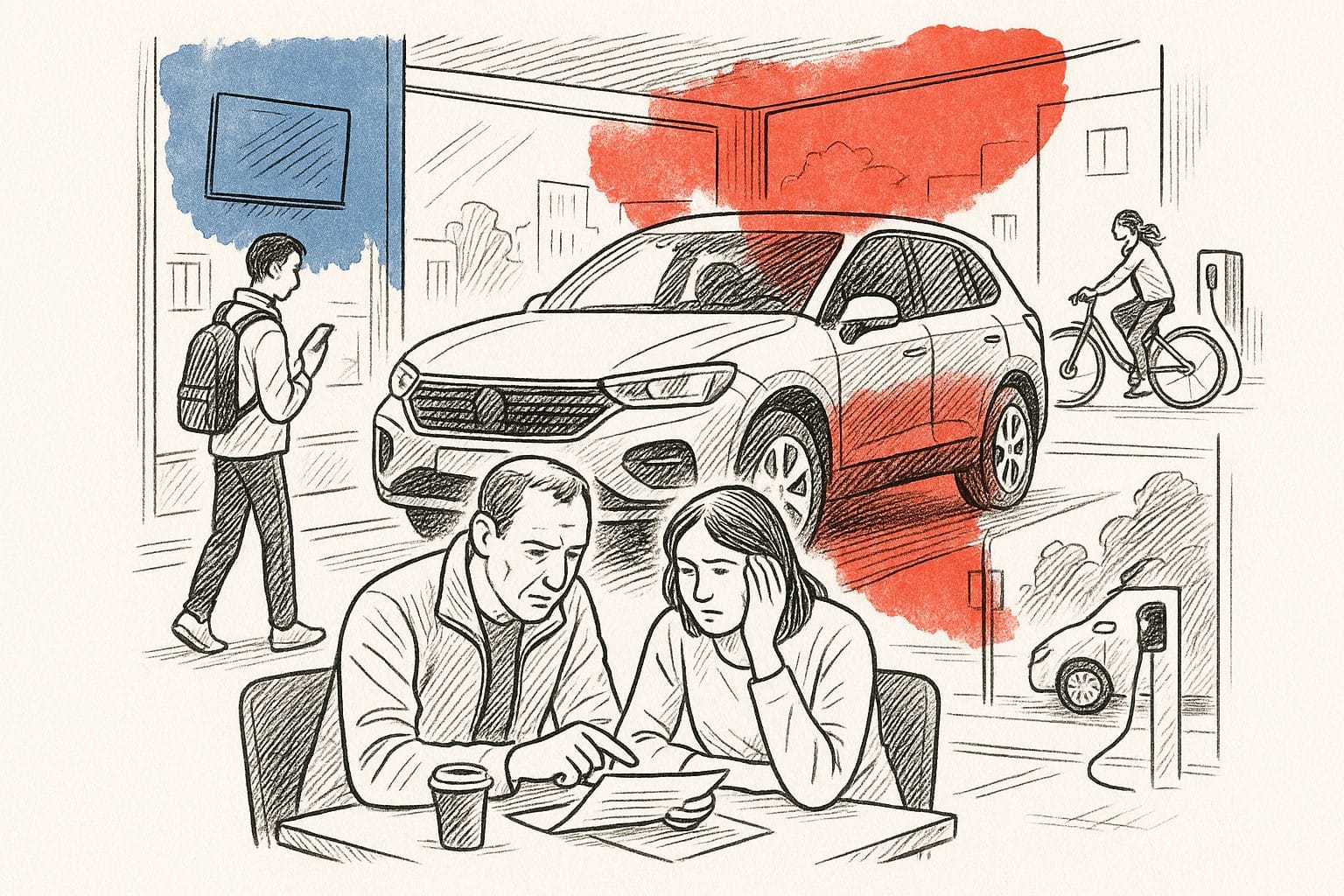
In Paris, bicycles now account for 11.2% of trips compared to 4.3% for cars. This is not a projection, nor a policy objective: it is a measurement from the Institut Paris Région’s Public Mobility Survey (2022-2023). Furthermore, researchers from the Technical University of Munich have analyzed the impact of cycling policies on Paris automobile traffic flow, and their study, published in 2026 in Transportation Research Record, arrives at a conclusion that is both straightforward and politically difficult to address: the reallocation of public space has worked technically.
Parisian bicycle traffic has increased very significantly in recent years. Overall congestion, meanwhile, has not increased. These two facts together constitute something rare in urban debate: a natural experiment whose results are measurable, replicable, and troubling for everyone at the same time.
The Essentials
- Bicycles account for 11.2% of trips in Paris compared to 4.3% for cars, according to the Institut Paris Région’s Public Mobility Survey (2022-2023)
- Parisian bicycle traffic has increased substantially in recent years without an increase in overall congestion, as confirmed by a study from the Technical University of Munich published in Transportation Research Record in 2026
- The City of Paris has eliminated approximately 60,000 parking spaces and reduced automobile circulation on several major axes since 2014
- The study leaves open the question of the model’s transferability to medium-sized cities and peripheral areas, where the car remains a structural constraint, not a choice
Munich Researchers Without Bias
The study by Elena S. Natterer, Allister Loder, and Klaus Bogenberger is interesting precisely because it comes from outside Paris. The Technical University of Munich has no agenda in the debate over Avenue de la Grande-Armée or Boulevard Saint-Germain. Its researchers used automobile loop detectors from the City of Paris—sensors integrated into road infrastructure—to analyze what happened over the 2010-2023 period using the Network Fundamental Diagram.
What they measured: automobile traffic volumes declined sharply on axes affected by the infrastructure changes, without the city’s overall congestion, measured by travel times and traffic flow indices, experiencing any clear deterioration. The hypothesis of traffic displacement, which fueled most objections to bike lanes, does not appear in the aggregated data.
This is what is significant. Not that Paris is a universal model, but that a massive urban intervention produced the effects expected by its proponents without producing the catastrophes predicted by its opponents. In public debate, this type of verdict is rare.
What Paris Has Actually Done Since 2014
The inversion of modal shares did not happen spontaneously. It is the result of deliberate, costly policy, contested at every step.
Since Anne Hidalgo’s election in 2014, the city has eliminated approximately 60,000 on-street parking spaces, converted several major axes into boulevards with reduced circulation or closed to motorized vehicles, and built a bicycle lane network exceeding 1,000 kilometers today. The 2021-2026 Bike Plan, approved in 2021, provides for 250 million euros of investment over five years to densify the network and secure intersections—50 million more than the previous plan (150 million for 2015-2020).
The Vélo RER (VIF – Île-de-France Bike), which aims to connect municipalities adjacent to Paris to central Paris, was officially launched in November 2020. It represents the most ambitious bet: continuous, wide axes, physically separated from traffic, designed for cruising speeds of 20 to 30 km/h. Several sections are operational. Some show usage rates exceeding initial projections in the first seasons.
What makes the Parisian experience instructive is not its scale, but its sequence: the reduction of automobile space came before bicycle growth, not after. The city made the bet that supply would create demand. Data from Natterer and colleagues suggest the bet was sound.
Congestion Did Not Shift: What This Says About Classical Models
Objections to urban redesign favoring active modes have long rested on a simple model: if you reduce road capacity, cars that can no longer find their usual route seek another path, saturate parallel roads, and overall congestion remains identical or worsens. This theory, sometimes called “induced traffic” in reverse, was used for ten years to contest every lane removal.
Paris data do not validate this scenario. Several hypotheses explain why. The first is suppressed latent demand: a significant fraction of motorists, faced with degraded driving conditions or reduced parking spaces, simply abandoned the car trip. Some switched to public transit, others to bicycles, still others consolidated their trips or eliminated them entirely. This phenomenon, documented in other European cities, is sometimes called “evaporated traffic.”
The second hypothesis concerns Paris’s specific characteristics: a public transit density among Europe’s highest, a metro network covering nearly all of central Paris, and a compact geography that makes bicycles mechanically competitive for a large fraction of trips. The median distance for a home-to-work trip in central Paris is less than 5 kilometers. At this distance, bicycles are often faster than cars during rush hour.
These conditions are not found everywhere. This is the crux of the problem.
What Paris Cannot Teach Others
The temptation, after publishing a study like Natterer’s, is to conclude that the Paris model is exportable. This would be a misreading.
Paris is an exceptional city in the statistical sense. Its population density (over 20,000 residents per km²), its public transit network, its relatively flat geography in central arrondissements, and its concentrated economic fabric make it an atypical case among French cities. Lyon, Bordeaux, and Nantes have undertaken similar transformations, with encouraging results on central sections. But medium-sized cities of 50,000 to 200,000 residents, often more sprawling, with dispersed employment centers and less dense public transit, operate according to different logic.
And above all, the periphery. French peri-urban and rural zones are home to a growing share of the population, often among the least affluent. For a resident of Corbeil-Essonnes who works in Évry and earns 1,400 euros net, the car is not a lifestyle choice: it is the infrastructure that makes work possible. Opposing to them the cycling success of the 11th arrondissement is speaking of another city, literally.
This asymmetry is the real political issue that the Munich study is not meant to settle. It measures what happened in Paris. It does not say what to do elsewhere. Confusing these two registers, as both proponents and opponents of the model often do, is an analytical fault before being a political one. This same mechanism appears in other infrastructure debates: the question of who benefits from public investment and under what geographic conditions structures most of the controversies over mobility transition. The African road network illustrates the other extreme of this problem: entire regions where the absence of infrastructure prevents any mobility, and thus any development.
Actors Moving the Conversation Beyond Paris
Facing the risk of the debate being monopolized by the Paris case alone, several actors are working to broaden the framework.
Cerema, a public body advising local governments on their planning policies, has published methodological guides since 2020 for adapting bike plans to less dense urban configurations. Its work distinguishes several typologies: medium-sized cities with dense city centers and diffuse peripheries, polycentric agglomerations, rural territories with isolated employment centers. For each configuration, the levers are not the same.
ADEME finances, through its AVELO program launched in 2019 (AVELO 1) and continued in 2021 (AVELO 2), experiments in small and medium-sized cities without Paris’s profile. These territories test combinations of bike parking facilities at city entrances, subsidized electric bicycles, and feeder connections to public transit. Results are still partial, but several of these programs show adoption rates exceeding projections in middle-income brackets.
At the national level, the State has pursued the “Bike and Active Mobility Plan” since 2018, initially funded with 350 million euros over five years, then renewed. Funding from the Active Mobility Funds allows local governments to co-finance their cycling infrastructure. This mechanism has enabled cities of very different sizes to launch programs that would not have been financially accessible otherwise.
These programs do not solve the peri-urban question. They show, however, that the answer to this question is being actively sought, and that the debate is no longer that of 2015, which often boiled down to a stark opposition between pro-bike and pro-car camps.
The Real Issue Is Not Technical, It Is Distributive
What emerges from reading the Munich study, seen in perspective with the reality of French mobility, is not a question of engineering but of political priority.
The reallocation of urban space in Paris worked for populations living in Paris who can choose their mode of transport. It was financed by public investment and carried by clear political will. It produced measurable positive externalities: less local pollution, fewer accidents involving cyclists on improved axes, reduced CO2 emissions from trips.
But mobility in a developed country is not only a major metropolitan problem. France has 35 million private vehicles, the vast majority of which are used in conditions where no credible alternative exists in the short term. Any additional investment in cycling infrastructure in city centers responds to a reality. It does not erase the other one.
The question the study implicitly poses is this: how can one design a mobility policy that improves travel conditions in metropolises without worsening the sense of abandonment in peripheral territories? This tension is not unique to France. Amsterdam, Copenhagen, and Utrecht have built exemplary cycling networks in their centers while continuing to invest massively in regional rail links for commuters who cannot bike to the office.
The models do not oppose. They complement each other. But this complementarity requires simultaneous investments, coordination between levels of government, and political acceptance that solutions are not identical from one territory to another. This is precisely the type of articulation most often missing from national mobility debates, where each camp tends to impose its answer as universal.
The Technical University of Munich study resolves an empirical question. It opens another, more difficult one: at what scale, for whom, and under what conditions can the model be generalized? French medium-sized cities experimenting right now may have more to teach on this point than Paris.
Sources
- Natterer, E. S., Loder, A., Bogenberger, K. (2026). Transportation Research Record (SAGE Publications). https://journals.sagepub.com/doi/10.1177/03611981251356507
- Institut Paris Région – Public Mobility Survey (EMG) 2022-2023. https://www.institutparisregion.fr/mobilite-et-transports/deplacements/enquete-regionale-sur-la-mobilite-des-franciliens/
- City of Paris – Trip Assessment 2024. https://www.paris.fr/pages/le-bilan-des-deplacement-a-paris-en-2024-31371
- City of Paris – Bike Plan 2021-2026 (official document). https://cdn.paris.fr/paris/2021/12/08/2fc9cb8ad6db58b6bfde3e6ccfc4c48c.pdf
- City of Paris – Parking Reform (60,000 spaces). https://www.paris.fr/pages/reforme-du-stationnement-repenser-60-hectares-privatises-par-les-voitures-18146
- INSEE – Median Home-to-Work Distance for Parisians (5 km). https://www.insee.fr/fr/statistiques/5425974
- ADEME AVELO – Official Program Site. https://avelo.ademe.fr/
- Vélo RER / VIF – Launch November 2020. https://rerv.fr/
- City of Paris, Bike Plan 2021-2026 — data available on paris.fr
- Cerema, methodological guides active mobility, editions 2020-2024
- Ademe, Active Mobility Funds program — progress reports available on ademe.fr
- Ministry of Transport, Bike and Active Mobility Plan 2018-2022, continuation 2023