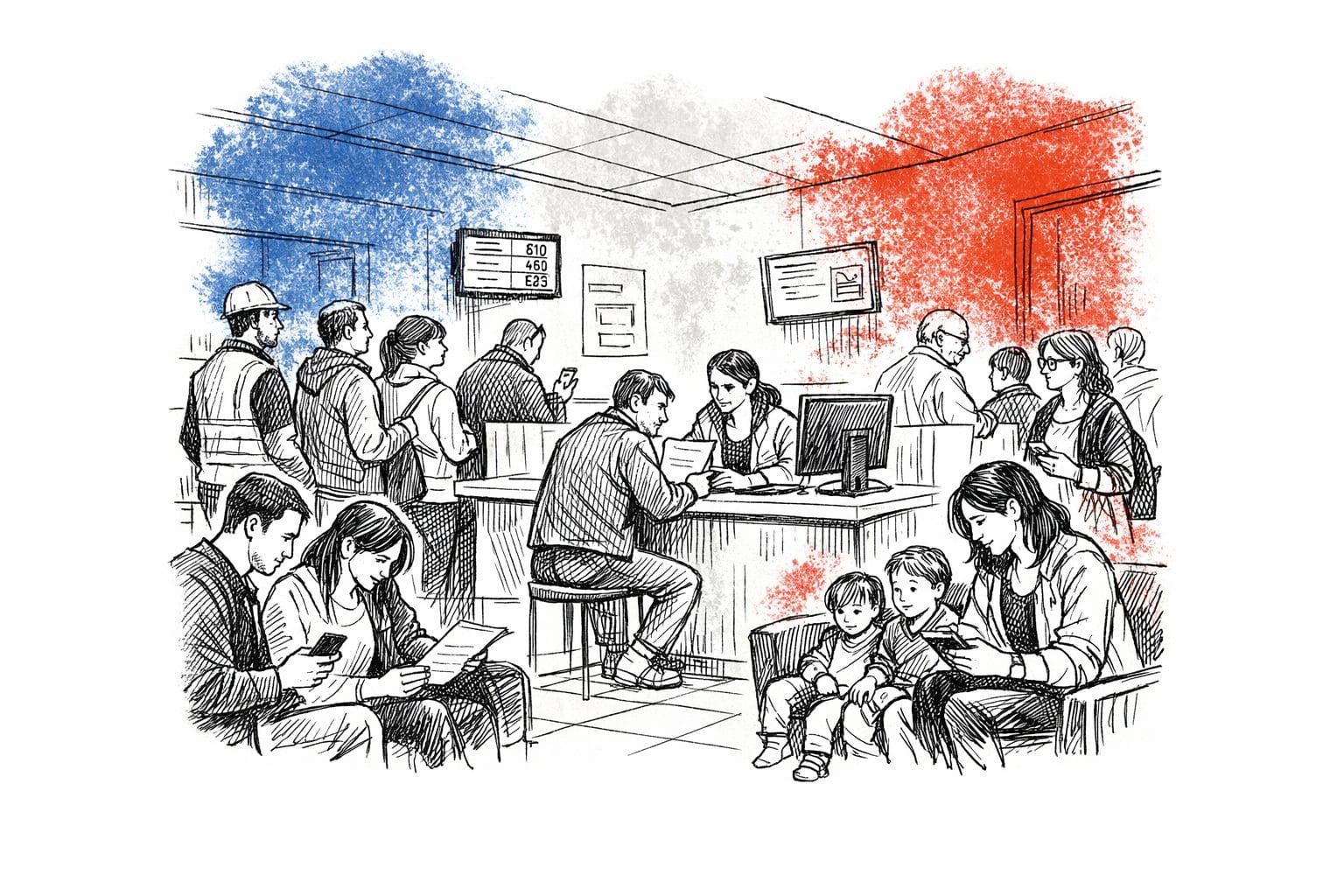
In 2024, INSEE counts 2.3 million working poor in France. This is the figure missing from the debate on purchasing power: millions of people get up every morning to go to work, and their salary is not enough to cover what they must pay before they can live.
Rent, energy, and bus fare devour the salary before anything else
The share of fixed expenses in household income has risen from 12% in the early 1960s to 28% in 2022, according to INSEE. This doubling over sixty years has not weighed equally on everyone.
For low incomes, the scale is incomparable to the national average. The poorer you are, the more these expense items represent an important part of your resources. The main items—food, housing, and transport—represent 77% of the available income of households in the first decile (the 10% poorest) but less than 20% of the available income of the richest 10%.
Translated concretely: a part-time home care worker receives approximately 900 euros net. She pays her rent, her electricity, her transport subscription, and her insurance. She has left, according to INSEE data, 260 euros per month per consumption unit for her discretionary spending: food, clothing, uninsured healthcare, everything that is not already committed by contract, compared to 1,110 euros for a household with higher incomes. Four times less to choose how to live.
Poor households whose reference person is in their thirties are most heavily constrained in their budget, since they allocate 69% of their available income to payment of pre-committed expenses, more than three-quarters of which are absorbed by housing.
Thirty years of scissors effect between rents and low-wage salaries
This is not a recent crisis. It is the result of a long-term movement. The share of consumer spending related to housing in household available income has more than doubled between 1959 and 2024, rising from 10.5% to 22.8%. In the same period, the jobs that concentrate the working poor have not evolved in their structure.
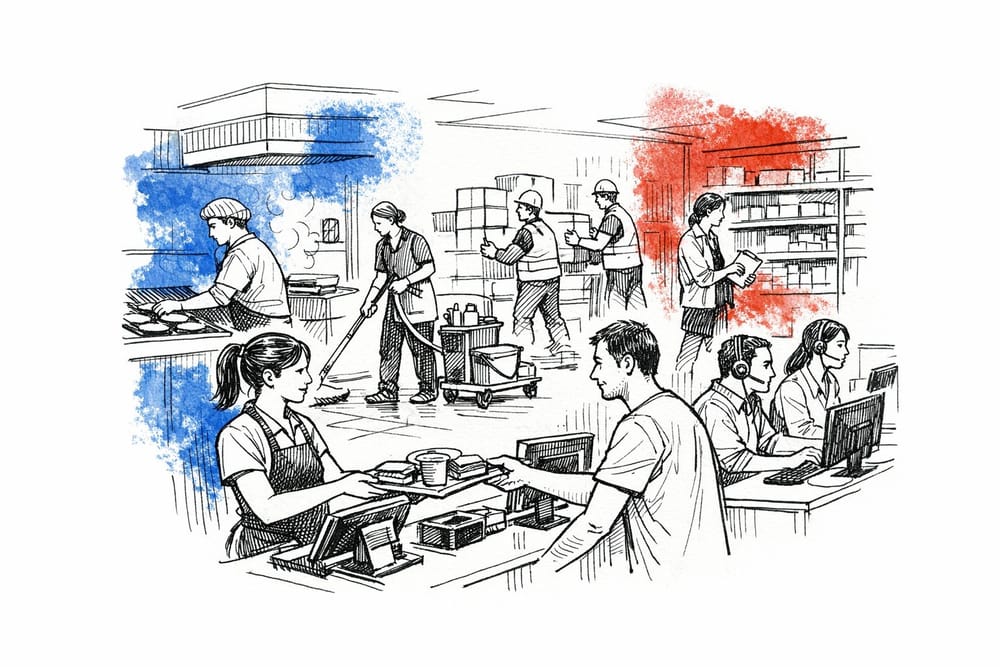
More than a third of the working poor are employed in cleaning and home care jobs. These are essential professions, massively female (women hold eight of every ten cleaning jobs) and structurally organized around involuntary part-time work. Part-time work is not a choice: it lowers monthly pay well below the minimum wage for full-time work, while maintaining fixed charges at their full level.
The number of working poor had fallen below 900,000 in 2002; since then it has grown slowly. This increase results primarily from the growth in the total number of jobs in France: and from the fact that these new jobs are concentrated precisely in low-wage sectors, with fragmented schedules and high charges.
The poverty rate has been rising in France since the early 2000s. Between 2004 and 2024, it increased from 6.8% to 8.8% at the threshold set at 50% of median living standards. Job growth has therefore not resolved working poverty. It has displaced it: toward jobs that exist but do not allow people to live.
49% of the working poor report being frequently forced to restrict their food consumption due to their financial situation. 80% had to reduce all their spending categories (medical care, heating, transportation, clothing) to continue buying groceries. Food becomes the adjustment variable for those who have nothing left to adjust.
Employment increased, working poverty also: the mechanism
Why does work no longer protect? The answer is not in the hourly minimum wage. It is in the structure of jobs created.
The monthly minimum wage for full-time work in 2024 is 1,398 euros net, above the poverty threshold of 1,337 euros. But the majority of the working poor do not work full-time. These are mainly unskilled self-employed workers with low sales, part-time employees who receive only a fraction of the minimum wage each month, or employees who work only part of the year.
To this incomplete income are added complete fixed charges. The weight of pre-committed expenses depends first on standard of living. It is heavier in total spending for poor households than for affluent households, and the gap has increased significantly between 2001 (6-point gap) and 2017: 13-point gap.
The activity bonus was created to compensate for this distortion. It is paid to 4.56 million households, covering approximately 8.8 million people. Its cost represents more than 10.6 billion euros in 2025.
This considerable sum is a transfer to modest working households. It does not change the jobs. It supplements income that the market does not produce sufficiently. And it is now in the sights of budget trade-offs, which means the only available shock absorber threatens to shrink at the moment when working poverty is spreading.
Paul Osterman, in his work on the quality of low-wage employment, documents the same logic for the United States: mobility out of the low-wage market is a chimera: too many adults remain trapped in poor-quality jobs. The activity bonus is the French equivalent of what American policy calls the Earned Income Tax Credit: an instrument that accepts the structure of jobs as a given and attempts to correct its effects at the margins.
Changing who pays what in essential service jobs
The architecture of the problem is clear: fragmented jobs in low-productivity-measured sectors, fixed charges in continuous increase, public supplements that cushion without transforming. The issue for 2027 is not to adjust the activity bonus amount up or down. It is to decide whether public authority continues to subsidize poorly structured jobs, or whether it conditions its support on the restructuring of these jobs.
Dani Rodrik, in Shared Prosperity in a Fractured World (2025), formulates precisely this requirement: tackling climate change, strengthening the middle class, and reducing poverty require structural changes. Rebuilding the middle class requires promoting good jobs. And in advanced economies, service industries are the most promising source of good jobs for the future: provided we solve the central problem: how to make them productive enough to support good wages and good conditions.
The concrete lever exists. It consists in shifting the conditionality: rather than paying 10.6 billion to households to compensate for degraded jobs, the state conditions public funding (public cleaning contracts, home care agreements, accreditations in personal services) on commitments regarding minimum hourly quotas, wage progression grids, and working conditions. This is not a rate to adjust: it is a new right made binding on those issuing orders. Large public and private buyers who outsource these services must account for the quality of the jobs they order, not only their cost.
This architecture reverses current logic: the state ceases to compensate for the negative externalities of fragmented jobs to fund them directly at their source. Providers who maintain involuntary part-time and scattered schedules would lose access to public contracts. Those who commit to decent working hours and career progression would keep it. Public spending no longer feeds the problem: it conditions it.
Sources
[1] INSEE, “Living Standards and Poverty in 2024,” INSEE First No. 2117, July 2025, https://www.insee.fr/fr/statistiques/9019316 (consulted 22/10/2026).
[2] INSEE, “Essential facts on… poverty,” 2024 data, https://www.insee.fr/fr/statistiques/5759045 (consulted 22/10/2026).
[3] France Stratégie, “Food, Housing, Transport: Who Is Most Affected by Inflation?,” Analysis Note No. 119, February 2023, https://www.strategie-plan.gouv.fr (consulted 22/10/2026).
[4] INSEE, “More than One-Third of Pre-Committed Spending for the Majority of Poor Households,” INSEE Focus No. 225, 2021, https://www.insee.fr/fr/statistiques/4764098 (consulted 22/10/2026).
[5] France Stratégie, “Pre-Committed Expenses: Nearly One-Third of Household Spending in 2017,” Analysis Note No. 102, August 2021, https://www.strategie-plan.gouv.fr (consulted 22/10/2026).
[6] France Stratégie, “Remaining to Spend and Territories,” Analysis Note No. 118, February 2023, https://www.strategie-plan.gouv.fr (consulted 22/10/2026).
[7] DREES, “Pre-Committed Expenses: What Weight in Household Budgets?,” DREES Dossiers No. 25, 2020, https://drees.solidarites-sante.gouv.fr (consulted 22/10/2026).
[8] DREES, “Living Standards and Discretionary Income,” in Minimum Income and Social Benefits 2025, https://drees.solidarites-sante.gouv.fr (consulted 22/10/2026).
[9] Andès / Ipsos BVA, 2026 Barometer of Food Insecurity Among the Working Poor, June 2026, https://andes-france.com (consulted 22/10/2026).
[10] DARES, “Cleaning Occupations: What Types of Jobs, What Working Conditions?,” DARES Analyses No. 043, September 2019, https://dares.travail-emploi.gouv.fr (consulted 22/10/2026).
[11] Observatoire des inégalités, “One Million Working Poor in France,” 2022 data, https://www.inegalites.fr/travailleurs-pauvres (consulted 22/10/2026).
[12] Observatoire de la société, “Poverty Rising for 20 Years,” March 2024, https://www.observationsociete.fr (consulted 22/10/2026).
[13] Court of Accounts, Analysis of 2024 Budget Execution: Solidarity, Integration and Equal Opportunity Mission, April 2025, https://www.ccomptes.fr (consulted 22/10/2026).
[14] Paul Osterman and Beth Shulman, Good Jobs America: Making Work Better for Everyone, Russell Sage Foundation, 2011.
[15] Dani Rodrik, Shared Prosperity in a Fractured World: A New Economics for the Middle Class, the Global Poor, and Our Climate, Princeton University Press, 2025.
[16] INSEE, “Poverty by Occupational Category,” Annual Data 1996-2024, https://www.insee.fr/fr/statistiques/3566521 (consulted 22/10/2026).
[17] CESE, “Fixed Expenses: What Impact on Household Purchasing Power?,” October 2026, https://www.lecese.fr (consulted 22/10/2026).