Kenya succeeds at the pedagogical revolution that Europe is still missing
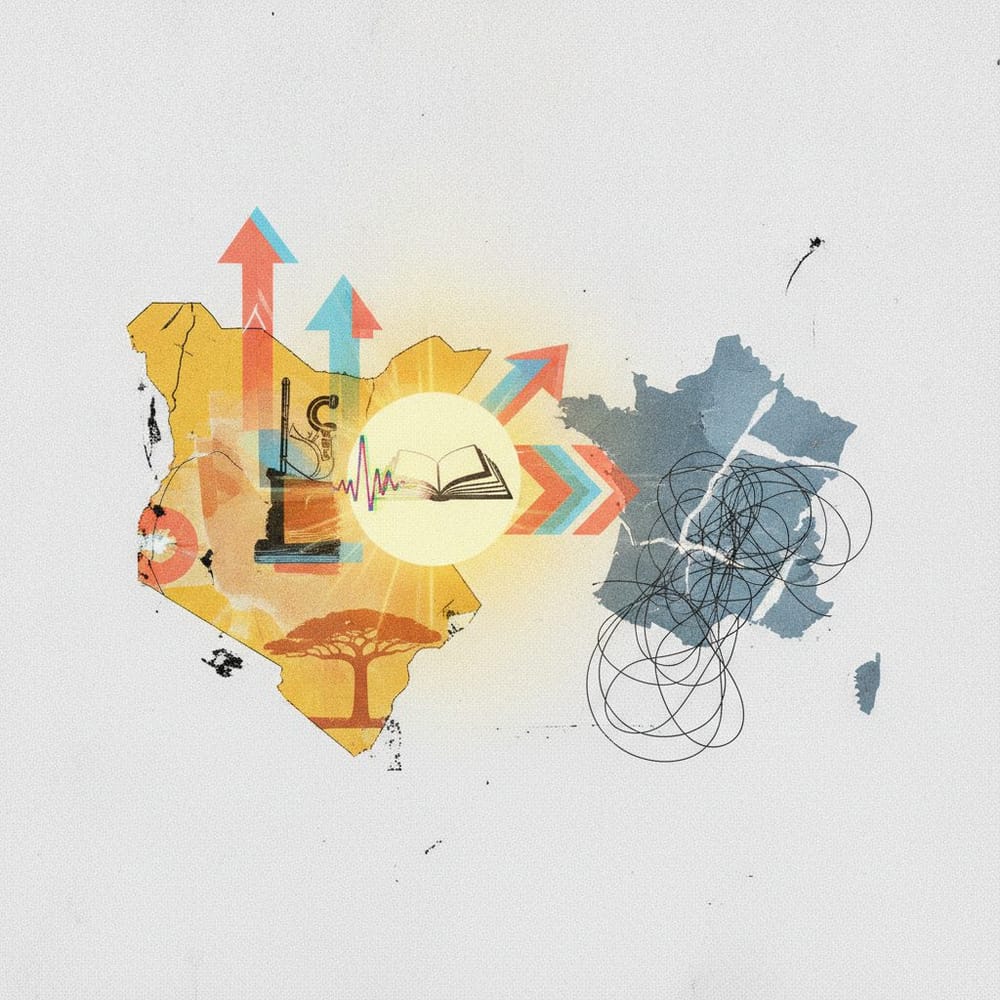
In a single year, Kenya doubled its students’ performance in reading and writing. While Europe continues to debate its learning methods, Africa is experimenting and obtaining concrete results that challenge Western certainties about education.
The Tusome program, deployed in 22,000 Kenyan schools reaching 8 million children, increased the proportion of students meeting national standards in English and Kiswahili from 30% to 60%. This performance raises questions at a time when France is still struggling to settle the debate over the effectiveness of the syllabic method and when European education systems are stagnating despite considerably higher budgets.
The essentials
- The Tusome program in Kenya doubled reading results in 22,000 schools, with these improvements occurring gradually over several years
- French-speaking Africa is testing bilingual education in national languages with 40% gains in comprehension
- These African experiments surpass European educational performance in fundamental learning
- The cost per student remains approximately 70 times lower than OECD standards while producing measurable results
When African experimentation surpasses Western theory
The Tusome program is based on a structured pedagogical approach that combines the syllabic method, standardized visual supports, and intensive teacher training. Launched in 2014 and then massively expanded, it relies on identical textbooks in each school, lessons sequenced by duration, and systematic weekly assessments. This standardization, often criticized in Europe in the name of pedagogical creativity, produces quantifiable and reproducible results in Kenya.
The Kenyan approach contrasts sharply with European methodological debates that have opposed the global method and syllabic method for decades. While France timidly experiments with a return to basics with mixed results, Kenya applies a hybrid method that works: syllabic decoding for English, a more global approach for Kiswahili, whose linguistic structure lends itself better to it. This pedagogical pragmatism allows the tool to be adapted to the language, a principle that European standardization struggles to integrate.
Teacher training follows the same logic. Instead of the long theoretical training favored in Europe, Kenya trains its teachers through practical modules lasting 5 intensive days, renewed every quarter. This approach makes it possible to quickly reach the entire teaching body and adjust methods in real time based on field feedback.
Bilingual education changes the game in French-speaking Africa
The Kenyan experience resonates with pedagogical innovations emerging throughout sub-Saharan Africa. In Burkina Faso, Mali, and Senegal, bilingual French-national languages education is transforming fundamental school performance. Students who learn to read first in their mother tongue before moving to French achieve results 40% higher in written comprehension and elementary mathematics.
This approach reverses the logic inherited from colonization that imposed French from the first year. The ELAN program (École et Langues Nationales en Afrique) demonstrates that children who first master their mother tongue more effectively transfer their cognitive skills to the second language. In Cameroon, bilingual classes in English-French-local languages produce functionally trilingual students by primary school, a rare performance in European monolingual education systems.
These African experiments are based on cognitive neuroscience research that Europe struggles to integrate into its curricula. The simultaneous activation of multiple linguistic systems strengthens abstract thinking and problem-solving abilities. While European education systems continue to debate the optimal age to introduce a second language, Africa is training multilingual generations from a very young age.
African digital education surpasses European expectations
The digital revolution amplifies these African pedagogical innovations. Rwanda is gradually digitalizing its schools but has not yet digitized the entire system, especially in rural areas. Ghana is testing adaptive learning algorithms that automatically adjust the difficulty level according to individual performance, technology more advanced than most European EdTech solutions.
This technological advantage is explained by the absence of heavy education systems to reform. While Europe painfully modernizes infrastructure inherited from the twentieth century, Africa is directly building native digital education systems. Kenya thus integrates artificial intelligence into Tusome to personalize learning paths, an innovation that European education systems struggle to deploy on a large scale.
Costs remain a decisive advantage. Training a Kenyan teacher in the Tusome program costs $200 over three years, compared to 15,000 euros for equivalent training in France. This economic efficiency allows for rapid scaling of pedagogical innovations, whereas European budgets concentrate on salaries and infrastructure without necessarily improving learning outcomes.
Persistent limitations despite successes
These African performances do not mask persistent structural challenges. The dropout rate remains high in rural areas, particularly among girls. In Kenya, 30% of students do not complete primary school, a proportion that rises to 50% in the pastoral regions of the north. Malnutrition affects 26% of school children, limiting their learning capacity even with effective pedagogical methods.
Geographic inequalities remain significant. Kenyan urban schools achieve results comparable to OECD standards, while rural schools still lag considerably. This territorial divide reproduces the disparities observed in Europe, but with larger gaps and more limited means of catching up.
International funding remains fragile. Tusome is financed primarily by USAID, not by the GPE which finances PRIEDE. This external dependence weakens the sustainability of innovations, even the most promising ones. When funding cycles are interrupted, pedagogical gains risk eroding rapidly.
Europe facing the African mirror
These African successes question the foundations of European education systems. While the OECD advocates for prudent pedagogical reforms and prolonged consultations, Africa experiments, measures, and quickly adjusts its teaching methods. This pedagogical agility produces results that European systems struggle to match in fundamental learning.
France spends approximately 10,000 euros per student in primary school according to the OECD. This raises questions about the efficiency of European educational spending, often absorbed by structural costs rather than directed toward pedagogical innovation.
Africa demonstrates that it is possible to massively transform an education system in a few years when political will is backed by proven methods. These African experiments could inspire European reforms, provided we abandon the prejudice that pedagogical innovation necessarily comes from the North.