1.5 million American management jobs risk disappearing by 2030. The reason: 60% of managers spend more than half their time on administrative tasks now automatable by artificial intelligence.
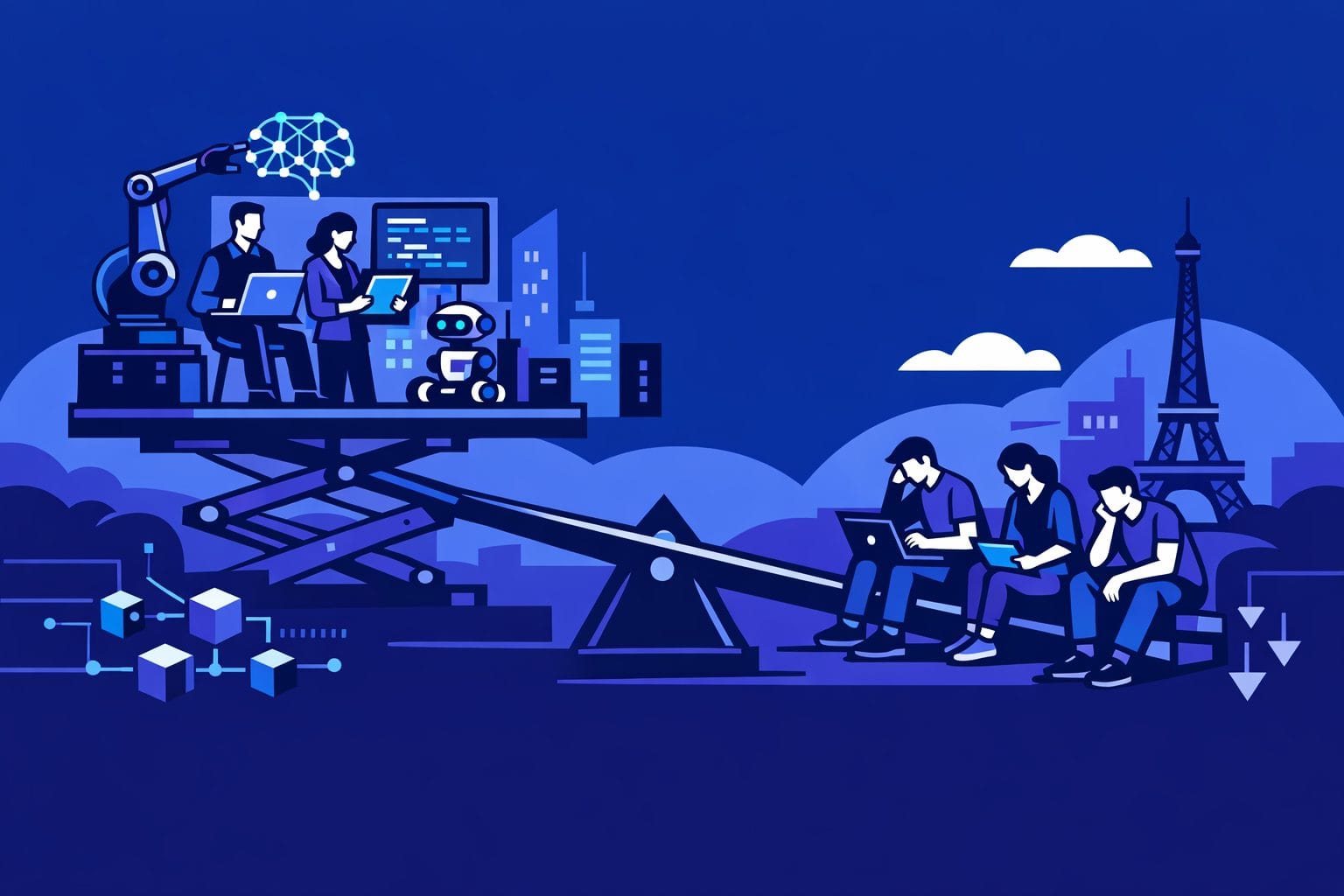
This transformation strikes at the heart of Western corporate organization. AI is no longer merely automating manual tasks — it is redefining the hierarchy itself. Middle management, a pillar of social mobility since the 1950s, becomes the first victim of a revolution that benefits the extremes.
The essentials
- 60% of managers spend more than half their time on automatable administrative tasks
- 1.5 million American management jobs threatened by 2030
- Organizational AI transforms hierarchical structure by eliminating intermediaries
- Senior leaders and workers are strengthened; middle managers are sacrificed
Automation strikes coordination more than execution
Artificial intelligence disrupts companies from the top down. Unlike previous technological waves that automated manual tasks first, AI directly attacks coordination and supervision functions.
A Harvard Business School study reveals that 60% of middle-level managers spend more than half their time on activities now automatable: report synthesis, resource allocation, performance tracking, inter-team coordination. These tasks have represented the core of their added value since the rise of large twentieth-century corporations.
Generative AI excels precisely in these domains. It processes data from multiple departments, identifies bottlenecks, proposes reallocations, drafts meeting minutes, and coordinates schedules. An algorithm can supervise 200 employees as efficiently as a three-level hierarchy.
The transformation particularly affects sectors where information flows in standardized ways: insurance, banking, logistics, human resources. JPMorganChase is already testing AI systems that manage case assignment, credit risk assessment, and inter-departmental coordination — tasks traditionally entrusted to managers.
Companies rediscover flat organization
This automation of middle management accelerates an organizational trend already underway. American companies are massively eliminating intermediate hierarchical levels to adopt flat structures where leaders interact directly with operational teams.
Amazon illustrates this evolution. The e-commerce giant operates with only four levels between Jeff Bezos and warehouse employees, compared to eight levels at General Motors in the 1980s. AI enables pushing this logic further by automating the remaining coordination functions.
Meta eliminated 11,000 positions in 2022, primarily intermediate management roles. Mark Zuckerberg publicly acknowledges this: “We’re discovering that much of the coordination work can be done by automated systems.” The company is testing AIs that automatically assign projects, track deadlines, and alert on delays.
This restructuring presents an immediate economic advantage. A manager costs an average of $120,000 per year in the United States. Replacing ten managers with an AI system represents an annual saving of $1.2 million for the company, not counting gains in decision-making speed.
But it also radically transforms the nature of work. Employees lose their usual human counterpart. They receive their instructions from algorithms, their performance is evaluated by automated systems, their careers depend on metrics calculated by AI.
The social elevator stalls in the middle
This evolution threatens one of the pillars of American society: social advancement through middle management. Since the 1950s, becoming a “manager” constituted the royal road to upward mobility for the middle classes. A skilled worker became a foreman, then team leader, then department manager.
This career path allowed one to multiply their salary by three or four without an advanced university degree. It represented the embodiment of the American dream: climbing the social ladder through merit and experience, not merely through credentials.
Automation of management breaks this mechanism. Companies retain their strategic leaders at the top and their workers at the bottom, but eliminate intermediate rungs. Professional advancement becomes binary: either one remains an employee, or one accesses management functions directly — which typically requires an MBA and an elite network.
This polarization reproduces educational inequalities within work organization. As MIT economist David Autor explains, “AI digs a chasm between complex cognitive tasks reserved for the highly educated and execution tasks for everyone else. Middle management, which allowed transition from one to the other, is disappearing.”
German co-determination resists automation better than the American labor market precisely because it maintains human countervailing powers in the organization. Employee representatives on boards of directors slow overly brutal restructurings.
The winners of the transformation: leaders and workers
Paradoxically, this organizational revolution strengthens both extremes of the hierarchy. Leaders see their decision-making power amplified by AI, which provides them with real-time analysis across the entire organization. They pilot their companies directly without intermediaries distorting information.
Managerial AI gives them access to data impossible for humans to process: individual performance of each employee, predictions about resignations, automatic schedule optimization, early detection of operational problems. They become “super-managers” with multiplied capabilities.
Execution-level employees also benefit from this disintermediation. They escape the dysfunctions of human management: favoritism, failing communication, contradictory objectives, micromanagement. AI assigns them clear tasks, evaluates their performance according to objective criteria, proposes tailored training.
In Amazon warehouses, employees often prefer receiving instructions from algorithms rather than from their human supervisors. AI does not discriminate, shows no mood, treats all employees equally according to their measured performance.
This evolution follows the digital platform model. Uber coordinates millions of drivers without intermediate managers. The algorithm assigns rides, calculates prices, evaluates performance, manages conflicts. Each driver interacts directly with the central system.
Companies test algorithmic management
The transition accelerates across all sectors. Walmart deploys AI systems that automatically manage the schedules of 1.5 million employees, optimize staff assignments based on predicted traffic, detect training needs. The company eliminated 40% of its proximity management positions in two years.
In finance, Goldman Sachs automates case allocation among traders, credit risk assessment, inter-team coordination. AI analyzes the skills of each employee, predicts their performance on different types of operations, optimizes work distribution.
Management consulting firm McKinsey estimates that 40% of managerial tasks will be automated by 2030. This proportion reaches 60% for proximity management — team supervision, project tracking, operational coordination.
But automation also generates new needs. Companies create positions for “AI managers” who supervise algorithms, interpret their analyses, manage exceptional cases. These new roles require double technical and managerial expertise — a rare profile commanding high salaries.
The challenge of middle management conversion
Facing this transformation, 1.5 million American managers must convert by 2030. Their advantage: experience with organization, coordination, leadership. Their disadvantage: skills rendered obsolete by automation.
The most adaptable move toward strategic functions: innovation, business development, change management. These domains require creativity, emotional intelligence, relational capacities that AI struggles with.
Others convert toward supervising AI systems. They become “prompt engineers,” data analysts, human-machine coordinators. These emerging professions combine their managerial experience with new technical skills.
But a portion of middle managers risks downward mobility. Those unable to convert drop to execution positions or permanently exit the labor market. This social regression would particularly affect managers over 50, less adaptable to new technologies.
Companies are beginning to anticipate this challenge. IBM offers six-month conversion programs for its managers toward AI roles. Microsoft finances training for its middle managers in new digital skills. But these initiatives remain insufficient facing the scale of transformation.
Automation of middle management illustrates a major characteristic of organizational AI: it does not merely destroy jobs, it transforms the very nature of hierarchies. This evolution questions the social organization of companies and, beyond that, the architecture of inequality in Western societies. The response will determine whether AI democratizes work or permanently deepens the chasm between governing elites and workers.