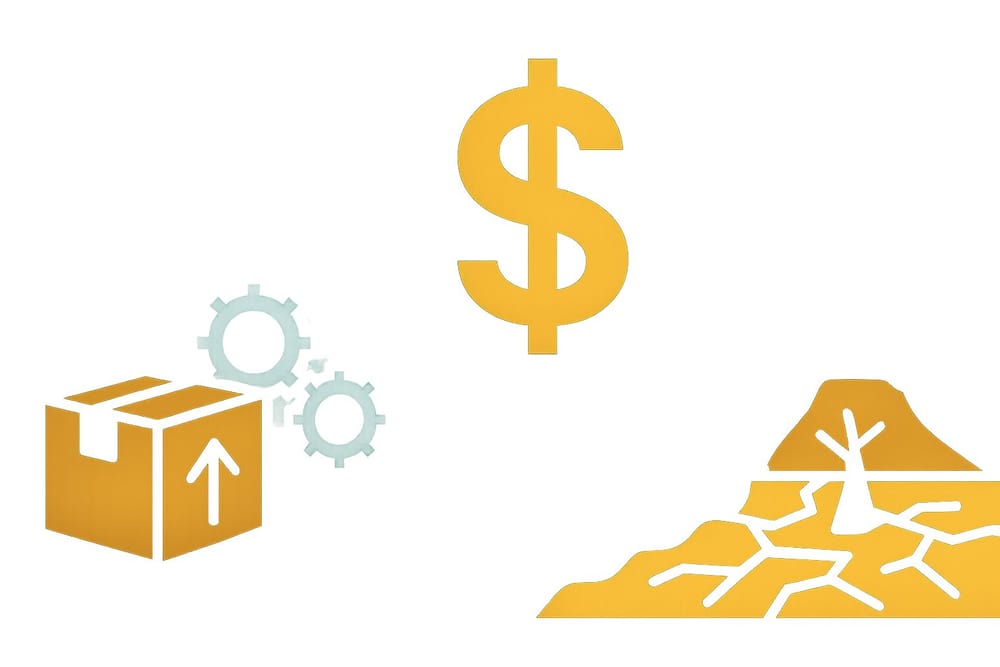
Northern Mexico has become one of the world’s most sought-after industrial destinations. In 2025, Mexico received 40.871 billion USD in total foreign direct investment, a record; several water basins in the north show moderate to severe stress. Industrial expansion and water scarcity do not yet converge in the same decision-making rooms, but they already occupy the same territory.
The essentials
- Mexico received 40.871 billion USD in total foreign direct investment in 2025, in a context of global supply chain reconfiguration following U.S.-China trade tensions, although 67.7% of the total corresponds to profit reinvestment (Secretaría de Economía).
- The food and beverage industry represents approximately 5% of volumes granted for consumptive uses at the national level, with locally significant stakes in northern regions where CONAGUA documents overexploited aquifers and increasing water stress.
- The Monterrey crisis in 2022, several weeks without running water for millions of residents, demonstrated the fragility of urban supply and the role of temporary water transfers from industry and agriculture.
- Strengthened hydrological governance is determinative for the long-term viability of industrial zones.
- Mexico can study reforms undertaken in Chile following a prolonged megadrought.
A record investment built on fragile geography
Nuevo León, Chihuahua, Baja California, Coahuila: the states of northern Mexico are hosting a growing number of factories that American, Japanese, and European companies are establishing to shorten their supply chains. The phenomenon has a name, nearshoring, and a clear driver: trade tensions between Washington and Beijing have made “all China” too risky. Mexico, within trucking distance of the United States, is benefiting directly.
The 40.871 billion USD constitutes the historical record for total foreign direct investment in 2025. The sectors establishing themselves there are capital-intensive: automotive, electronics, medical equipment, aerospace. These industries share two points in common. They create skilled jobs. And they require significant volumes of water.
Mexico’s geography creates a constraint that economic indicators do not spontaneously reflect. Northern Mexico is a semi-arid to arid region, where water was already scarce before factories arrived. CONAGUA, the federal water management agency, identifies aquifer overexploitation in several of these states. When industry demands 5% of the national resource from basins that also feed agriculture and cities, the calculation becomes tight, even without additional climate pressure.
The parallel with other emerging economies that have made the same industrial bet imposes itself. Africa produces 70% of the world’s cobalt but lets added value leave: Mexico risks a symmetrical dynamic, not on minerals but on water, drawing industrial value from a resource until its scarcity destabilizes the entire model.
Monterrey 2022: when an industrial city runs dry
The summer of 2022 provided a dress rehearsal. Monterrey, Mexico’s third-largest city and one of its industrial capitals, suffered several weeks of severe water cutoffs. Entire neighborhoods were supplied by water tanker trucks. Factories reduced production. Residents lined up for containers of drinking water.
The crisis did not come out of nowhere. CONAGUA identified drought and rapid population growth as factors contributing to the supply crisis. What struck analysts was the speed with which a metropolis of five million residents and a dense industrial fabric shifted to a serious supply crisis, requiring temporary water transfers from industrial and agricultural sectors.
The hydraulic infrastructure of the north faces simultaneous pressures linked to demographic growth, irrigated agriculture, and recent industrial expansion. The available capacity of aquifers shrinks as withdrawals accumulate.
This detail matters for understanding what is at stake now. The 2025 investment occurs within a hydraulic system already under strain, following a Monterrey crisis that demonstrated supply fragility to all stakeholders, including multinationals.
Agriculture caught between industry and drought
Competition for water in Mexico does not oppose industry to cities alone. It also opposes industry to agriculture, in basins where agricultural availability faces tensions.
Northern Mexico is an export-oriented agricultural production zone: avocados, tomatoes, peppers, pecans. These irrigated crops mobilize a significant share of local water rights, often allocated under concession regimes inherited from the 1990s. When industry arrives and negotiates its own withdrawal rights, the total sometimes exceeds the natural recharge capacity of aquifers. CONAGUA has identified several basins where overexploitation is documented, characterized by a long-term hydrogeological balance that is deficit in relation to average recharge, natural discharges to preserve, and cumulative extractions.
This mechanism is aggravated by climate change. Climate change reduces available water resources in the regions concerned. Growing pressure on available resources could result from simultaneous growth in industry and agro-exports if rules governing water rights allocation are not revised.
Emerging countries have ten years to avoid robot polarization: Mexico’s decision window on water is of the same order. Choices made between now and 2030 will determine whether nearshoring becomes a sustainable development lever or an extraction cycle that depletes its own foundation.
The Chilean lesson: fifteen years of delay costs dearly
Chile offers a case study that Mexico can examine without having to replicate it.
Chile’s model of private and market-based allocation of water rights, inherited from the 1981 water code, was long presented as a success of allocative efficiency. Water would go where economic value was highest. In practice, this meant that copper mines and large agricultural operations consolidated water rights in semi-arid basins, while small farmers and local communities were progressively excluded.
Central Chile’s megadrought, generally dated from 2009 and prolonged over more than fifteen years of below-average precipitation, put this system under pressure that water rights markets could not absorb. The country reformed its water code in 2022, introducing use priorities for human consumption and minimum ecological usage. But the reform came after two decades of groundwater depletion and exodus of agricultural communities from central valleys.
The comparison with Mexico is not term for term. Legal systems differ, water resources are distributed differently, and Mexico has a federal agency, CONAGUA, that centralizes basin management. But the underlying pattern is similar: a resource allocated according to concession regimes with variable limits depending on basins, simultaneous industrial and agricultural demand growth, and a governance system that reacts to crises rather than anticipating them.
Mexico has advantages that Chile did not have in 2008: data on water stress is available, and the Monterrey crisis objectively revealed a supply vulnerability.
What water governance can save northern industrial zones
Water governance in northern Mexican basins relies on rules and institutions whose capacity to impose limits on industrial withdrawals remains determinative.
Currently, CONAGUA allocates water concessions by sector and basin. These concessions have a set duration but can be renewed. The national regime already includes conditions related to availability and technical documentation, even if formalized audits and compensation are not necessarily uniform. Access to national waters falls under concession titles whose processing must account for availability and existing rights; specific cases of implementation should be individually supported.
A first scenario, which Columbia Emerging Markets Review explores in its analyses of Mexican nearshoring, would see Mexico establish binding hydrological governance by basin before 2028: sectoral quotas, industrial recycling requirements, public-private investments in desalination for accessible coastal regions. In this scenario, Mexico would mitigate the risk that nearshoring concentration in water-stressed zones becomes a structural fragility. Industrial attractiveness is maintained because investors have long-term visibility on the resource.
The second scenario extends the current trajectory, without additional withdrawal regulation, with increased risks of aquifer degradation. Persistent water stress risks compromising the viability of industrial facilities concentrated in these basins. Companies relocate, but after immobilizing capital and leaving unused infrastructure.
The difference between the two trajectories does not depend on uncertain climate projections. It depends on governance decisions that Mexico can make now, with the data it has.
Two signals will allow measurement of the direction the country is heading. The first: the level of groundwater tables in northern basins, which CONAGUA measures and should systematically make public. The second: the share of new industrial installations equipped with certified water recycling systems, reported in FDI annual reports. These two indicators, currently partially available, could become decision criteria for investors themselves, if Mexican authorities choose to highlight them rather than leave them in technical appendices.
Possible requirements from investors before crisis strikes
Nearshoring also engages foreign companies. Their establishment in northern Mexican states can add localized pressure on constrained basins, but irrigated agriculture generally remains the principal holder of granted volumes.
Several large manufacturing companies have integrated water stress criteria into their establishment decisions, under pressure from ESG—environmental, social, and governance criteria that carry increasing weight in large institutional investor accounts. But these criteria remain variable in their application to the Mexican nearshoring sector. Some corporate reports explicitly integrate water risks, but a systematic assessment would be necessary to conclude that there is generalized inadequacy.
A water due diligence framework, strengthening the conditions for granting industrial permits in stress zones through consumption audits and adaptation measures, would serve both the interests of companies and local populations. Residents of industrial zones have access to drinking water that depends on the same aquifers as industry. A drop in aquifers can affect both domestic supply and industry; the order and extent of impacts depend on local systems and management measures.
Several economists specializing in emerging markets mention the creation of a public-private fund dedicated to desalination and industrial recycling in nearshoring host regions. Mexico has a coastline on two oceans and border states where desalination is technically feasible at costs that have fallen 80% in twenty years. Desalination consumes energy and generates saline discharge, but it broadens the base of available resources for coastal regions at risk.
Mexican nearshoring produces real economic results: jobs created in the north of the country, technology transfers and integration into global value chains, significant gains for a country of 130 million inhabitants seeking inclusive growth. This dynamic now requires a sustainable physical foundation. An industry that depletes its territory’s water exposes itself to long-term structural fragility.
Sources
- Rio Times, Latin America Nearshoring 2026: https://www.riotimesonline.com/latin-america-nearshoring-2026/
- Brookings Institution, Mexico nearshoring brief (no link: consult Brookings website, Global Development section)
- Columbia Emerging Markets Review, nearshoring and water resources analysis (no link: academic publication, consult Columbia SIPA)
- CONAGUA, data on water stress in Mexican basins (Comisión Nacional del Agua, annual reports available on gob.mx)
- Environment + Energy Leader, coverage of water crisis in northern Mexican industrial zones (no link: consult publication website)
- IPCC, Working Group II, Sixth Assessment Report (AR6), Central and North America chapter, hydrological projections