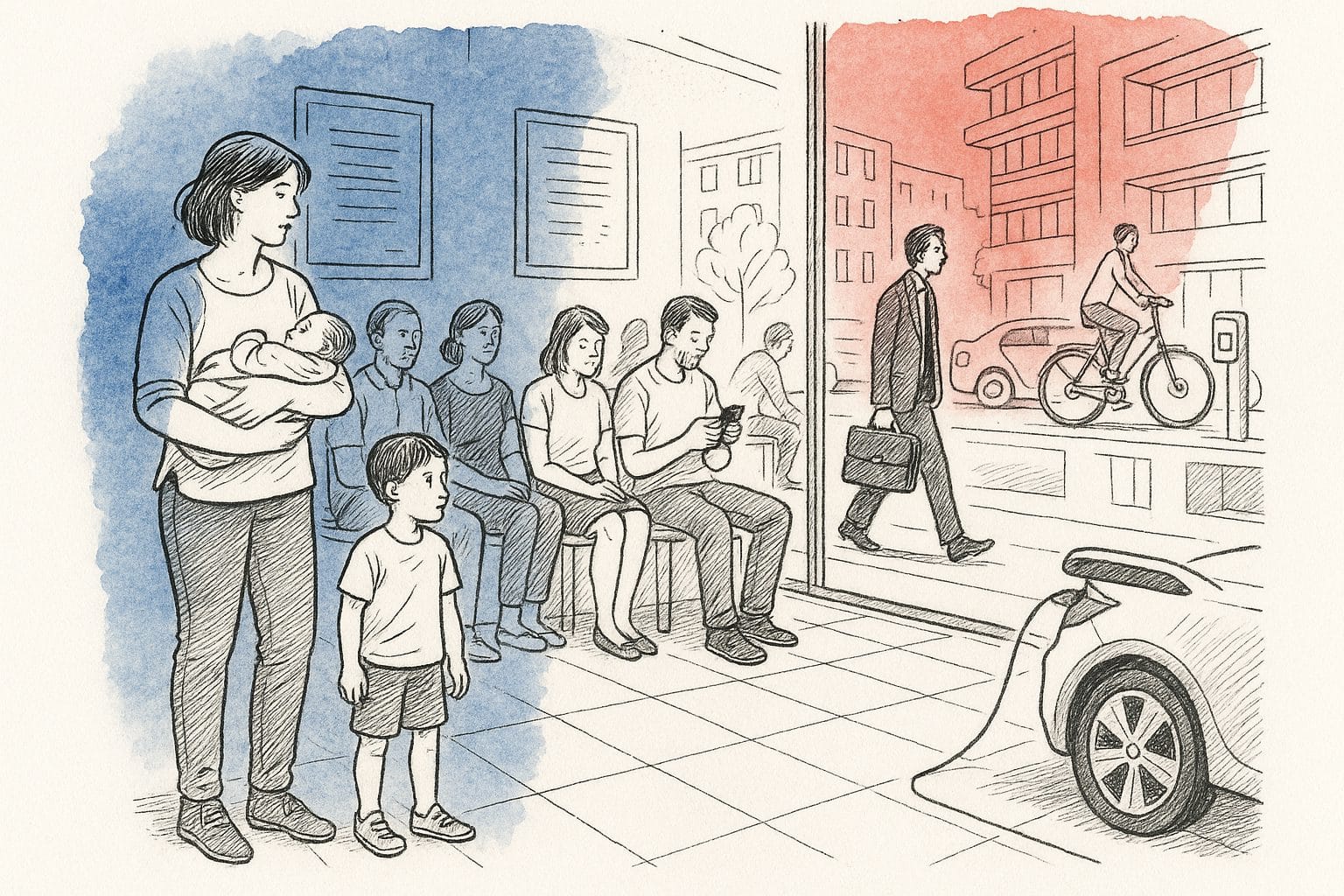
550 million dollars. That is the amount that New York’s congestion pricing generated in net revenues during its first year of implementation in 2025. This pioneering U.S. experiment reveals a double lesson: the health and economic effectiveness of urban tolls is no longer debated, but its social acceptability depends entirely on how the revenues are used.
The New York program confirms what London has observed since 2003 and Stockholm since 2007: taxing automobile access to the city center drastically reduces pollution, improves traffic flow, and generates massive revenues. The real innovation lies in the redistributive equation: only 2% of low-income workers actually pay the tax, while 90% of collected funds finance the public transportation on which they predominantly depend.
The essentials
- 550 million dollars in net revenues generated by New York’s pricing in 2025, funding 15 billion dollars in public transportation investments
- 11% reduction in automobile traffic and 22% reduction in pollution in Manhattan
- Only 2% of workers earning less than 50,000 dollars daily drive to Manhattan
- 90% of toll revenues directly finance improvements to subways and buses used by low-income populations
- 17 American cities are studying adaptations of the New York model
New York demonstrates the winning equation of redistributive tolling
The Metropolitan Transportation Authority released a report one year after launch that exceeded all projections. The 9-dollar toll per passage during daytime hours to access south of 60th Street in Manhattan generated 550 million dollars net, 20% more than initial estimates. This performance owes to two factors: higher base traffic than anticipated and a lower diversion rate than expected.
Automobile traffic declined by 11% in the tolled zone, comparable to results obtained by London after its first year. More significantly, air pollution fell by 22% according to a Cornell University study. This improvement concentrates on fine particulates PM2.5 and nitrogen dioxide, directly linked to respiratory and cardiovascular diseases.
The redistributive effect proves less problematic than opponents feared. A demographic analysis conducted by the NYU Furman Center reveals that only 2% of New Yorkers earning less than 50,000 dollars annually use their car daily to reach Manhattan. Conversely, 34% of households with more than 150,000 dollars in annual revenues are affected by the toll.
Use of revenues determines social acceptability
The political success of the New York program rests on a kept promise: 90% of revenues directly finance public transportation improvements. The 15 billion dollars in investments planned over ten years will increase subway frequency by 30%, modernize 150 stations, and electrify 1,200 additional buses.
This approach contrasts with other global experiences. In London, only 40% of congestion charge revenues return to public transportation, the rest feeding the city’s general budget. Stockholm allocates 70% of revenues to financing new road and rail infrastructure, but the distribution remains opaque.
Seattle illustrates the importance of this transparency. The city abandoned its pricing project in 2023 after opinion surveys revealed massive mistrust about fund usage. Without guaranteed allocation to public transportation, 68% of residents opposed the measure, including 52% of those who never drive downtown.
American cities adapt the model despite resistance
Boston, San Francisco, and Washington D.C. are preparing to introduce similar systems by 2027. Los Angeles has been testing since September 2025 a watered-down version with variable tolls of 5 to 12 dollars depending on time of day and air quality. These adaptations reflect local specificities: greater urban sprawl than New York, stronger automobile dependence, less developed public transportation networks.
Political opposition remains strong in 14 Republican states that have voted laws explicitly prohibiting congestion pricing. Texas thus blocked projects in Austin and Houston despite municipal support. This resistance relies on the argument of a “tax on the poor,” contradicted by New York data but politically effective.
The Federal Highway Administration nonetheless approved 17 feasibility studies for urban pricing projects, equipped with 2.3 billion dollars in federal subsidies. This momentum fits the Biden administration’s climate objectives: reduce urban transportation emissions by 50% by 2030.
Western Europe stagnates facing political resistance
Paradoxically, Europe struggles to expand a model it pioneered. After London and Stockholm, only Milan (2012) and Göteborg (2013) have adopted permanent systems. Paris abandoned its project in 2022 facing suburban opposition, Madrid suspended it in 2023 after a municipal majority change.
This stagnation contrasts with Asia where Singapore has perfected since 1975 an electronic tolling system, soon to be imitated by Jakarta (2024) and Bangkok (planned 2026). The difference lies in political structures: Asian metropolises have unified authority over transportation and urban planning, whereas European cities negotiate with regional and national levels often hostile.
Germany illustrates this fragmentation. Berlin, Munich, and Hamburg support pricing projects, but the federal government refuses any legislative modification facilitating their implementation. The German compromise favors low-emission zones, less economically efficient but more politically consensual.
Technological innovations accelerate feasibility
The generalization of RFID chips and geolocation radically transforms the political economy of urban tolling. New York uses an automatic license plate detection system that eliminates bottlenecks at toll points, the main grievance against previous devices.
Artificial intelligence now enables real-time dynamic pricing, adapted to actual congestion. Los Angeles adjusts its rates every 15 minutes according to traffic conditions and pollution measured by 200 urban sensors. This technical sophistication addresses arbitrariness criticisms while maximizing environmental effectiveness.
Electric vehicles benefit from partial exemptions in all new systems, creating a double incentive effect. In New York, 15% of affected motorists stated they were considering purchasing an electric vehicle to reduce travel costs. This dynamic accelerates urban energy transition, a connected but central objective of mobility policies.
The global expansion of urban tolling is no longer in question: 34 cities are actively studying it according to an International Transport Forum survey. The issue shifts toward implementation modalities and use of generated revenues. New York proves that social acceptability depends less on the pricing principle than on benefit redistribution toward alternatives to individual vehicles.