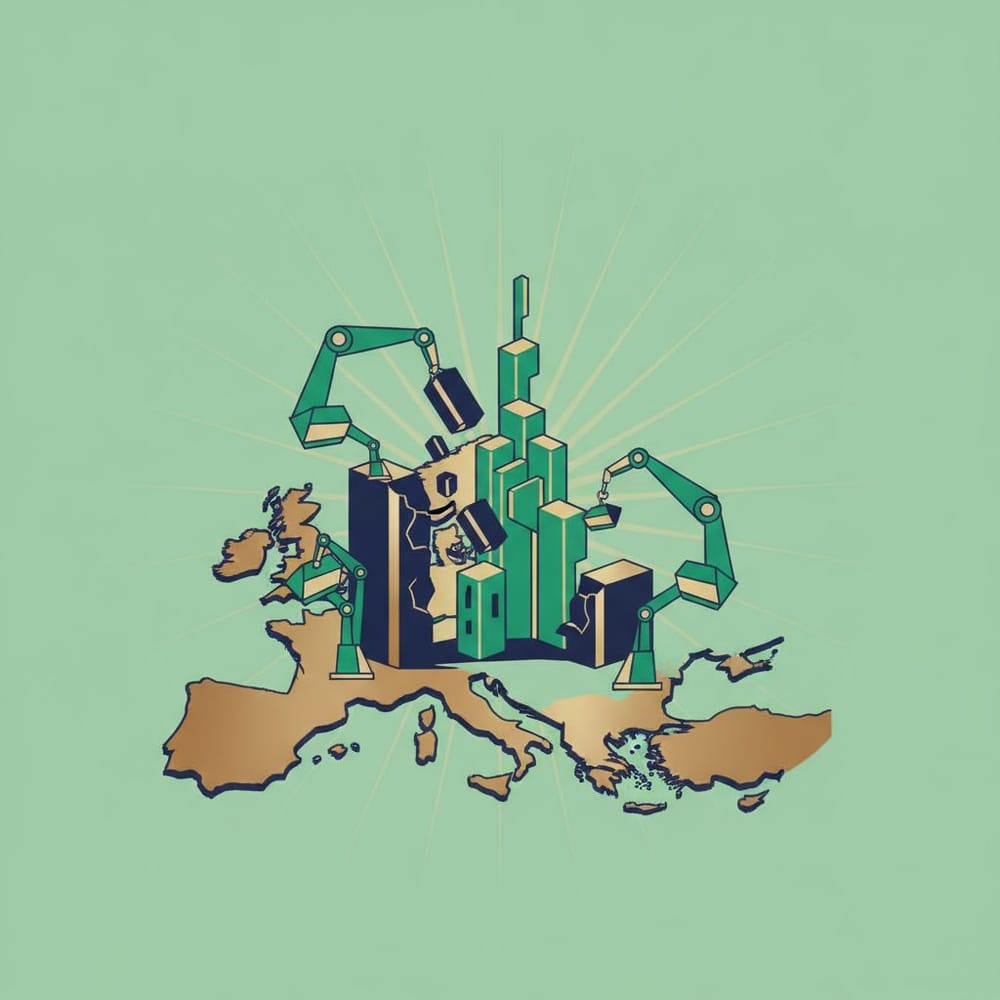
Europe didn’t lack money, it lacked creative destruction
Until 2024, no European company founded since 1975 exceeded 100 billion euros in market capitalization — a finding that was central to the Draghi report. This assertion has since been superseded: Spotify, founded in 2006 in Sweden and listed in New York, crossed this threshold in early 2025 to reach over 116 billion euros in market capitalization. The exception nonetheless confirms the rule. In the United States, at least nine firms now exceed the 1 trillion dollar threshold — there were still only six in September 2024, when the Draghi report was published: Apple, Microsoft, Nvidia, Amazon, Alphabet, and Meta. All were created within the same fifty-year window.
This figure summarizes a divergence that Europe has been debating for twenty years without resolving it. The Draghi report highlighted it in 2024. Competitiveness plans dress it up as geopolitical urgency. But Philippe Aghion and Simon Johnson, in an interview granted to Project Syndicate and Bruegel in June 2026, pose a more unsettling diagnosis: the problem is not financial. European public R&D is comparable to that of the United States as a share of GDP. The money exists. What is missing is the institutional will to let old champions die so that new ones can be born.
The essentials
- Until the Draghi report (September 2024), no European company founded after 1975 exceeded 100 billion euros in market capitalization. Spotify (Sweden, 2006) has since crossed this threshold in early 2025. In the United States, at least nine firms now exceed the 1 trillion dollar threshold, compared to six at the time of the Draghi report’s publication.
- European public R&D represents a share of GDP comparable to that of the United States, but only 10% of this spending is centralized at the Union level.
- Aghion and Johnson identify two structural bottlenecks: a competition policy focused on market size rather than entry dynamics, and a cultural aversion to creative destruction.
- Their most controversial proposal consists of forming a restricted regulatory core around the Digital Markets Act extended to AI, open to partners outside the Union, outside the format of the 27.
- Symmetric risk: the American model that Europe is trying to catch up with is itself showing signs of regulatory capture by the titans it has produced.
Public R&D does not explain the lag
The first reflex, when evoking European decline, is to seek a financing deficit. This is understandable: the amounts allocated to American startups are incomparable, European venture capital funds remain fragmented, and access to capital markets remains difficult for a young company from Krakow or Porto. But this reflex distances us from the real problem.
As a share of GDP, European public R&D spending is equivalent to that of the United States. European research universities regularly feature in global rankings. Engineers from Polytechnique, Delft, or ETH Zurich have nothing to envy their Stanford counterparts. And yet, the list of global technology giants includes no European names in the top ten — with the notable exception of ASML, the Dutch specialist in lithography equipment, which now ranks in the top 10 of global technology companies by market capitalization.
Aghion and Johnson point to a more revealing datum than absolute volumes: only 10% of European public R&D spending is centralized at the Union level. The rest is fragmented across twenty-seven national systems that duplicate, compete with, and struggle to generate the critical masses necessary for major technological bets. This is not a money problem. It’s an architecture problem.
Comparison with the United States illustrates the difference. DARPA doesn’t fund projects that will please incumbent industrialists: it funds crazy bets that threaten them. The National Institutes of Health have produced breakthroughs that no one in the pharmaceutical industry would have had an interest in funding on their own. American public investment is not only massive; it is directed toward the risks that the private sector refuses to take. European public investment, meanwhile, tends to consolidate what already exists.
Schumpeter versus Brussels
The heart of Aghion’s diagnosis is Schumpeterian. Long-term growth does not come from the accumulation of capital in existing firms. It comes from the destruction of these firms by new entrants who do better with less. This process is brutal. It produces losers. And Europe, for profound cultural and political reasons, refuses to let this mechanism operate fully.
The most concrete illustration is competition policy. For twenty years, the European Commission has used its antitrust arsenal primarily to sanction large American firms dominating European markets. This strategy has merits: it has produced fines, preserved some plurality of players, and given rise to the Digital Markets Act. But it also has a blind spot: focusing on the market size of incumbent players protects acquired positions. Aghion and Johnson call for a reversal of perspective. The real question is not whether Google is too big. It is whether the next company that could challenge it can emerge in Europe. Current rules do not favor this.
The demonstration passes through a simple arithmetic observation. American firms worth more than 1 trillion dollars were not created by established institutions. Apple, Microsoft, Google, Amazon, Meta, and Nvidia all emerged by disrupting dominant players of their time: computer makers, media, retailers, advertising. The sector they came from was hostile to them. They won because the American institutional framework tolerated, indeed encouraged, disruption of the existing order.
In Europe, high value-added sectors are often those with the highest barriers to entry: energy, finance, telecommunications, pharmaceuticals. These sectors are regulated to preserve the stability of incumbent players, who are also major employers and unavoidable political interlocutors. The circle is vicious: national champions protect their markets, new entrants cannot reach critical size, and Europe remains at the mercy of the global champions it has not produced.
The trap of 27 and the Aghion-Johnson proposal
The most controversial proposal by Aghion and Johnson is also the most interesting. Rather than reforming the European Union as a whole, they suggest forming a restricted core around a DMA extended to artificial intelligence, open to non-European partners sharing compatible regulatory standards. The idea is to create a common regulatory space large enough for companies to reach global critical mass without being slowed by the difficult consensus among twenty-seven members with divergent interests.
This proposal departs from the European institutional reflex, which is to broaden to include rather than deepen to advance. It implicitly acknowledges that the format of 27 is ill-suited to quick decisions on subjects like AI, where technological cycles short-circuit legislative cycles. A European AI regulation takes five years to develop. An American foundation model can change the rules of the game in five months.
The envisioned rapprochement with open economies with solid institutions, a tradition of pragmatic regulation, and active competition policy without excessive national protectionism would create a market homogeneous enough for companies to develop products with global ambitions. This is not an abandonment of European sovereignty: it’s a bet on critical mass as a necessary condition for competition.
The question that remains open is political. Some member states will see in this proposal a sidelining of smaller countries, a two-speed Europe that fractures the unity of the single market. Others will see an opportunity to escape by the top exit a governance structure that is no longer suited to the pace of the world. This debate has not yet seriously occurred. It should.
Is the American model still the model?
This is where Luigi Zingales enters the conversation. The Chicago economist, whose work on regulatory capture is standard reference, makes an argument that Europeans looking toward the United States would be wrong to neglect: the system that produced these giants may be allowing them to capture the institutions that created them.
Zingales’s finding, extended by recent observations on tech lobbying in Washington, is that large American firms are today devoting a growing share of their resources to influencing regulation rather than innovating. Amazon has built a lobbying infrastructure that weighs on federal antitrust policy. Google finances university chairs, think tanks, public policy training programs. Meta has helped shape content moderation rules in its own interest. This movement is not unique to the tech sector: it reproduces exactly what major American banks did after the 2008 financial crisis, transforming their economic power into political power to block reforms that threatened them.
This observation complicates the thesis of European lag. If Europe suffers from not having produced giants, the United States may suffer from having let them grow unconstrained. The productivity gains related to AI that large American firms accumulate do not diffuse as widely as growth theories would predict. A recent article in this journal documented exactly this mechanism: in the United States, productivity is rising, but average wages are not benefiting proportionally. The concentration of gains at the top suggests that the American model produces rents as much as innovation.
The stakes for Europe are therefore not simply to reproduce the American model. It is to find a path that combines the Schumpeterian dynamism that this model has generated with the redistribution of gains that this model has failed to ensure. Creative destruction is only worthwhile if its benefits are not entirely captured by the creators.
What Singapore does better than Paris
It is useful to look at what Singapore does, precisely because the city-state figures in the Aghion-Johnson proposal. In fifty years, Singapore has produced several world-class companies in sectors its regional competitors dominated: port logistics with PSA International, commercial real estate with CapitaLand, defense technology with ST Engineering. None of these companies reaches 100 billion euros in market capitalization, but the mechanism that produced them is instructive.
The Singapore government did not protect its national champions from foreign competition. It created conditions in which its companies had to compete with the best global operators on their own soil to survive. It invested massively in training, infrastructure, and research, but without guaranteeing captive markets. Companies that failed to adapt were allowed to die. Those that survived were solid enough to internationalize.
This model is not directly exportable to Europe. Singapore is a unitary state of 5 million inhabitants with a capacity for quick decision-making that twenty-seven democracies cannot reproduce. But the underlying principle is precisely what Aghion describes as missing in Europe: the state as a creator of dynamic conditions, not as a protector of acquired positions.
France illustrates well what Singapore avoids. The system of national champions, inherited from Colbertism and perpetuated by state shareholdings in groups like EDF, Renault, or Air France, long offered implicit protection against bankruptcies and radical restructuring. This protection has an invisible cost: it immobilizes capital in structures that innovate little, and it sends entrepreneurs the signal that radical risk-taking is not the path to success. To deepen the question of French reindustrialization in this context, the work of Olivier Lluansi on the 2035 objective offers a useful analytical framework.
Building a core or reforming the 27?
The debate between Aghion-Johnson on one side and supporters of comprehensive EU reform on the other is structured by a real tension. Reforming all twenty-seven means choosing legitimacy and inclusivity at the cost of slowness. Building a restricted core means choosing speed and coherence at the cost of fragmentation.
Advocates of comprehensive reform have a strong argument: the single market is the Union’s main economic success. Fragmenting it, even partially, risks producing devastating spillover effects on the European industrial value chain, which is deeply integrated between member states. A German automobile firm that assembles in Slovakia and sells in France cannot function in a dual-speed regulatory space.
But advocates of the core have an equally strong argument: the main technological decisions of the next decade cannot wait for the political cycles of all twenty-seven. Generative AI, autonomous agent governance, cybersecurity standards, data portability, intellectual property of learning systems: these subjects evolve in months, not years. While Brussels develops a collective response, standards will be defined in San Francisco or Beijing. The question of AI agent governance illustrates precisely this temporality problem: autonomy architectures already deployed create accomplished facts before legislators have been able to examine them.
The Aghion-Johnson proposal does not claim to resolve this tension. It states it clearly. And that is perhaps its main value: to force a debate that European institutions avoid by preferring compromises that settle nothing.
The real question that this lag poses is not whether Europe can still catch up with the United States in the list of mega-capitalizations. That window is probably closed for the generation of major platforms from the 2000s. The question is whether Europe can organize itself not to miss the next one, that of integrated AI systems, decarbonized energy, and synthetic biology, where dominant positions are not yet taken.
This requires a choice that Europe has been postponing for twenty years: accepting that some incumbent companies die so that others can be born. Accepting that regulation serves entry as much as it protects consumers. And perhaps accepting that the institutional format itself is part of the problem. Aghion and Johnson do not provide a definitive answer. They state the terms of a choice that Europe can no longer avoid.
Sources
- Philippe Aghion and Simon Johnson, “Europe’s Economic Malaise Rooted in Lack of Dynamism”, Project Syndicate / Bruegel, June 2026: project-syndicate.org
- Mario Draghi, Report on European Competitiveness, European Commission, September 2024: commission.europa.eu
- Philippe Aghion, Céline Antonin, Simon Bunel, The Power of Creative Destruction, Odile Jacob, 2020
- Luigi Zingales, A Capitalism for the People, Basic Books, 2012; recent work on regulatory capture of major digital platforms
- Eurostat, public R&D spending as a share of GDP, European Union and United States, 2023
- European Commission, Annual Report on Competition Policy, 2024
- Spotify exceeds €100 billion market capitalization in 2025 (BFM Bourse / TradingSat): tradingsat.com
- OECD — Worldwide R&D Spending 2024: oecd.org
- EU AI Act — Official Timeline: iapp.org
- ASML in top 10 global technology (AlphaSense, 2026): alpha-sense.com
- NIH — Funding of Approved Drugs 2010-2019 (JAMA / Bentley University): bentley.edu