In 29 countries tracked over ten years by Afrobarometer, demand for democracy has fallen by an average of ten points, associated with more negative assessments of political and institutional performance. 36% of African citizens prefer democracy and simultaneously reject personal rule, one-party rule, and military government. The perceived performance of public services is linked to institutional trust.
- The perceived performance of public services is linked to institutional trust.
The essentials
- Demand for democracy has fallen by an average of ten points across 29 African countries over ten years (Afrobarometer, 2026).
- Only 36% of citizens prefer democracy and simultaneously reject personal rule, one-party rule, and military government.
- Afrobarometer links the decline to negative assessments of political and institutional performance.
Democracy loses the daily test, not the battle of ideas
Analyses of democratic decline in Africa often point to coups, electoral manipulation, or propaganda from authoritarian regimes. These factors exist. But Afrobarometer 2026 data describes a more mundane and deeper mechanism.
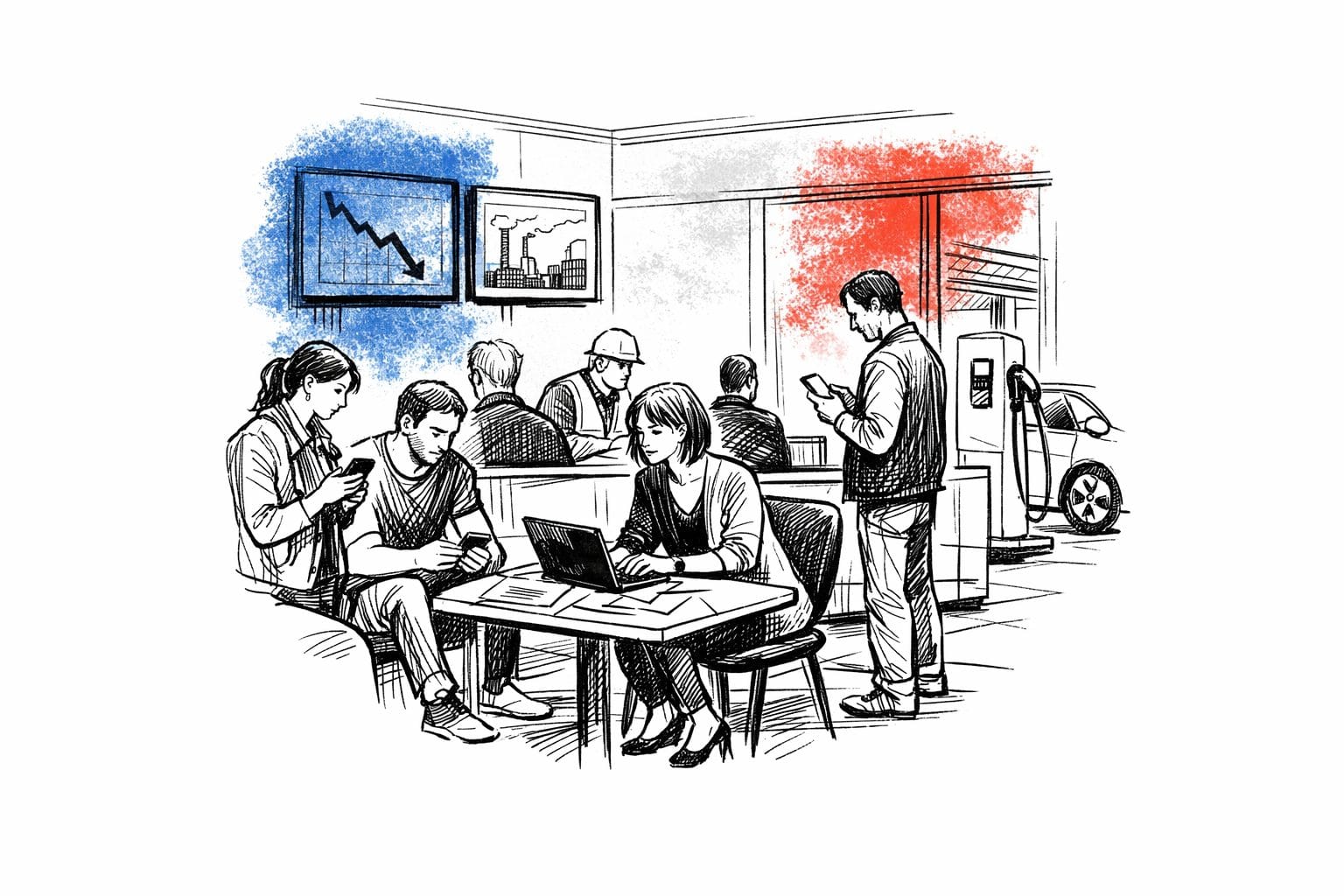
African citizens are not massively rejecting democratic values. They are making a practical observation: in their neighborhood, schools lack teachers; at the health clinic, medicines are often unavailable; access to water remains intermittent. When asked afterward whether democracy is the best system of government, many shrug their shoulders. The decline is linked to negative assessments of public performance and is accompanied by increased openness to certain authoritarian alternatives.
This distinction matters. A disillusioned citizen can still be mobilized. A citizen convinced that a strong man would solve their problems is far more difficult to bring back toward representative institutions.
The ten points lost over ten years are not distributed uniformly. Some countries maintain strong and stable democratic demand. Others have seen their scores drop by twenty points or more. Afrobarometer documents an association between assessments of political performance and democratic demand.
The meaning of the 36% figure
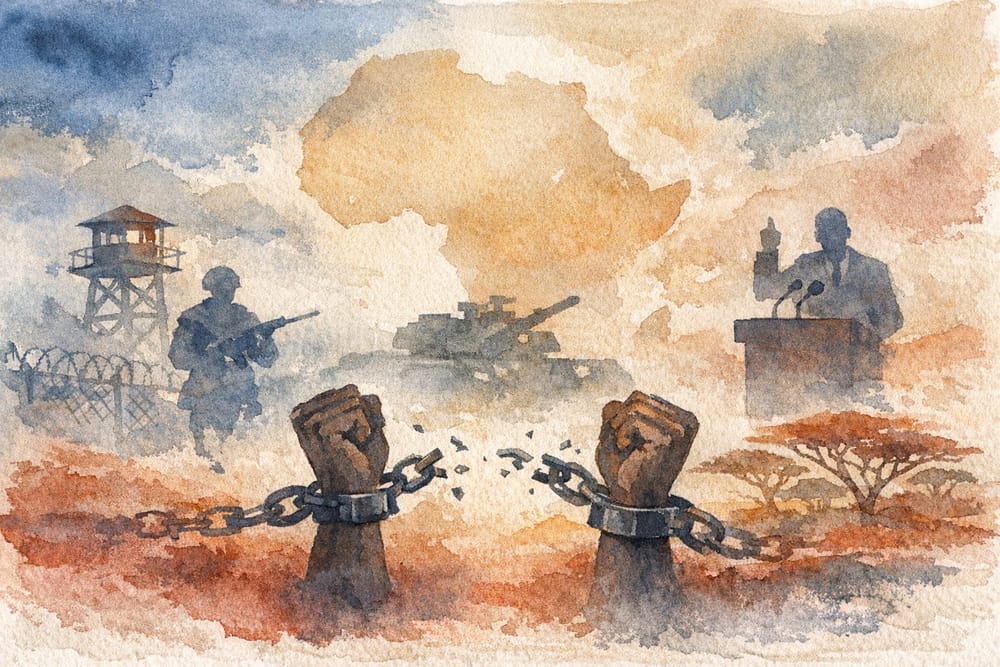
What the internal structure of this figure reveals is as important as its absolute value. Resignation to one form of authoritarianism does not progress uniformly across the three options measured. Military government remains generally the least tolerated form, as it is associated in collective memory with episodes of direct violence. One-party rule attracts greater acceptance, because it is often perceived as compatible with a certain administrative stability. Personal rule is the form that benefits from the highest tolerance, precisely because it can wrap itself in the language of efficiency and national will.
This hierarchy in resignation indicates that erosion of democratic attachment proceeds through successive and partial shifts, without adherence to a coherent alternative model. Each shift reduces the perceived political cost of further concentration of power. The tolerance threshold moves gradually, without visible rupture, making the trend difficult to identify and counter when it takes hold.
The 36% figure must be read precisely. Afrobarometer’s indicator combines preference for democracy with simultaneous rejection of three authoritarian alternatives. Rejecting personal rule alone is frequent; rejecting one-party rule alone or military government alone is also frequent. The 36% corresponds to complete demand for democracy, defined by four consistent responses.
Fewer than four out of ten citizens express complete demand for democracy, including preference for democracy and all three rejections.
This measure is more demanding, and therefore more revealing. It targets citizens who have a coherent vision of power: those who understand that concentrating power in the hands of one man, one party, or an army produces the same harmful effects, regardless of the form chosen. The decline indicates a retreat of complete pro-democratic coherence, not necessarily increased acceptance of at least one authoritarian form by each respondent concerned.
An important nuance: acceptance is not support. Many respondents who no longer reject the principle of one-party rule or military government do not actively desire this type of regime. They have simply stopped believing that the democratic alternative is superior to them in terms of concrete results. This is a position of resignation, not authoritarian activism. But politically, resignation opens spaces it did not open ten years ago.
Public service as infrastructure for democratic trust
This mechanism contains an important limitation that the data itself allows us to identify. Cross-sectional data show an association between service assessments and institutional trust, without enabling its evolution over time to be established. Associations between perceived service performance and institutional trust vary by institution and context, without results on time horizons. A perceived degradation of services is associated with weaker institutional trust, without demonstration of an immediate causal effect. This asymmetry has direct practical consequences: the report documents an association between positive service assessments and higher institutional trust, without establishing the timeframe for any effect, while the report only establishes that a less favorable perception of services is associated with weaker institutional trust.
It creates a structural incentive to underinvest, even when political will exists. Independent accountability mechanisms and citizen-led service quality measures can partially correct this asymmetry, by making intermediate progress visible before it is fully felt by the entire population.
Positive service assessments are statistically associated with higher institutional trust. Education, health, and water produce direct, daily experience, where freedom of the press or civil rights often remain abstract for a significant portion of the population.
A parent whose child cannot go to school due to a lack of teachers experiences state failure every morning. A patient who returns empty-handed from the health clinic experiences state failure every week. The decline is associated with negative assessments of government performance, particularly political and institutional. It does not deny that freedom is a value. It simply leads to the belief that this freedom does not translate into concrete improvement in living conditions.
The report establishes an association between perceived public service performance and political trust.
Comparable mechanisms have been documented in Central and Eastern Europe: the legitimacy of democratic regimes depends partly on their ability to deliver visible public goods. The African specificity lies in the scale of failures and the speed at which they translate into disaffection.
Who moves things forward, and how
The overall picture is troubling. But several actors work precisely at the intersection between public service performance and recapturing democratic trust.
Several countries are testing accountability approaches for public services. These experiments produce growing documentation on links between delivery performance and political trust.
Continental initiatives are emerging to track basic public service delivery with harmonized indicators.
These initiatives do not solve the problem at continental scale. But they demonstrate that public service performance is improvable, that it can be made visible through independent measures, and that it has effects on political trust.
Two trajectories for the next fifteen years
Afrobarometer data point to two plausible scenarios by 2030-2040. Neither is predetermined.
In the first scenario, African states whose democratic scores have fallen invest massively in visible and controllable basic public services. The stakes go beyond budget alone: results must be measurable by independent bodies that citizens can access.
If delivery performance improves, indicators of democratic demand could experience favorable movement. Democracy becomes again a system associated with concrete improvement in living conditions.
In the second scenario, government performance remains weak. Public services continue to disappoint. Indicators of complete democratic demand would record a further decline. Hybrid regimes could find growing social acceptance. Formal democracy persists, but becomes hollow.
This second scenario is plausible, but not inevitable. It depends largely on a variable that African governments control: the capacity and willingness to deliver basic services. And this variable can be influenced by concrete mechanisms.
Health and education budgets in several African countries depend partly on international transfers. The recomposition of official development assistance weighs on this capacity. Scenarios must integrate this real constraint.
Signals for the next waves
The next waves of Afrobarometer surveys will provide two key indicators to follow.
The first is the evolution of satisfaction scores for basic public services, country by country. If this score stabilizes or rises, the 2026 Afrobarometer data would allow its contemporary evolution to be assessed. If the score continues to fall, previous trends would offer a framework for interpretation.
The second is the share of citizens simultaneously rejecting all three forms of authoritarianism. This indicator measures an important aspect of democratic demand expressed by citizens. A further decline would signal a more pronounced retreat of complete pro-democratic coherence.
The data suggest a relationship between the two signals. Afrobarometer data document this relationship over the period covered. This link is also a lead: it shows where to act.
The performance of public services and institutional trust are linked to the daily experience citizens have of institutions. These concrete objects, which political science sometimes qualifies abstractly as “state capacity,” are what citizens evaluate every morning before they even think about democracy. Transparency and accountability mechanisms for public services are among the levers being explored to maintain trust.