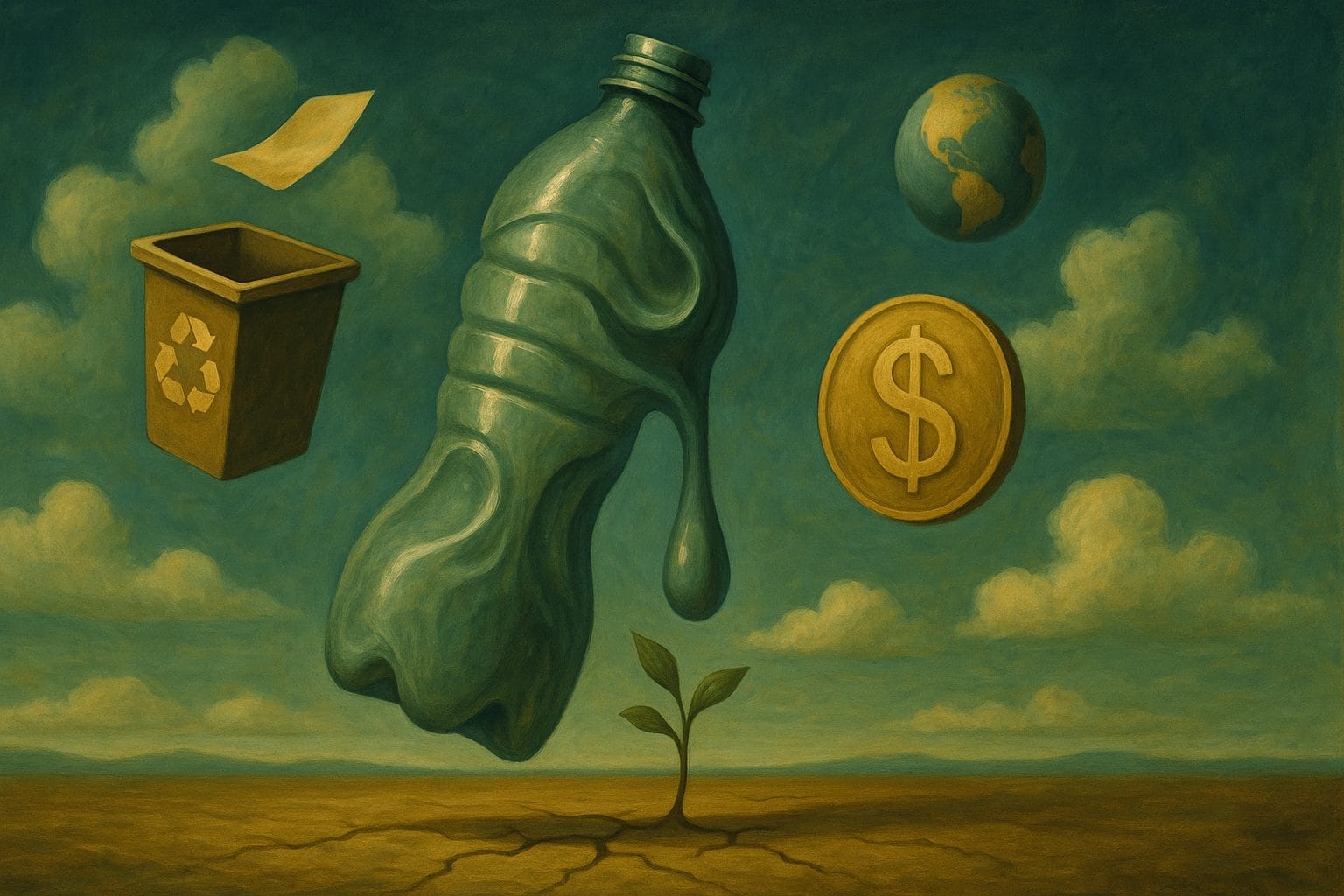
In March 2026, researchers identified 24 new species of crustaceans in the Clarion-Clipperton Zone, that vast expanse of seafloor stretching between Mexico and Hawaii. The same week, the International Seabed Authority counted 31 active exploration contracts, 17 of them concentrated in this single zone. These two facts, taken together, illustrate the dilemma facing ocean defenders: the more the deep ocean reveals its biodiversity, the more it attracts covetous interests.
But a study published in May 2026 in Nature Ecology & Evolution shifts the question. It does not ask whether seabed exploitation is acceptable. It asks what happens if it is banned. And the answer is uncomfortable: blocking the extraction of polymetallic nodules from the Pacific floor could intensify nickel mining in Sulawesi, Halmahera, in the forests of Palawan. In other words, protecting one of the planet’s least-known ecosystems would amount to accelerating the destruction of some of the richest.
The Essential Points
- A modeling study published in Nature Ecology & Evolution (May 2026) shows that a moratorium on seabed mining would redirect nickel demand toward terrestrial extraction, primarily in Indonesia and the Philippines.
- The International Seabed Authority has granted 31 exploration contracts to date, with 17 concentrated in the Clarion-Clipperton Zone alone, which contains the most coveted deposits.
- In March 2026, 24 new crustacean species were discovered in this zone. Scientific data indicates that more than 5,000 new species have been identified in the CCZ, of which 88 to 92% remain undescribed, representing thousands of species still unknown to science.
- Nickel extracted from Sulawesi directly feeds into the value chains of electric vehicle batteries; according to the IEA (Global Critical Minerals Outlook 2024), total nickel demand doubles by 2040 under the APS scenario, while global demand for critical minerals across all metals could triple by 2030 under the NZE scenario.
- No international regulatory framework currently exists to compare impacts between ecosystems in order to arbitrate between extraction sources.
The Clarion-Clipperton Zone, an Incomplete Laboratory of Biodiversity
First, we must understand what is being considered for exploitation. The Clarion-Clipperton Zone extends over approximately 4.5 million square kilometers at depths of 4,000 to 6,000 meters. On its floor lie polymetallic nodules, rocky concretions formed over millions of years that concentrate manganese, cobalt, nickel, and copper. These are precisely the metals that the energy transition is hungry for.
What marine biology reveals changes the perspective. Over the past decade, each scientific expedition to this zone has brought back unknown species. The 24 crustaceans identified in March 2026 are not an anomaly: they fit into a documented reality of much greater scale, as scientific data indicates that more than 5,000 new species have been identified in the CCZ, of which 88 to 92% remain undescribed. Most are endemic, meaning they are found nowhere else. Industrial exploitation of the nodules would physically destroy their habitats through seabed scraping and sediment plumes that disperse over hundreds of kilometers.
Ocean defense organizations, from Greenpeace to the Deep-Sea Conservation Coalition, had in some ways won the rhetorical battle: the seabed established itself as a space to protect, populated by fragile and irreplaceable life. The ISA, under pressure from member states and NGOs, has repeatedly deferred the adoption of a commercial mining code. Protection seemed to be advancing.
That is precisely where the Nature Ecology & Evolution model intervenes, and it disturbs.
What the Model Reveals About Substitution Effects
The study does not contest the ecological value of the abyss. It poses another question: if demand for nickel remains constant or increases, where will this metal come from if it is not extracted from the Pacific floor? The answer is well documented by existing trade flows: from terrestrial mines, concentrated in Indonesia and the Philippines.
The model integrates projected demand data for lithium-ion batteries, nickel prices, comparative extraction costs, and investment trajectories. It concludes that a moratorium on seabed exploitation, without complementary policies on demand reduction or terrestrial biodiversity loss compensation, would mechanically displace extractive pressure toward high-grade terrestrial deposits. Yet these deposits lie precisely beneath tropical rainforests, among the richest ecosystems on the planet.
The case of Sulawesi is central. The Indonesian island hosts one of the highest concentrations of biodiversity in Southeast Asia: endemic primates, threatened birds, unique forest formations. Since 2019, it has also been the heart of Indonesia’s nickel boom, driven by demand for electric vehicle batteries. Forests in the Morowali region have suffered accelerated deforestation. Rivers bear traces of mining leachates. Local communities have been displaced in some cases, integrated as precarious labor in others.
In the Philippines, the provinces of Palawan and Mindanao face similar pressures. Here again, nickel laterite deposits overlap with areas of high ecological value and indigenous settlement.
The figure that Nature Ecology & Evolution puts in tension with the rest of the debate is this one: potential biodiversity losses induced by this shift toward terrestrial extraction could, according to the model, exceed those a seabed moratorium was supposed to prevent. Protecting one ecosystem would destroy another. This is not an argument against protecting the seabed. It is an argument against sectoral protection disconnected from the broader picture.
The Structural Problem of Siloed Environmental Policies
What the study describes has a name: harm displacement, or leakage in environmental economic literature. The phenomenon is well documented in other fields. Energy policies that close coal plants in one country without reducing regional demand often displace emissions to less-regulated neighboring countries. Deforestation-zero policies in one watershed sometimes redirect agricultural pressure to the next watershed.
The originality here is the geographic scale and the nature of the ecosystems being compared. The abyss and tropical forests have nothing in common: they do not share the same jurisdiction, the same actors, or the same protection instruments. One falls under international seabed law under the authority of the ISA, a UN institution. The other depends on the national policies of Indonesia and the Philippines, their forest regimes, their mining concessions, their relationships with Chinese investors who finance much of Sulawesi’s nickel.
This compartmentalization is the problem. Activists who advocate for a seabed moratorium and those who defend the forests of Sulawesi generally do not speak to each other. Their battles are fought in separate arenas, before separate institutions, with separate funding. The result can be, paradoxically, that their respective victory accelerates the defeat of the other.
This is not a fatality. It is a matter of policy design. But it requires a level of coordination that current instruments do not allow.
What the Energy Transition Requires and What No One Wants to Arbitrate
Nickel demand occupies a central place in this debate for a precise reason: high-density lithium-ion batteries, and especially NMC batteries (nickel-manganese-cobalt) that equip the majority of premium electric vehicles, consume it massively. According to the IEA (Global Critical Minerals Outlook 2024), total nickel demand doubles by 2040 under the APS scenario—it is global demand for critical minerals, across all metals, that could triple by 2030 under the NZE scenario.
This figure is rarely put alongside the forest areas or seabed that this transition requires. The energy transition is presented as an exit from extractivism; it is also, in certain respects, a transformation of it. It displaces fossil fuel extraction toward metal extraction. It substitutes one type of damage for another. That is not a reason to slow it down. It is a reason to integrate its real costs into decision-making.
Two technical approaches would reduce nickel dependency without geographic arbitrage. LFP (lithium-iron-phosphate) chemistry contains neither nickel nor cobalt, and is rapidly gaining market share, particularly in the segment of short-range vehicles and stationary storage. BYD and CATL, the two battery manufacturers dominating the global market, have largely shifted toward this chemistry for part of their production. The circular economy represents another path: recycling end-of-life batteries allows recovery of metals, but volumes remain limited as long as the electric vehicle fleet has not reached the age of mass battery replacement, which will take several more years.
These solutions exist and are progressing. But they will not resolve the constraint in the short term. Between now and 2035, nickel demand will remain structurally high, and extraction decisions will be made.
Ways Out of the Choice Between Two Forms of Destruction
The Nature Ecology & Evolution model proposes, beyond diagnosis, three directions that would allow decoupling protection of the abyss from the redirection toward forests.
The first is conditional moratoria. A moratorium on seabed mining would only make environmental sense globally if it is accompanied by a binding mechanism for reducing nickel demand or compensating for losses in terrestrial biodiversity. Without this conditionality, protection remains nominal from the perspective of the overall balance.
The second is the construction of an ecological equivalence framework between ecosystems. No international instrument currently allows comparison of the value of the abyss and that of a tropical forest in Sulawesi to arbitrate an extraction decision. Researchers, particularly within the UN’s ABNJ (Areas Beyond National Jurisdiction) group, are working on biodiversity metrics comparable at the international scale. The high seas treaty adopted in 2023, whose ratification is progressing slowly, creates a partial legal framework, but without the assessment tools that would make it operational.
The third avenue is industrial: accompanying Indonesian nickel producers toward stricter extraction standards, coupled with verifiable zero deforestation commitments, in exchange for preferential market access to European markets. The European Union, whose deforestation regulation for imports is currently being implemented, has real leverage. It has not yet applied it to nickel with the same rigor as to soy or palm oil.
None of these three avenues is simple. They all require coordination among actors who are not accustomed to working together: the ISA, the Indonesian and Philippine governments, battery manufacturers, financial institutions that finance mines, marine and forest NGOs. This coordination is precisely the gap the study highlights.
The Data Exist, What Is Missing Is an Institution to Hold Them Together
What the Nature Ecology & Evolution study accomplishes, beyond its conclusions, is a demonstration of method. It poses a question that existing institutions are not designed to address: what is the net balance of an environmental policy when its displacement effects are integrated?
This question goes beyond the seabed. It applies to deforestation policies, to biodiversity corridors, to marine protected areas. Environmental policies are built sector by sector, border by border, ecosystem by ecosystem. Nature, meanwhile, circulates between these categories. Extraction decisions do too.
The Clarion-Clipperton Zone deserves to be protected. The forests of Sulawesi and Palawan as well. These two positions are not contradictory. But holding them together requires a policy that thinks the entire system, not each of its parts separately.
The open question is this: is there an institution capable of bearing this global calculation, and that would have enough authority over the actors involved for this calculation to change anything?
Sources
- Model of moratorium impact on seabed — Nature Ecology & Evolution, May 2026: https://www.nature.com/articles/s41559-026-03077-3
- ISA exploration contracts — International Seabed Authority, data as of January 31, 2026 (isa.org.jm)
- Nickel demand for batteries — International Energy Agency, Critical Minerals Outlook 2024
- High Seas Treaty (BBNJ) — United Nations, Division for Ocean Affairs and the Law of the Sea
- European regulation on deforestation imports (EUDR) — Official Journal of the European Union, 2023
- LFP battery market share — CATL and BYD reports, 2024-2025
- ZooKeys 2026 — 24 new amphipod species CCZ: https://zookeys.pensoft.net/article/176711/
- ISA Financial Statements 2024 — 30 active contracts: https://www.isa.org.jm/wp-content/uploads/2025/06/ISA-Financial-Statements-2024.pdf
- ISA — Official exploration contracts — 17 in CCZ: https://isa.org.jm/exploration-contracts/
- Nature Ecology & Evolution — Hyman et al., May 2026: https://www.nature.com/articles/s41559-026-03068-4
- IEA Global Critical Minerals Outlook 2024 — nickel demand x2 by 2040: https://www.iea.org/reports/global-critical-minerals-outlook-2024/executive-summary
- IEA Global Critical Minerals Outlook 2025: https://www.iea.org/reports/global-critical-minerals-outlook-2025/overview-of-outlook-for-key-minerals
- Pew Charitable Trusts — CCZ Fact Sheet: https://www.pew.org/en/research-and-analysis/fact-sheets/2017/12/the-clarion-clipperton-zone
- Bloomberg Businessweek — Sulawesi nickel EV supply chain: https://www.bloomberg.com/features/2024-indonesia-sulawesi-nickel-fire/