Restoring a degraded landscape can enrich the families who maintain it. A study by the National Bureau of Economic Research measures, across farms in sub-Saharan Africa, an increase of roughly 75% in household wealth by the third year following an agroecological intervention. The intervention studied, TREES, provides inputs, training and technical support, while participants contribute their land, labor and water to establish and directly manage their forest gardens. This finding shifts the conversation about conservation: no longer as a cost to be compensated, but as a productive investment whose primary beneficiaries are rural populations themselves.
The Essentials
- Agroecological restoration generates a wealth gain of roughly 75% for rural households by the third year, measured by livestock ownership (NBER, 2026).
- Participating households retain the measured gains, though they benefit from external support in kind and training.
- The study combines household survey data with satellite imagery to isolate the causal effect of restoration, making it one of the first rigorous measurements of this kind in sub-Saharan Africa.
- The political durability of conservation rests on this local ownership: households that gain maintain the practices, while gains flowing elsewhere cause practices to disappear once funding ends.
- The open question concerns the formalization of these gains in usage rights capable of surviving cycles of funders.
Survey Data and Satellite Measurements Combined
For a long time, studies of conservation in Africa measured either biodiversity or income, rarely both on the same households over several years, using a method capable of separating the effect of the intervention from that of initial conditions. The study published by NBER in 2026 fills this gap. It follows farms in sub-Saharan Africa that benefited from an agroecological intervention and cross-references household survey data with satellite imagery to reconstruct the evolution of local natural capital.
The central finding shows that a quasi-exogenous increase in natural capital, caused by the intervention and therefore not attributable to favorable initial conditions, translates into an increase of roughly 75% in household wealth in the third year. The measure used is livestock ownership. In rural economies of sub-Saharan Africa, livestock is simultaneously a property asset, a store of value and an indicator of food security. Its 75% increase describes a transformation in households’ economic position, not merely a supplement to monetary income. The program provides inputs and technical support during the training phase, but states it does not pay or provide financial incentives to participants.
The combination of the two data sources, ground and satellite, makes possible something classical studies could not do: verify that the vegetation and natural resources measured from space correspond to the assets from which households derive their gains. The imagery confirms that natural capital has indeed increased where households are growing wealthier, and nowhere else.
Restored Landscapes as Productive Base, Not Reserve
The classical argument for conservation in Africa rests on compensation: local communities renounce productive uses of land—extensive agriculture, grazing, timber cutting—in exchange for external financial transfer. This model has a structural limitation: it makes conservation dependent on donors. The moment funding dries up, the incentive disappears and practices revert.
What the NBER study documents is different. Households do not receive compensation for what they renounce doing. They draw productive gain from what they have contributed to restore. The livestock they own additionally after three years is fed by more abundant pasture, watered by better-supplied water points, protected by ecosystems more resilient to climate shocks. Restored nature functions as capital that generates annual returns, and those returns flow to the households who are its near-term managers.
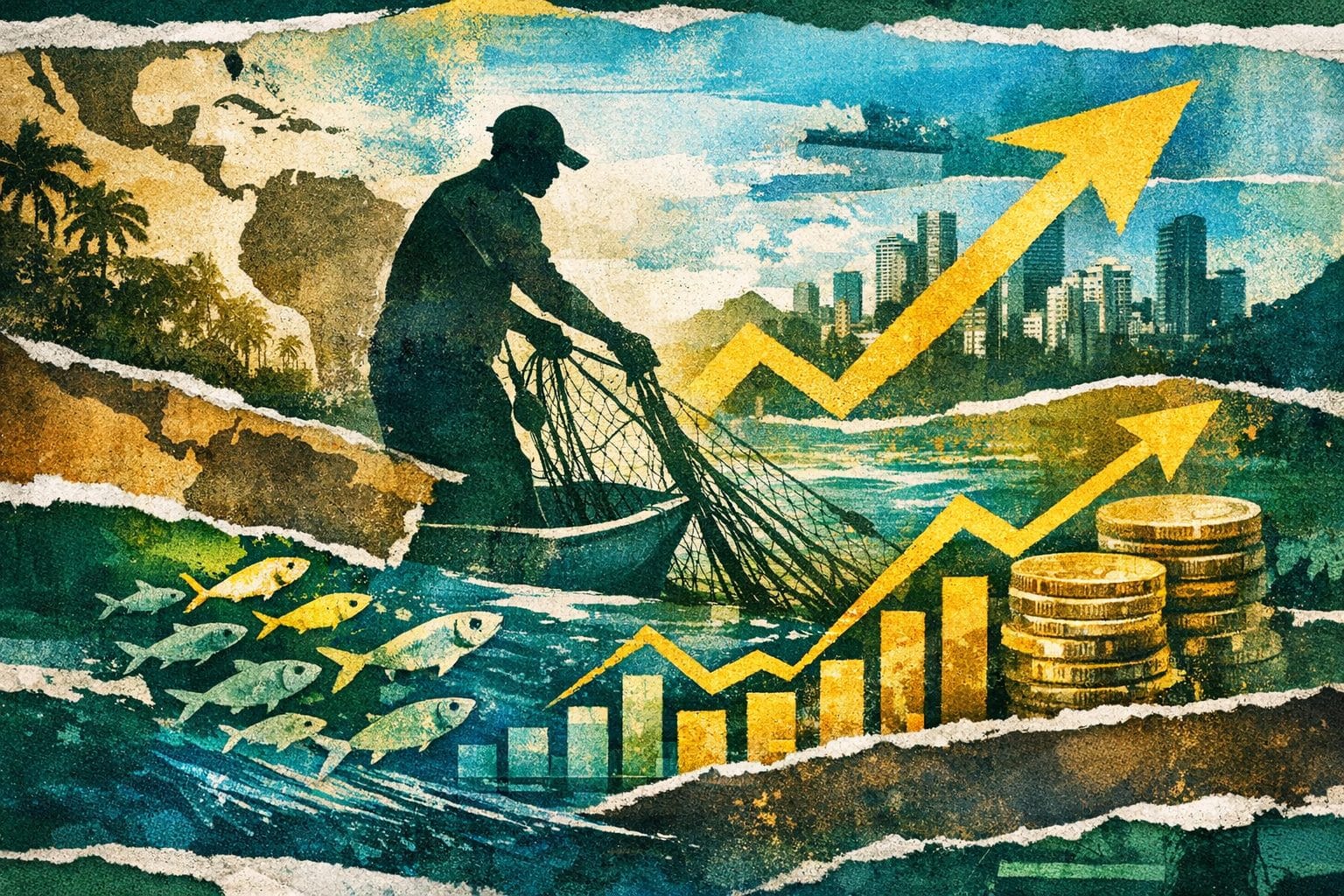
This conceptual shift matters. It bridges two literatures that often ignore each other: the economics of living systems, which seeks to measure the services ecosystems render to human economies, and rural development, which seeks to understand how African households accumulate assets and escape poverty. The study shows that these two dynamics can reinforce each other in the same action, on the same farms, at the same time. Sustainable fishing in Latin America follows similar logic: managing natural resources as productive assets creates more long-term value than exploiting them to exhaustion.
Three Years to Measure, a Generation to Consolidate
The study detects first measurable gains in the three years following the intervention. This means two things simultaneously. First, that agroecological restoration takes time: soils reconstitute, vegetation regrows, hydrological cycles rebalance before households can derive tangible benefits. Second, that the gain arrives quickly enough to be perceived by families planning over a horizon of a few seasons, not decades. This timing is decisive for adoption.
Reforestation or soil restoration programs that produce visible effects only after twenty years struggle to mobilize communities whose food security is precarious. A three-year horizon makes it politically feasible. Households can connect cause to effect within their own agricultural cycle. They can observe neighbors, compare, adjust. Adoption does not require a long-term act of faith.
The question is whether this gain consolidates beyond the third year or plateaus. The study cannot yet settle this for the very long term; it is one of its explicit limitations. But the logic of natural capital suggests a cumulative effect: better-structured soil retains more water, which improves pasture, which allows maintaining more livestock, which generates more organic matter, which further improves the soil. This type of virtuous cycle is documented in the agroecology literature, notably in research on agricultural land regeneration practices in the United States and West Africa.
The Political Map These Data Redraw
Biodiversity conservation has long been carried by moral or scientific argument: species disappear, ecosystems collapse, humanity loses irreplaceable heritage. This argument is correct. It is also, in most rural African contexts, insufficient to weigh against immediate subsistence constraints.
The NBER study brings a distinct and more politically robust argument: restoration is profitable for the households practicing it. An African government investing in landscape restoration can defend that investment as a measurable rural development policy. Tracking indicators—livestock ownership, access to natural resources and drought resilience—are indicators that rural administrations and development funders know and finance.
This requalification also shifts the balance of power in climate negotiations. Up to 65% of Africa’s productive land is degraded, according to the FAO. If this restoration generates measurable wealth gains for local households, the continent can negotiate financing no longer as a passive beneficiary of compensatory aid, but as an active manager of natural assets with documented returns. The framework for publishing nature dependencies developed by the Task Force on Nature-related Financial Disclosures, the TNFD, a financial reporting mechanism on biodiversity, provides architecture for valuing these assets to private investors. The challenge is to channel this type of financing to rural farms, not merely to capitals.
What Will Determine Trajectory Through 2040
Two scenarios open for the next fifteen years, and the signals to distinguish them are already visible.
In the first, restoration programs are designed so rural households directly capture productive gains. This requires that participants have secure and long-term land tenure over the restored plot: if a household can be evicted from land it helped restore once it regains value, the risk of losing the land or improvements incorporated in it sharply reduces its incentive to invest in and maintain land improvements. It also requires financing mechanisms of sufficient duration for gains to become visible and practices to stabilize. In this scenario, the NBER study observes a roughly 75% increase in wealth proxied by livestock ownership in the third year of treatment, spreading to other households through imitation and social pressure, and conservation becomes politically irreversible because it is economically attractive to those stewarding it.
In the second, restoration funding flows through external structures that manage practices without households being direct beneficiaries. Local populations participate as labor, but do not thereby become holders and direct managers of agricultural assets created on their land. Biodiversity gains are real during the funding period, but fragile: once the program stops, practices risk disappearing. This model of externalized management has largely predominated in Northern-funded conservation in Africa, with mixed results on sustainability.
The most discriminating signal between the two trajectories is simple to observe: the rate of maintenance of agroecological practices after initial funding ends. Where households continue without being paid to do so, they appear to have internalized the gain. Where practices fade, the model proved compensatory rather than productive. Tracking institutions combining household surveys and satellite imagery, following the NBER study model, are the only ones able to produce this type of information reliably and systematically. Their development is itself an investment in the credibility of restoration policies.
Conservation International identifies in its roadmap for Africa’s nature transition several priority zones where this rigorous monitoring is feasible in the short term. The challenge is to test the two configurations there, formalized usage rights versus externalized management, and compare wealth trajectories over five to ten years. The results would allow empirically settling a question that remains largely ideological today.
Levers Available to African Public Finance
Sub-Saharan African governments rarely have budgetary margins to finance restoration programs at scale alone. But they control something more valuable in the short term: the land regime. Formalizing usage rights on restored lands is a political decision that costs little in public money and much in political will, because it challenges local power arrangements over land.
Several countries have advanced on this front. Ethiopia has launched watershed restoration programs with village committees collectively managing restored lands and drawing shared benefits. Rwanda has linked hill restoration to formal agricultural usage rights. These experiments are imperfect, but show that the financing problem and the land problem can be addressed simultaneously.
The logic is close to what the living systems economy calls natural capital accounts: recording on a territory’s balance sheet the value of natural assets it harbors, and recognizing households maintaining them as asset managers to be compensated, not as beneficiaries of transfers. The IPBES, the intergovernmental platform on biodiversity, develops methodological frameworks for this type of accounting. What remains is connecting them to realities of African rural farms, where wealth is measured in livestock and trust in public institutions is often weak.
The question posed by this study is not whether restoration works. In this agroecological intervention studied, data indicate measurable ecological and economic gains. The question is who will capture those gains beyond each program’s third anniversary: the rural households that restored, or the structures that funded.
Sources
- National Bureau of Economic Research, Restoring Nature, Creating Wealth: Evidence from Rural Households in Africa (2025), https://www.nber.org/papers/w34929
- Conservation International, Africa’s Nature Transition: A Roadmap, https://www.conservation.org/research/africas-nature-transition-a-roadmap
- IPBES, methodological frameworks on natural capital accounts, ipbes.net (no direct link, institutional access page)
- Task Force on Nature-related Financial Disclosures (TNFD), reporting framework on nature dependencies, tnfd.global