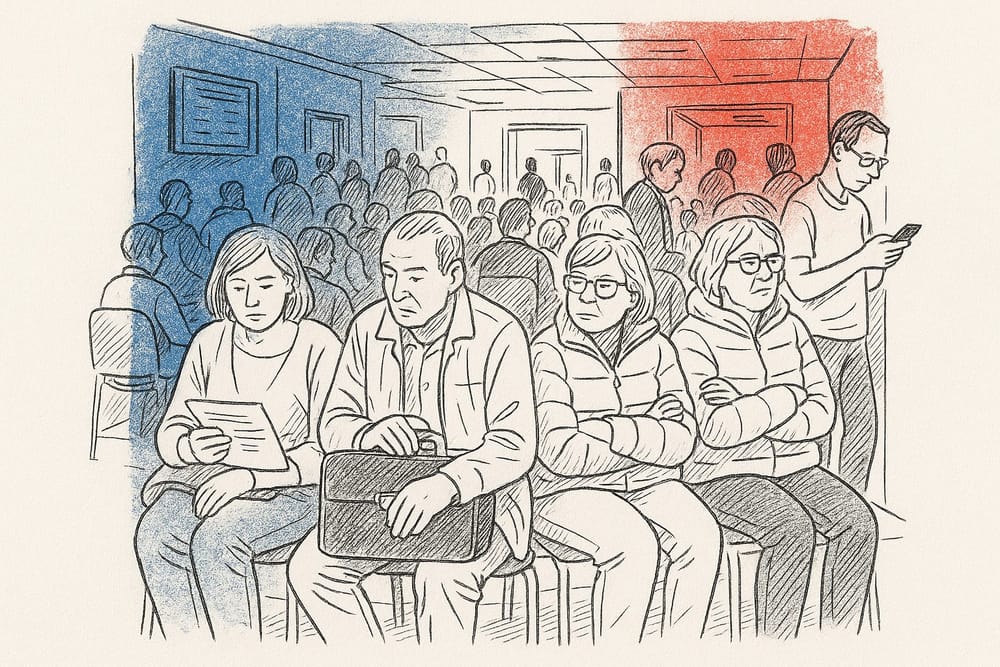
Only 42 percent of people aged 60-64 are employed in France. The system spends 388 billion euros per year, or 14 percent of GDP [1]. Three days of social benefits out of thirty are financed by borrowing passed on to future generations [12]. Raising the retirement age without making the end of career viable transfers the cost to those already holding on the shortest: manual workers, whose life expectancy is six years lower than that of senior professionals [10]. This is the trade-off of 2027.
Fourteen percent of GDP, revenues that are eroding
Retirement is France’s largest budget item. It absorbs 388.4 billion euros in 2024 [1]. That is nearly 14 percent of GDP, four points more than Germany. This single item accounts for 24.4 percent of all public spending [1].
This weight appears stable, but its financing is eroding. The system posted a deficit of 1.7 billion euros in 2024 [1]. The COR’s projection worsens the diagnosis: −0.2 percentage points of GDP in 2030, or 6.6 billion euros in current terms [1]. By 2070, the deficit would reach −1.4 percentage points of GDP [1].
The movement does not come from spending. It slides from 13.9 percent of GDP in 2024 to 14.2 percent in 2070 [1]. It comes from revenues, which erode from 13.9 percent to 12.8 percent of GDP over the same period [1]. Three causes: the decline in public sector workforce, contribution exemptions, less favorable demographics.
Contributions paid by working-age people represent 65.1 percent of the system’s resources in 2024 [1]. Added to this are government coverage for civil servants, CSG, and transfers from external agencies. The funds hold 213.8 billion euros in reserves [2]. The Pension Reserve Fund holds an additional 20.4 billion euros [2].
In 1980, debt financed 1 percent of annual social spending. In 2025, it finances 10 percent [12]. Out of 30 days of retirement, RSA, health benefits, and housing allowances paid each month, 3 days are financed by borrowing. Of the 3,346 billion euros in public debt accumulated since 1974, at least 2,000 billion corresponds to social benefits financed on credit, according to Nicolas Dufourcq in La dette sociale de la France [12].
The retirement age advances, but France remains far behind its partners
Since 1997, France has conducted eight parametric reforms. In 2023, the average age of retirement reaches 62 years and 8 months [5]. That is two years and two months more than in 2010, before the reform that took effect that year.
International comparison reveals a persistent gap. In 2024, the average retirement age is 61.9 years for French men and 62.4 years for French women [7]. The OECD average for people entering the labor market in 2024 is 66.4 years [7].
The gap is even more visible for people aged 60-64. In France, 42.4 percent of this age group is employed in 2024 [9]. In the EU-27, the proportion is 53.1 percent [9].
In 2024, Germany employs 75.2 percent of its 55-64-year-olds. The Netherlands reaches 75.3 percent the same year [7]. France struggles at 60.4 percent for the same age group, according to the OECD [7].
Life expectancy after exiting the labor market reaches 26.1 years for French women and 22.5 years for men [7]. The OECD averages are 22.8 years and 18.7 years respectively [7]. The average length of retirement in France was 23.3 years for men in 2022, the highest of the countries examined by the COR [1]. Germany shows 18.8 years over the same period [1].
The central asymmetry of the French system is there: exiting the labor market early reduces revenues and simultaneously lengthens the duration of payments.
A declining replacement rate, deep inequalities hidden beneath the average
The replacement rate—the percentage of former income that a pension provides—declines from generation to generation, regardless of sector or scheme [1]. In the COR’s central scenario from June 2025, it reaches 45 percent in 2070 [1]. A pension equal to 45 percent of last income marks the end of the retirement model as continuity of living standards.
The average obscures documented inequalities. In 2023, the median living standard of retirees stands at 1,994 euros per month [3]. But 10 percent of retirees live on less than 1,193 euros per month that same year [3].
In 2023, the poverty threshold is set at 1,217 euros per month. At the other extreme, 10 percent of retirees have more than 3,411 euros [3]. The ratio between these two thresholds is 2.9 [3].
The gap between women and men remains very significant. In 2023, women receive a direct pension 38 percent lower than that of men [4]. In 2004, this gap was 50 percent [4]. When including survivor’s pension, the gap narrows to 25 percent in 2023 [4].
The heaviest inequality is the one the debate on age most often ignores. A male senior professional lives on average six years longer than a manual worker [10]. This inequality persists almost unchanged since the 1970s. Senior professionals also collect their retirement longer: among men, they receive it 2.8 years longer than manual workers [3]. Their life expectancy is 3.3 years higher [3].
This mechanism reveals the regressive bias of a purely parametric reform based on age. Uniformly raising the retirement age reduces the pensions of manual workers proportionally more. They already retire late relative to their disability-free life expectancy.
In 2024, at age 65, men can expect to live 10.5 years without disability [6]. Women, 11.8 years [6]. Disability-free life expectancy at age 65 has increased by one year and nine months since 2008. Its progress has stalled since 2019 [6].
Work becomes untenable well before the retirement age
Since 1993, each reform has used the same lever: lengthening the contribution period or raising the legal age. This logic rests on an implicit assumption: that a 60-year-old employee can work until 64 or 65. Employment data on older workers contradicts it [9].
In 2024, 77.8 percent of people aged 55-59 are employed [9]. Then only 42.4 percent of those aged 60-64 remain so [9]. This 35-point drop in five years reveals a problem that pension law does not directly control: working conditions. Bruno Palier documents this in his work on European pension reforms: intensified work and the impossibility of having one’s voice heard fuel resentment toward successive reforms [13].
How companies manage human resources weighs as much as retirement departure rules on senior employment rates, as shown by analyses by Hippolyte d’Albis [14]. Raising the legal retirement age without improving working conditions for 55-64-year-olds swells the ranks of people neither employed nor retired [9]. This is a problem of work quality before it is a problem of legal age.
Out of 100 people in OECD countries, the number of people aged 65 and over will rise on average from 33 in 2025 to 52 in 2050 [7]. This demographic challenge is shared: 19 of 38 countries will raise the retirement age [7]. Sweden has chosen a retirement age adjusted to life expectancy. This mechanism decouples the political decision from the electoral calendar and reduces uncertainty for the youngest insured [7].
Making the end of career viable, correcting inequalities across working lives
Facing imbalances between revenues and spending, the COR identifies three levers in its June 2025 report: lower spending, raise contributions, or raise the retirement age [1]. These levers can be combined according to the retained objectives regarding equity, competitiveness, and retirees’ living standards.
The Lecornu suspension froze the debate until January 2028. The Prime Minister put a price tag on it: 400 million euros in 2026 and 1.8 billion in 2027, to be offset by savings [16]. The freeze does not cancel the 2023 reform. It will be part of the 2027 debate.
To balance the system using only the retirement age lever until 2070, this age would need to be raised to 64.3 years by 2030, then to 65.9 years by 2045, then to 66.5 years by 2070 [1]. Acting on this single parameter passes the cost to the less qualified and those most exposed to work-related strain. Manual workers whose life expectancy is six years lower than that of senior professionals bear the brunt first [10].
The demographic constraint is real. The ratio of contributors to retirees fell from 2.1 in 2000 to 1.7 in 2024 [1]. It will reach 1.4 by 2050 [1]. The recurring trap of French reforms is treating the legal age as the only parameter. The actual age at which people exit the labor market depends on conditions that pension law does not control.
Making collective bargaining on end-of-career issues binding and indexing ages to health
The central trade-off of 2027 is to make binding on companies the obligation to negotiate age management, with real penalties for failing to reach an agreement. The alternative is to continue steering the system through legal age while keeping working conditions outside the framework.
This choice changes what happens between 55 and 64. The employment rate of 60-64-year-olds, at 42.4 percent in 2024, is the variable that conditions everything else [9]. Mechanisms for part-time work late in career financed by the pension scheme, like those implemented in Nordic countries, make it possible to extend working life without worsening inequalities from work-related strain [8].
The trade-off is real: small and medium-sized businesses cannot alone bear the cost of training and adapting job positions. A mutualized mechanism is essential. Without it, formal obligation remains without effect.
Deeply reforming work-related strain completes this first lever. Strain criteria were narrowed in 2017. Restoring a measure of exposure over the entire career, not only at the end, would make it possible to base the trade-off between contribution length and early retirement on a verifiable individual reality [14].
Progressively index retirement ages to disability-free life expectancy, not total life expectancy. In 2024, at birth, women can expect to live 64.1 years without disability [6]. Men, 63.7 years [6]. The gap between the sexes is five months for this indicator in 2024.
For total life expectancy, it is five years and seven months [6]. Indexing to total longevity mechanically favors the most long-lived social categories. Indexing to disability-free life expectancy is more equitable. It also requires annual public monitoring of this indicator [6].
Correct the pension gap between women and men at the source. The 38 percent gap in 2023 does not narrow through survivor’s pension mechanisms, which create their own financial dependence [4]. It is corrected upstream: genuine wage equality, retirement rights based on income actually received during parental leave at its true value, validation of periods of reduced activity at their fair level. Robust childcare policy is, in the end, a retirement policy for women [13].
Contribution exemptions on low wages represent lost revenue for the system whose effectiveness for employment is not regularly established [1]. Clarifying the architecture distinguishing contributory benefits from transfers financed by taxes is the condition for genuine accountability of actors.
There remains the basis lever. The system’s revenues erode from 13.9 percent to 12.8 percent of GDP by 2070 because they rest on contributions based on the wage bill [1]. Basing employer contributions on the company’s added value, as the manifesto for this series proposes, is the structural response to this erosion. A company creating wealth then contributes, whether it employs a hundred people or ten robots.
Communicating to the insured their individualized retirement assets would allow workers to understand what they can actually expect [15]. The crisis of confidence of young generations in the system stems in part from the opacity of their future rights, a doubt that the COR itself documents [1].
Repealing or amending the 2023 reform without addressing these questions simply displaces the problem by a few years.
Sources
[1] COR, “Annual Report: Evolutions and Prospects for Retirement in France,” June 2025, https://www.cor-retraites.fr/sites/default/files/2025-06/RA_2025_def_publi.pdf (accessed 09/09/2026).
[2] Court of Auditors, “Financial Situation and Prospects of the Pension System,” February 2025, https://www.ccomptes.fr/sites/default/files/2025-02/20250220-Situation-financiere-et-perspectives-du-systeme-de%20retraites_0.pdf (accessed 09/09/2026).
[3] DREES, “Retirees and Retirement: 2025 Edition,” July 2025, https://drees.solidarites-sante.gouv.fr/publications-communique-de-presse-documents-de-reference/250731_PANORAMAS-retraites (accessed 09/09/2026).
[4] DREES, “Retirees and Retirement: 2024 Edition,” October 2024, https://drees.solidarites-sante.gouv.fr/publications-communique-de-presse-documents-de-reference/panoramas-de-la-drees/241030_Retraites_2024 (accessed 09/09/2026).
[5] DREES, “The Average Retirement Age and Its Evolution: Sheet 15,” 2025 edition, https://drees.solidarites-sante.gouv.fr/sites/default/files/2025-07/Fiche%2015%20-%20L%27%C3%A2ge%20moyen%20de%20d%C3%A9part%20%C3%A0%20la%20retraite%20et%20son%20%C3%A9volution.pdf (accessed 09/09/2026).
[6] DREES, “Disability-Free Life Expectancy at Age 65 Is 11.8 Years for Women and 10.5 Years for Men in 2024,” Studies and Results, January 2026, https://drees.solidarites-sante.gouv.fr/publications-communique-de-presse/etudes-et-resultats/260122-ER-esperance-de-vie-sans-incapacite (accessed 09/09/2026).
[7] OECD, “Pensions at a Glance 2025,” data from https://www.lafinancepourtous.com/decryptages/finance-perso/retraite/retraite-comment-ca-marche-ailleurs/ (accessed 09/09/2026).
[8] Senate, “Incidence of Senior Employment Rate on the Financial Balance of the Pension System,” Report No. 616, May 2025, https://www.senat.fr/rap/r24-616/r24-6162.html (accessed 09/09/2026).
[9] DARES, “Senior Employment: 2024 Indicators,” from https://evaluation.securite-sociale.fr/home/retraite/29-ameliorer-le-taux-demploi-des.html (accessed 09/09/2026).
[10] COR, “Measuring Gaps in Health and Life Expectancy Related to Occupational Risks: Session of February 6, 2025,” https://www.cor-retraites.fr/sites/default/files/2025-02/Doc_02_%C3%89carts%20EV%20cadres-ouvriers_Insee%20Premi%C3%A8re.pdf (accessed 09/09/2026).
[11] Bruno Palier, Reforming Retirement, Presses de Sciences Po, June 2021; interview CNRS Le journal, https://lejournal.cnrs.fr/articles/la-longue-histoire-des-retraites-et-de-leurs-reformes-en-europe (accessed 09/09/2026).
[12] Nicolas Dufourcq, France’s Social Debt, 1974-2024, Odile Jacob, October 2025; summary at https://journaldunprogressiste.fr/fiche-lecture-dette-sociale-france-dufourcq-2025/ (accessed 09/09/2026).
[13] Bruno Palier, Reforming Retirement, Presses de Sciences Po, June 2021; interview CNRS Le journal, https://lejournal.cnrs.fr/articles/la-longue-histoire-des-retraites-et-de-leurs-reformes-en-europe (accessed 09/09/2026).
[14] Hippolyte d’Albis, Seniors and Employment, Presses de Sciences Po, 2022; review OpenEdition, https://journals.openedition.org/lectures/56308 (accessed 09/09/2026).
[15] Bertrand Martinot, Work Is the Solution, 2025, presentation at https://www.wikiberal.org/wiki/Bertrand_Martinot (accessed 09/09/2026).
[16] Prime Minister Sébastien Lecornu, general policy statement, October 14, 2025, https://www.info.gouv.fr/actualite/ce-qu-il-faut-retenir-de-la-declaration-de-politique-generale-de-sebastien-lecornu (accessed 09/09/2026).
[17] François Ecalle, “The Situation and Prospects of Pension Schemes,” Fipeco, updated 2026, https://www.fipeco.fr/fiche/La-situation-et-les-perspectives-des-r%C3%A9gimes-de-retraite (accessed 09/09/2026).