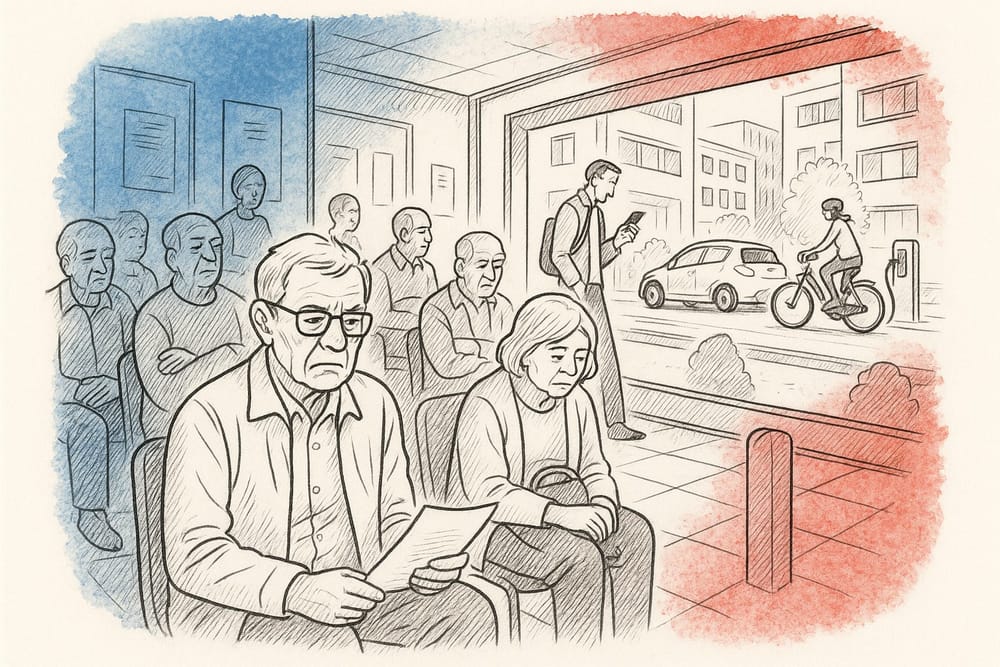
Turning 50 in France and losing your job statistically means risking never finding another one. In 2025, 39.1% of unemployed people aged 50 or older have been without work for at least one year [7]. France employs only 60.3% of its 55-64 year-olds, according to INSEE, compared with 75.2% in Germany and 75.3% in the Netherlands [10].
This fifteen-point gap is not cyclical. It is the product of three decades of policy that has multiplied jobs by lowering their entry cost, without addressing either the conditions that exhaust seniors or the funding base that finances their prolonged unemployment. Generative AI makes this trade-off urgent: approximately 5 million positions could be threatened within five years [21], precisely in the categories that feed unemployment insurance financing. The choice in 2027 concerns the architecture of financing, not a slider adjustment.
A Record Employment Rate That Masks Two Persistent Anomalies
The progress is real. The unemployment rate rose 2.9 points between 2008 and 2013, stabilized, then fell 3.1 points between 2015 and 2022 [9]. In 2025, 69.3% of 15-64 year-olds are employed, a record since 1975 [7]. Yet this level remains below the OECD average. In Switzerland, the Netherlands, and Iceland, the rate exceeds 80% [11].
The feminization of employment is a solid achievement. The female employment rate has risen 12.1 points over thirty years [6]. That of men has barely moved, hovering around 69%, until the post-Covid rebound [6].
Two anomalies persist, at both ends of working life.
On the seniors side, progress exists but remains insufficient. The activity rate of 50-64 year-olds reaches 72.0% in 2024, or 18.4 points higher than in 2000 [6]. For 60-64 year-olds, it has nearly quadrupled since 2000 due to pension reforms [6]. European comparison remains severe.
The employment rate of 55-64 year-olds stands at 65.2% in the EU and exceeds 75% in Denmark, Germany, the Netherlands, Estonia, Czechia, and Sweden [10]. France reaches only 60.3%, according to INSEE [10]. For 60-64 year-olds specifically, the European average is 53%. Sweden reaches 69.5%, Germany 66.8%, the Netherlands 68.7% [10]. France remains below the average.
On the young side, the signal has reversed. The employment rate of 15-24 year-olds had increased sharply in 2021 and 2022, driven by the boom in apprenticeships. It fell 0.6 points in 2024, to 34.4% [6]. By end 2025, nearly 1.5 million young people were in a NEET situation, neither employed nor in education nor in training [26]. This represents about 15% of France’s youth, a level nearly twice that observed in Germany or the Netherlands [26].
7.9% Unemployment, and 5.5 Million People Constrained
In the fourth quarter of 2025, the number of unemployed people by ILO definition reaches 2.5 million [3]. The rate stands at 7.9%, up 0.6 points from the fourth quarter of 2024 [3]. This is the highest level since the third quarter of 2021.
Unemployment alone is insufficient to measure tensions. In 2024, 1,939,000 people belong to the unemployment halo—those marginally attached to the labour force—representing 4.5% of 15-64 year-olds [1]. This is a slight decrease of 0.2 points compared with 2023 [1]. Over the year 2025 on average, 5.5 million people aged 15 to 64 are constrained in their labour supply [5]. The constraint rate reaches 16.6% of the broad working-age population [5].
Contract quality is improving, but slowly. For the third consecutive year in 2025, the share of fixed-term jobs in total employment is declining. It stands at 9.4% [7]. But the long-term trend tempers this optimism. Job precarity has more than doubled in forty years.
France shows 15.5% temporary employment, compared with 12.8% on average in the European Union [10]. Young people account for most of this stock. The precarity rate among those under 25 reached 18.7% in 1982 [14]. It rose to 49% in 1999, then to 58.5% in 2016 [14]. It has fallen slightly to 56% since 2017 [14].
Long-term unemployment has been declining since its 2016 peak. In 2024, the long-term unemployment rate stands at 1.7% of the active population, down 1.4 points from the previous peak in 2016 [4]. But in 2025, 39.1% of unemployed people aged 50 or older have been without work for at least one year [7]. Once disengagement sets in after age 50, it becomes very difficult to reverse.
Three Mechanisms That Produce the Senior Fracture
The record employment rate aggregates incomparable situations. A senior reclassified at 62 into a downgraded job, a young person in a six-month apprenticeship, a forced part-time position at 20 hours weekly: all appear in the numerator [6]. Three mechanisms produce this distribution.
The first is structural and documented for thirty years. French labour market activation instruments have primarily reduced the cost of low-skilled work, through massive exemptions from social contributions on low wages. This choice supported employment in the short term. It also kept in operation a segment of low-productivity jobs with minimal training and wage progression. Supporting cheap work for decades cost the state a fortune, without improving work quality or company performance [23].
The causal chain is precise. A low-skilled, poorly paid job generates fewer contributions. It produces more spells of unemployment and greater social spending. It generates less investment in human capital. The wage exemption strategy thus manufactured the imbalances it claimed to correct.
The second mechanism is the senior trap. In 2024, Germany employs 75.2% of its 55-64 year-olds [10]. The Netherlands employ 75.3% [10].
French people declare they want to retire at an average age of 60.8, compared with 64.5 for Germans [16]. This gap correlates with lower job satisfaction measured by the European survey on working conditions [16]. Seniors who lose their jobs after age 55 are less likely to find another [15]. Raising the retirement age without improving employment conditions transfers long-term unemployment to the halo without keeping seniors employed.
The third mechanism is the only one not yet appearing in labour market statistics: the deployment of generative AI and its agentic forms. The Employment Threat and Emerging Jobs Observatory (OEM), co-founded by Axelle Arquié of CEPII with Coface, published in March 2026 the most granular mapping to date of French employment exposure to AI [21]. Result: 3.8% of jobs are currently vulnerable to generative AI [21]. This rate jumps to 16.3% within a two- to five-year horizon [21]. This represents approximately 5 million positions from a base of 30 million [21].
This technology will impact all sectors, not just tech [21]. Its main target differs from previous automation waves. It targets repetitive cognitive tasks, formerly the refuge of qualified office jobs. A shock of this magnitude on the labour market could produce a very violent scissor effect for public finances [20].
The risk is also fiscal. The white-collar workers concerned—administrative executives, lawyers, accountants, analysts—are precisely the categories paying the highest social contributions. A financing model built on payroll contributions is structurally exposed to this shock.
Unemployment insurance spending reaches 45.3 billion euros in 2025 [18]. Unédic’s net debt at end 2025 reaches 58.4 billion euros [18]. This debt was deepened during successive shocks. It makes the system highly sensitive to a second shock to skilled employment.
Carl Benedikt Frey emphasizes in How Progress Ends (2025) that technological progress can produce stagnation rather than shared growth if the dominant actors in a general technology capture most of the productivity gains [25].
Shifting Part of Social Financing From Wages to Added Value and Algorithmic Capital
French employment policy has multiplied jobs by lowering their entry cost. The data are clear: more jobs, but many of them offer little training, little advancement, low productivity [6]. Continuing down this path means consolidating a base of jobs vulnerable to AI. It also maintains social protection financing whose funding base will shrink.
The architectural choice for 2027 is to shift part of social protection financing from payroll contributions alone to added value and algorithmic capital of firms. The double shock is documented: AI destroys the tax base while increasing compensation needs [20]. Once this base reform is underway, social protection no longer depends on the white-collar payroll mass. Employer exemptions can then be redirected toward skills development rather than maintaining low wages, without further deepening Unédic’s debt.
This choice makes possible what pension reform alone cannot produce. The fifteen-point gap with Germany and the Netherlands on senior employment requires a work-quality strategy across the entire career path [15]. The aim is to create employment that lasts, not merely employment that counts in the statistic. French people declare they want to retire at an average age of 60.8, compared with 64.5 for Germans, and this gap correlates with the experienced quality of work [16].
This choice has an identifiable cost. Broadening the base toward added value or algorithmic capital increases the contribution of capital-intensive firms. It also makes the continuation of exemptions without quid pro quo inadvisable. Daron Acemoglu and Simon Johnson identify the institutional balance of power as the decisive variable between AI that benefits workers and AI that benefits capital [24].
Without institutional framework, AI productivity gains go to capital. Adjustment costs go to labour. Unemployment insurance debt goes to the state [25]. After base reform, social protection financing rests on something other than the payroll mass of those in employment alone. It is a different system, with different winners and losers.
Sources
[1] INSEE, “Halo Around Unemployment and Underemployment,” Employment, Unemployment, Labour Income, June 2025, https://www.insee.fr/fr/statistiques/8376850 (accessed 07/09/2026).
[2] INSEE, “In the Fourth Quarter 2024, the Unemployment Rate Is Nearly Stable (7.3%) and the Employment Rate Falls 0.2 Points (68.9%),” Rapid Information no. 34, February 2025, https://www.insee.fr/fr/statistiques/8351234 (accessed 07/09/2026).
[3] INSEE, “In the Fourth Quarter 2025, the Unemployment Rate Reaches 7.9%,” Rapid Information no. 34, February 2026, https://www.insee.fr/fr/statistiques/8735266 (accessed 07/09/2026).
[4] INSEE, “Essential Facts on… Unemployment,” updated May 2026, https://www.insee.fr/fr/statistiques/4805248 (accessed 07/09/2026).
[5] INSEE, “Constrained Situations on the Labour Market,” Employment, Unemployment, Labour Income, July 2026, https://www.insee.fr/fr/statistiques/8733069 (accessed 07/09/2026).
[6] INSEE, “A Snapshot of the Labour Market in 2024,” INSEE Première no. 2044, March 2025, https://www.insee.fr/fr/statistiques/8391807 (accessed 07/09/2026).
[7] INSEE, “A Snapshot of the Labour Market in 2025,” INSEE Première no. 2096, July 2026, https://www.insee.fr/fr/statistiques/8901327 (accessed 07/09/2026).
[8] INSEE, “Evolution of the Active Population,” Employment, Unemployment, Labour Income, June 2025, https://www.insee.fr/fr/statistiques/8376846 (accessed 07/09/2026).
[9] INSEE, “Evolution of Unemployment,” Employment, Unemployment, Labour Income, June 2025, https://www.insee.fr/fr/statistiques/8376836 (accessed 07/09/2026).
[10] INSEE, “Employment and Unemployment in Europe,” France, Social Portrait, November 2025, https://www.insee.fr/fr/statistiques/8612578 (accessed 07/09/2026).
[11] OECD, Labour Market Situation, Q3 and Q4 2024, January 2025, https://www.oecd.org/content/dam/oecd/en/data/perspectives/publications-statistiques/2025/1/labour-market-situation-oecd-01-2025-En.pdf (accessed 07/09/2026).
[12] OECD, OECD Employment Outlook 2024: France Country Note, June 2024, https://www.oecd.org/en/publications/2024/06/oecd-employment-outlook-2024-country-notes_6910072b/france_b842dc68.html (accessed 07/09/2026).
[13] DARES, Temporary Employment Down Again in Q1 2025, DARES Indicators no. 25, May 2025, https://dares.travail-emploi.gouv.fr/publication/lemploi-interimaire-de-nouveau-en-baisse-au-1er-trimestre-2025-05 (accessed 07/09/2026).
[14] Directorate General for Labour, 2025 Labour Inspectorate Campaign: Precarity, Annex 3, 2025, https://idf.drieets.gouv.fr/sites/idf.drieets.gouv.fr/IMG/pdf/dgt_campagneprecarite_annexe03_fichepresentationexterne.pdf (accessed 07/09/2026).
[15] Senate, Impact of Senior Employment Rate on Pension System Financial Equilibrium, Report no. 616, May 2025, https://www.senat.fr/rap/r24-616/r24-6162.html (accessed 07/09/2026).
[16] OFCE, “Maintaining Seniors in Employment in Europe,” OFCE Review no. 184, 2024, https://www.ofce.sciences-po.fr/pdf/revue/2024/4-184OFCE.pdf (accessed 07/09/2026).
[17] Unédic, Unédic Financial Forecasts: February 2025, https://www.unedic.org/publications/previsions-financieres-de-l-unedic-fevrier-2025 (accessed 07/09/2026).
[18] Unédic, Financial Situation of Unemployment Insurance 2025-2027, June 2025, https://www.unedic.org/storage/uploads/2025/06/12/Situation-financire-Assurance-chmage-2025-2027-12-juin-2025.pdf (accessed 07/09/2026).
[19] FIPECO, “Unemployment Insurance,” François Ecalle, 2025-2026, https://www.fipeco.fr/fiche/Lassurance-ch%C3%B4mage (accessed 07/09/2026).
[20] Axelle Arquié (CEPII / OEM), “The Double Shock of AI: Employment and Taxation,” Political Economy, 2026/2 no. 110, https://shs.cairn.info/publications-de-axelle-arquie–111394 (accessed 07/09/2026).
[21] Coface / OEM (Axelle Arquié), Mapping of French Employment Exposure to AI, March 2026, https://anthemcreation.com/en/artificial-intelligence/ai-jobs-5-million-at-risk-france-coface-oem/ (accessed 07/09/2026).
[22] Bertrand Martinot and Franck Morel, Work Is the Solution: Reconciling the French with Work, Hermann, June 2025.
[23] Bruno Palier and Christine Erhel, Working Better, PUF, September 2025.
[24] Daron Acemoglu and Simon Johnson, “Can A.I. Be Pro-Worker?”, The New Yorker, 2026, https://www.newyorker.com/contributors/john-cassidy (accessed 07/09/2026).
[25] Carl Benedikt Frey, How Progress Ends: Technology, Innovation, and the Fate of Nations, Princeton University Press, 2025.
[26] Businesses for the City, “What Proportion of French Youth Are NEET Today?”, July 2026, https://www.reseau-lepc.fr/le-saviez-vous-quelle-proportion-des-jeunes-francais-sont-aujourdhui-sans-emploi-sans-etudes-ni-formation-neet/ (accessed 07/09/2026).