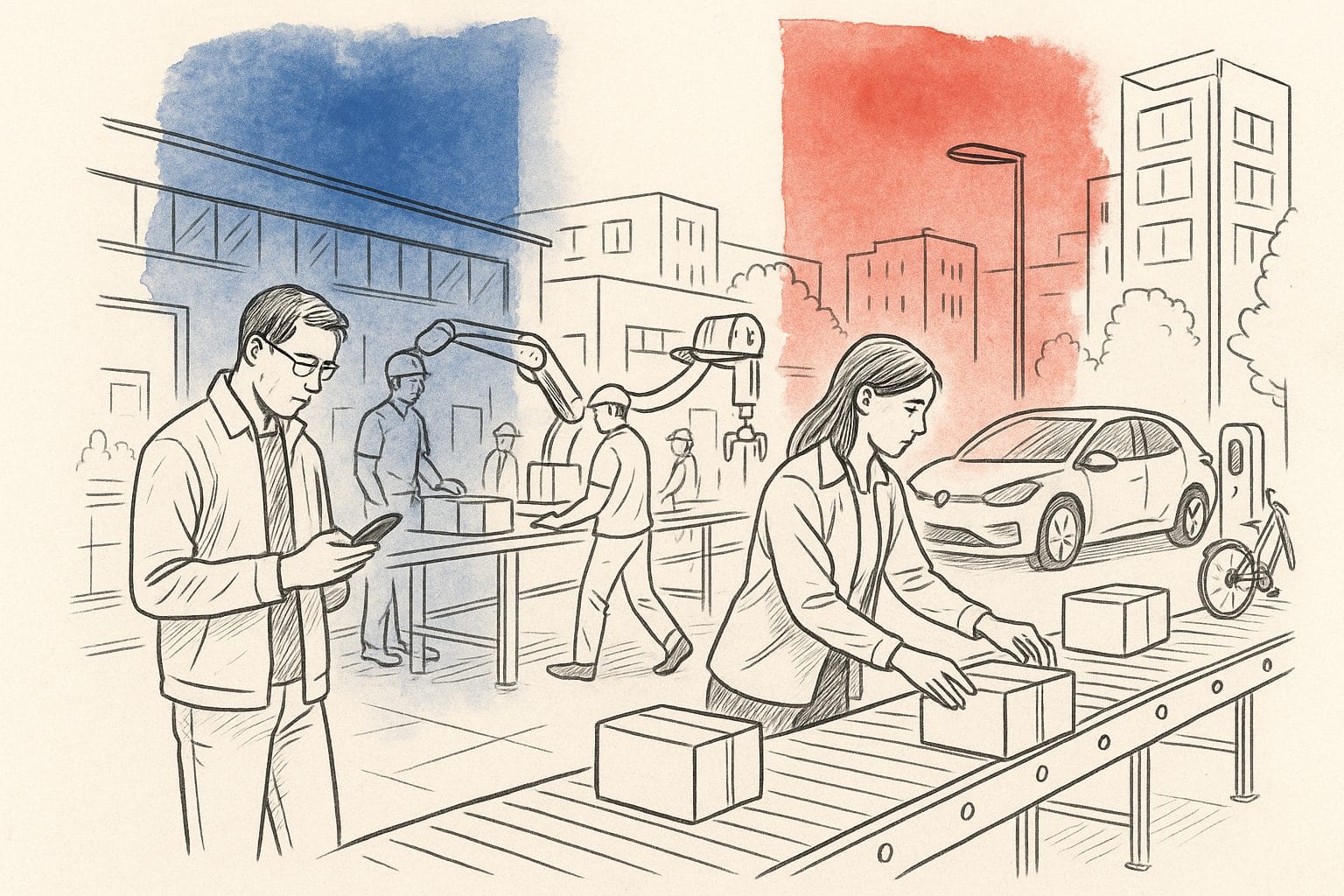
The EU Makes Its Rules Its New Weapon for Economic Conquest
The Carbon Border Adjustment Mechanism should create substantial additional revenues in the years to come. The AI Act generates a rapidly growing compliance market, with an increasing number of artificial intelligence systems to certify. The Critical Raw Materials Act restructures global supply chains for strategic raw materials. The European Union is no longer content to simply regulate its internal market — it exports its standards and captures a rent on certifying their compliance.
This strategy is redrawing global trade flows. Non-European companies must now comply with Brussels’ rules to access the European market, creating a certification ecosystem dominated by continental actors. Compliance becomes more effective than tariffs for filtering trade.
The Essentials
- The European compliance market represents several tens of billions of euros by 2030, dominated by continental certificators
- The CBAM has already generated significant revenues since January 2024 for an increasing number of industrial facilities
- A significant number of AI systems will need to obtain European certification costing between 100,000 and 500,000 euros each
- Chinese companies are investing massively in European compliance teams, up to several tens of millions of euros per group
The CBAM Transforms CO2 Into European Currency
The Carbon Border Adjustment Mechanism has imposed on importers since January 2024 the requirement to purchase certificates equivalent to the European carbon price. The affected sectors — steel, cement, aluminum, fertilizers, electricity — represent several billion tons of annual global emissions.
Bureau Veritas, SGS and TÜV SÜD share a significant portion of the European carbon verification market. These three European groups now certify the emissions of an increasing number of global industrial facilities exporting to the EU. Each CBAM certificate costs between 50 and 90 euros per ton of CO2, depending on fluctuations in the European carbon market.
China is adjusting its industrial strategy. Steel giant Baowu Steel is investing heavily in decarbonizing its export-oriented steel mills. India is launching its own carbon pricing system to avoid paying the European rent. Brazil is negotiating a mutual recognition agreement on climate standards with Brussels. These reactions confirm the mechanism’s effectiveness: global producers are adapting their production methods to European requirements rather than losing access to the continental market.
Artificial Intelligence Europeanizes Algorithmic Control
The AI Act creates the world’s first regulatory framework for artificial intelligence. Having entered into force in August 2024, this legislation imposes mandatory certification for all “high-risk” AI systems used on European territory. The affected sectors cover education, employment, public services, health and transportation.
A significant number of AI systems will require certification in the coming years. The average cost of certification ranges between 100,000 and 500,000 euros depending on system complexity. This rapidly growing market primarily benefits European notified bodies, the only entities authorized to issue certifications.
Google, Meta and OpenAI are establishing European compliance teams of several hundred people each. These American companies are investing tens of millions of euros annually in making their algorithms compliant. Chinese groups like ByteDance and Baidu are spending substantial amounts adapting TikTok and their AI services to European standards. This compliance race enriches an ecosystem of legal consultancies, technical auditors and certification bodies concentrated in Europe.
Europe is building its AI Factories and discovering that governance matters as much as GPUs, creating a regulatory advantage that complements its technological investments.
Critical Raw Materials Reshaping Global Supply Chains
The Critical Raw Materials Act identifies 34 strategic materials for the European energy transition. This legislation requires that 10% of the EU’s annual consumption come from recycling by 2030, that 40% of processing be carried out in Europe, and that no single country supplies more than 65% of any critical material.
These quotas are upending markets dominated by China. Beijing controls a significant share of rare earth refining, Congolese cobalt production and global lithium extraction. New European rules are forcing continental industrialists to diversify their supplies and invest in local processing capacity.
Northvolt is building a large-scale battery recycling facility in Sweden to recover lithium, cobalt and nickel. BASF and Umicore are developing rare earth separation technologies to reduce Chinese dependence. Rio Tinto is investing heavily in expanding its lithium mine in Serbia, Europe’s future largest mining operation.
This strategy is costly but working. European imports of Chinese rare earths declined notably between 2023 and 2024. Certification prices for “European” raw materials — extracted, processed and recycled according to continental standards — command substantial premiums over world prices.
Certification Captures More Value Than Production
The European economic model is evolving. Rather than competing head-to-head with Chinese or American producers on costs, the EU is positioning itself as the guardian of global standards. This strategy echoes that of the pharmaceutical industry, where the American FDA and European EMA control access to the most solvent markets.
EY, KPMG and PwC have created European regulatory compliance divisions employing an increasing number of specialized consultants. These firms charge between 1,500 and 3,000 euros per day for compliance consulting. TÜV Rheinland and Intertek are opening certification centers in Asia to get closer to producers wanting to export to Europe.
Certification revenues are growing faster than European industrial production revenues. Bureau Veritas posted substantial growth in its regulatory compliance activities in 2024. SGS is investing heavily in new testing laboratories to meet demand for environmental and digital certification.
This dynamic is transforming European companies into collectors of regulatory rents. They don’t necessarily produce better or cheaper goods, but they control access to the continental market by defining and certifying quality standards.
The Limits of Protectionism Through Standards
The system has loopholes. Chinese companies are partially circumventing European rules by creating continental subsidiaries that certify their products. CATL, the world’s leading battery manufacturer, has opened a factory in Germany that gives it access to the “Made in Europe” label while importing its cells from China.
Compliance costs penalize European SMEs as much as foreign competitors. A French AI startup spends proportionally more to comply with the AI Act than an American tech giant able to amortize these investments over millions of users. This asymmetry paradoxically favors established multinationals.
The EU’s trading partners are contesting these measures. The WTO is examining several complaints against the CBAM, accused of disguised protectionism. The United States is negotiating exemptions for its technology companies facing the AI Act. China is developing competing standards to reduce its dependence on European certifications.
Europe is betting on open data to compete with AI giants, but this open strategy contrasts with increasing regulatory closure.
Europeanized Globalization in Question
The EU is succeeding in exporting its standards beyond its borders. The United Kingdom is adopting rules similar to the AI Act. Canada is drawing inspiration from the CBAM for its own carbon mechanism. Australia is negotiating mutual recognition of key European certifications. This normative influence partially compensates for continental industrial decline.
But this strategy generates hidden costs. European consumers pay more for certified compliant products. Continental companies lose competitiveness in third markets where European standards don’t apply. Regulatory complexity discourages innovation in certain over-regulated sectors.
The effectiveness remains to be proven against stated objectives. Does the CBAM actually reduce global emissions or simply shift polluting production to less demanding markets? Does the AI Act protect European citizens or delay the adoption of useful innovations? Do raw material quotas secure European supply or create new vulnerabilities?
These questions will determine whether Europe succeeds in transforming compliance into a sustained strategic advantage or whether it is simply building a regulatory Maginot Line that competitors will eventually circumvent. The answer will depend on its capacity to maintain the attractiveness of its market while hardening access conditions.