By 2070, France will have 1.3 active workers for every retiree, compared to 1.7 today. The 2026 report from the Pension Orientation Council adopts an assumption of 0.7% annual hourly productivity growth from 2040 onward; the average observed between 2010 and 2024 is 0.3% per year. Three levers exist to bridge this gap: higher contributions, lower pensions, and longer working lives. Their combination will determine which generation bears the cost.
The Essentials
- The COR projects a 1.3 active-to-retiree ratio by 2070, compared to 1.7 in 2026: structural pressure on a system that dedicates 422.2 billion euros in 2025, or 14.1% of GDP, to retirement benefits.
- The COR 2026 reference scenario rests on annual hourly productivity growth of 0.7%; without genuine improvement in this trajectory, the pay-as-you-go model accumulates a scenario deficit.
- Three levers exist—contributions, pensions, retirement age—and their dosage is a political choice, not a mechanical necessity.
- Multiple analyses point to institutional brakes on extending working life as a factor in productivity stagnation.
- The long-term question—whether to maintain pure pay-as-you-go or introduce partial capitalization—remains open; the answer depends on choices about employment, training, and taxation that are being made now.
Demography Transforms the Intergenerational Contract
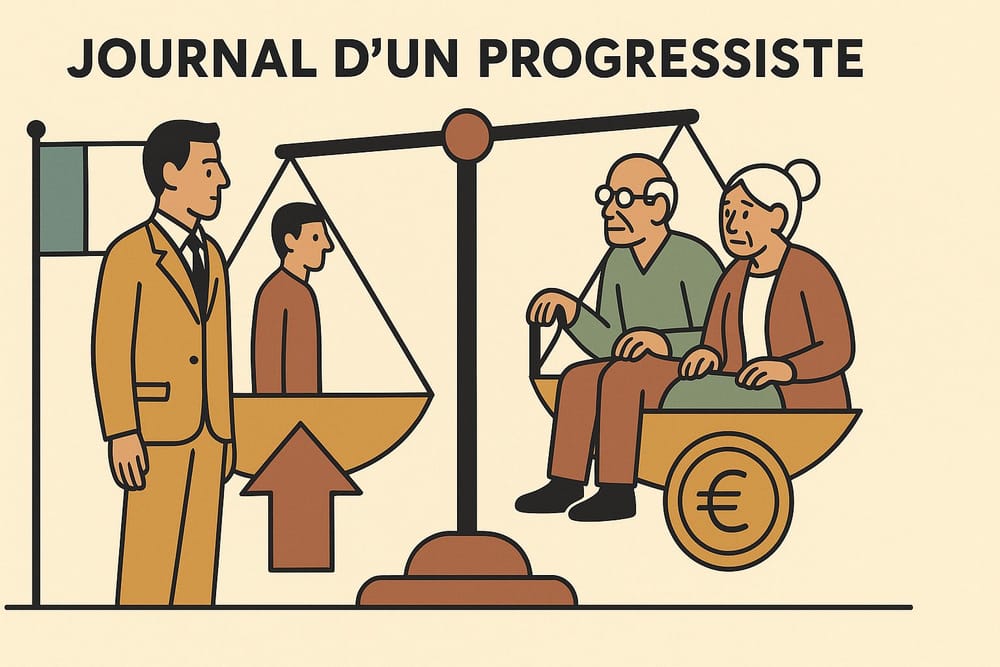
Pay-as-you-go systems rest on a simple premise: today’s workers fund today’s retirees, and future generations will do the same for them. A favorable ratio of contributors to retirees facilitates this balance, but other determinants come into play: pension levels, contribution rates, employment and wages, public transfers. At 1.7 to 1, the system already strains under tension. At 1.3 to 1, each retiree will be financed by fewer than one and a half active workers.
This demographic compression results from two cumulative forces. The first is longevity: the French live longer, which mechanically extends the duration of pension payments. The second is the low fertility of past decades, which today feeds a less dense labor market. Immigration provides partial compensation, but insufficiently to reverse the trend according to long-term INSEE projections.
The 2026 COR report shows that these two forces act simultaneously and sustainably. The ratio of 1.3 active workers per retiree by 2070 is the culmination of a trend already weighing from the 2030s onward. French retirement spending, estimated at 422 billion euros in 2025, or 14.1% of GDP, ranks among Europe’s highest; it will need to be distributed across a proportionally narrower base of contributors, or the system must adjust.
The Productivity Assumption: The Bet on Which Everything Rests
The pay-as-you-go model requires workers sufficiently productive that the taxable wage base compensates for demographic effects. The second figure in the COR report thus becomes decisive.
The COR 2026 reference model assumes hourly productivity growth of 0.7% per year. Hourly productivity has grown approximately 0.4% per year over the past fifteen years, while the average over twenty-five years stands at 0.7%. Over a decade, this gap is manageable. Over forty-five years—the horizon of the 2070 projection—this divergence from actual productive improvement represents a substantial gap between projected financing and available financing.
The work Work is the Solution (2025), co-written by Bertrand Martinot and Franck Morel, addresses several work-related levers, including retirement, training, and taxation. Various institutional factors can reduce incentives to extend professional activity. The 0.7% assumption is based on the trend of the past twenty-five years, but it exceeds average growth observed over the past fifteen years.
This diagnosis is demanding because it identifies an institutional cause where others see demographic fatality. The good news, if one follows it, is that the productive trajectory can change. The condition is that labor market, fiscal, and training reforms genuinely alter incentives to work longer and upgrade skills.
The Financing Trilemma: Who Pays, and How Much
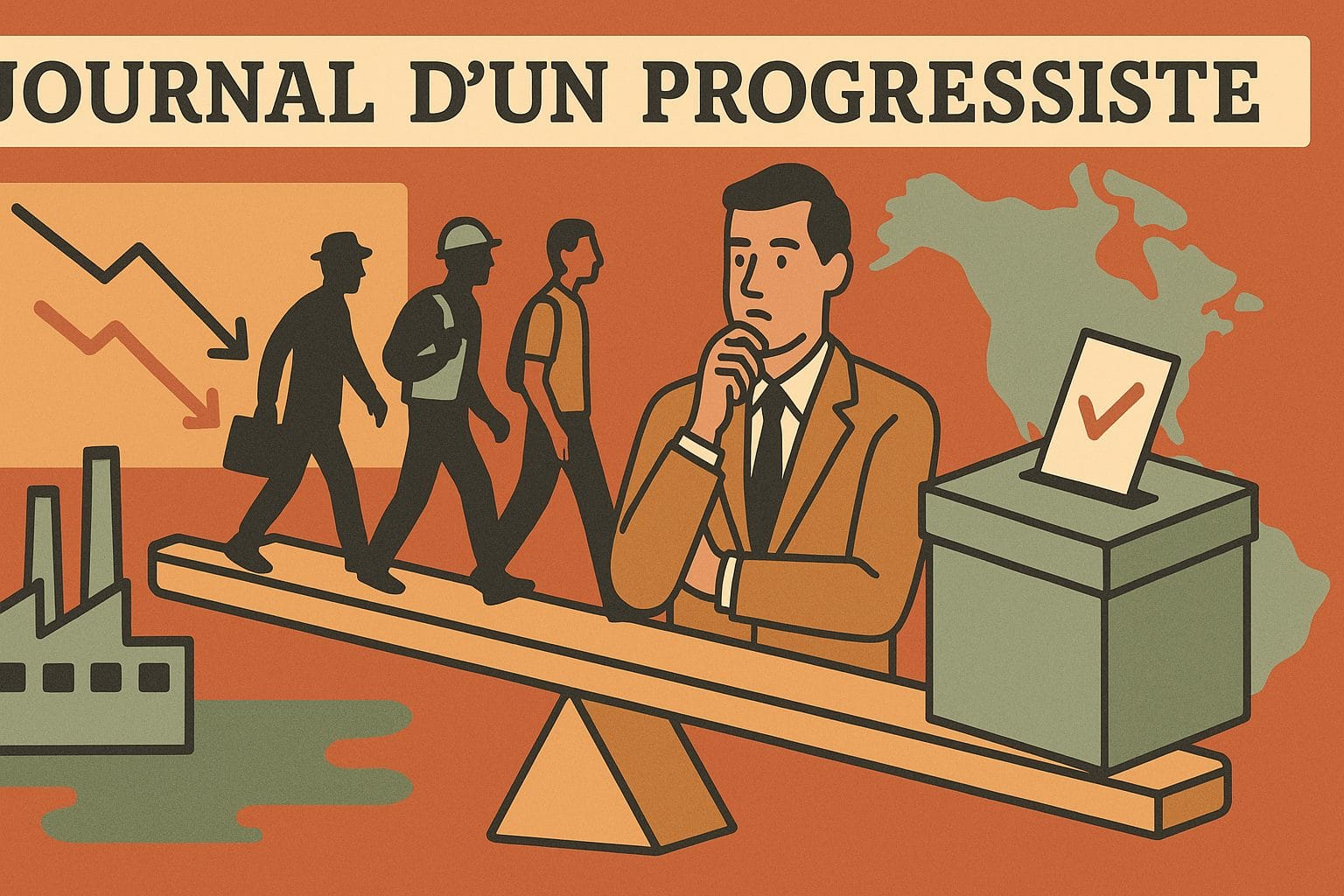
Facing a deteriorating ratio and stagnant productivity, the system has three levers. They are well known, arithmetically inevitable, and politically explosive.
The first is higher social contributions. It maintains pension levels without touching retirement age, but it increases the cost of labor and cuts workers’ purchasing power. In an economy struggling to restore industrial competitiveness, this is a choice with heavy consequences.
The second is lower pensions, through partial de-indexation or modulation based on income. This option preserves employment and competitiveness, but transfers the cost to retirees, often the most vulnerable among them. It also raises a contractual question: contributors paid in exchange for a pension promise. Devaluing it retroactively is legally and morally complex.
The third is extending working life—through retirement age, contribution duration, or both. The 2023 reform, which raised the legal age from 62 to 64, already took this path. But given a ratio that must fall from 1.7 to 1.3 by 2070, the progress made remains partial. The COR identifies three levers that can be used individually or combined, depending on political choices and objectives regarding equity, competitiveness, and living standards.
Dani Rodrik, economist of regulated globalization, reminds us that employment quality matters as much as quantity: precarious, physically demanding, or poorly paid jobs extended by two years do not reconstitute a robust contribution base. The financing trilemma is thus both arithmetic and qualitative. Sustaining professional activity until 64 or 65 requires transformations of working conditions that neither the 2023 law nor COR projections directly address.
It should be noted here that the question of employment after 60 remains very unequally distributed: working late is often possible in skilled metropolitan areas, far less so in industrial or rural territories where bodies wear out and retraining opportunities are rare.
Lessons from European Comparison
France is not alone in facing this demographic pressure. Germany, Italy, and Spain face comparable trajectories. But their dosing choices diverge, revealing different philosophies of the intergenerational contract.
Germany chose combination: gradual increase in retirement age to 67, pension moderation during deficit periods, and development of complementary retirement savings (Riester-Rente) encouraged through fiscal incentives. The result is not perfect—the German replacement rate is today among Europe’s lowest—but the system is financially sustainable according to 2040 projections.
Sweden chose a different architecture: notional accounts where each contributor accumulates rights indexed to actual economic growth, not fixed rules. When demography worsens, pensions adjust automatically, without political shocks. The adjustment is built into the contract from the start, which reduces its perceived harshness.
These models share a point the France has not yet fully integrated: transparency on the adjustment mechanism. Contributors know how the system responds to shocks. In France, each adjustment takes the form of a political reform, with its conflictual burden. This structural opacity of the contract makes adjustments costlier socially than they would be in a system where the rules are known in advance.
The question of caregivers overlaps this picture: as the population ages, care needs grow, and some active workers leave the labor market to care for dependent relatives. This silent flow weighs on both the wage base and social accounts well beyond retirement alone.
Can the Pay-As-You-Go System Hold Until 2050 Without Additional Structural Levers
The 2070 horizon of the COR report seems distant. It illuminates today’s choices only when read backward to the present. Decisions about employment, training, and taxation made over the next decade determine the productive trajectory of the 2040-2050 years, and thus the system’s sustainability well before 2070.
A question beginning to circulate in social policy circles is that of partial capitalization. Not as a replacement for pay-as-you-go, but as a complement designed to smooth demographic shocks. The Cercle de l’Épargne, in its 2026 work, stresses that several countries that maintained a pay-as-you-go foundation introduced a complementary capitalization pillar, built over several decades. The generations involved contribute without current pensions being called into question.
This scenario raises a fundamental objection: introducing capitalization in a period of budget constraint supposes that contributors simultaneously finance two systems, current pensions and their own future savings. This double contribution is a real effort, which cannot be obscured behind technique. Transition generations bear the weight. The question is whether this burden is less than that of an adjustment by pay-as-you-go alone in forty years.
The COR reference scenario combines INSEE’s central demographic assumptions, fertility of 1.45 children per woman, net migration of 150,000 persons per year and projected life expectancy, with 0.7% annual hourly productivity from 2040 onward. If Martinot is right about the source of the productivity deficit, the cultural and institutional reforms he advocates can change the trajectory, but they produce effects over several years. Political decisions must therefore anticipate, not react.
A signal to watch: the employment rate of 60-64-year-olds. Currently around 44% according to INSEE data, this rate is the most direct indicator of the system’s capacity to widen its contribution base without further reform of the legal age. Its progress, or stagnation, will tell more about the model’s sustainability than any fifty-year projection.
The 2023 Reform Is Insufficient, but It Asks the Right Questions
The 2023 pension reform crystallized major social conflict around two years, 62 to 64. In hindsight, this confrontation may have missed the essential: contribution duration and legal age are system parameters, but not its only levers on sustainability.
The COR integrates the 2023 reform’s effects on departures and retiree numbers, but does not conclude that it alone would have improved short-term financial trajectory or that it would be without effect on the contributor-to-retiree ratio. The COR projects the increase in retirement age as ultimately raising activity and employment, but it may also lead to short-term unemployment and displacement to other social benefits.
The useful reform, or sequence of useful reforms, is one acting simultaneously on several registers. Rethink vocational training so 50-year-old workers remain employable in recruiting sectors. Reduce fiscal inactivity traps between 58 and 64. Treat physical strain as a differentiated criterion for retirement access, rather than as a residual exception. Consider automatic smoothing mechanisms between demography and pension levels, like the Swedish model.
None of these levers alone resolves the equation. Together, they modify the trilemma’s parameters without making it disappear. The trilemma persists—it is the price of a pay-as-you-go system in an aging society. But its dosage can be chosen rather than endured.
The French system’s real margin for progress lies not in institutional upheaval. It lies in the capacity to accumulate, reform after reform, adjustments that widen the productive base, extend activity under good conditions, and perhaps build supplementary savings that absorb the shocks that pay-as-you-go alone cannot buffer by 2050.
Sources
- Pension Orientation Council, 2026 report, https://variances.eu/?p=8973
- Bertrand Martinot, Work is the Solution (2025), https://www.wikiberal.org/wiki/Bertrand_Martinot
- INSEE, long-term data on demography and employment, National Institute of Statistics and Economic Studies (no direct URL for 2070 projection)
- Cercle de l’Épargne, 2026 work on complementary capitalization, Cercle de l’Épargne (no direct URL)
- Journal d’un Progressiste, Working After 65: A Privilege of Affluent Metropolitan Areas
- Journal d’un Progressiste, The Ratio of Caregivers for Those 80 and Over Will Be Cut in Half by 2050 in Europe