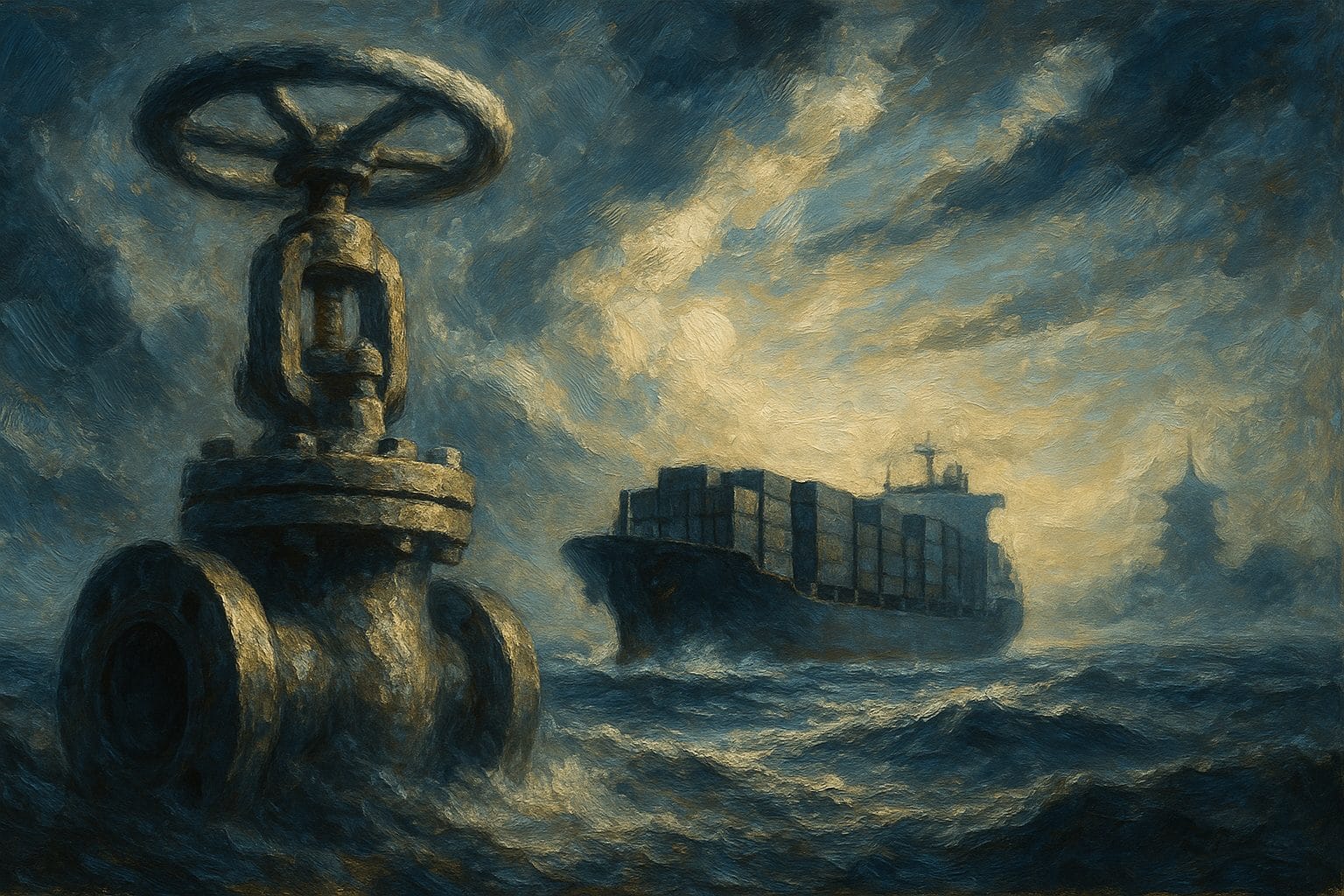
In March 2026, 60% of ships waiting outside Antwerp were unable to unload. The supply chain was operating at 70% of its capacity. Thousands of containers waited. A few months earlier, in Rotterdam, the largest lashing workers’ strike in Dutch history had paralyzed Europe’s leading port for several days, before an agreement was signed: between 17 and 21% salary increases over 2025-2027, with automatic indexation to inflation. Two ports, two crises, two forms of the same warning. Together, these two hubs handle 480 million tons per year, representing a determining share of European foreign trade.
The lesson is not that automation fails. It is that it succeeds only on one condition: that the men and women who work alongside machines have a reason to make them function.
The Essential Points
- Rotterdam experienced in October 2025 the largest lashing workers’ strike in its history; the signed agreement provides +17 to +21% salary increases over 2025-2027 with automatic indexation to inflation.
- Antwerp reached 60% of ships waiting in March 2026, with the supply chain operating at 70% capacity, according to Kuehne+Nagel data.
- The two ports together handle 480 million tons per year, representing the necessary passage for a major fraction of European trade.
- The 2015 Rotterdam Container Exchange Route contract remains the first successful model of sharing productivity gains between dock workers and automation.
- The central issue is not technical but political: who captures the gains when a mechanical arm replaces a human one.
Rotterdam is Not Europe’s Most Automated Port by Accident
Rotterdam began automating its terminals in the 1990s. The ECT Delta Terminal, one of the first in the world to deploy automatically guided vehicles, served as a large-scale experimental site. Today, Maasvlakte 2, inaugurated in 2014, is one of the most mechanized sites on the planet: automated cranes, unmanned conveyors, computerized sorting systems. The result is visible in productivity figures: Rotterdam handles approximately 15 million containers per year, a level that its human workforce alone could not sustain at the same cost.
But this infrastructure was not built in a social vacuum. It required years of negotiations, employment guarantees, training, and ultimately a document that attracted little attention from analysts at the time of its signing: the Container Exchange Route of 2015. This contract, negotiated between port operators and dock worker unions, established a simple yet politically costly principle: productivity gains generated by automation would not go exclusively to terminal shareholders. A portion would be redistributed to remaining workers, in the form of wages, bonuses, and improved working conditions.
It is this model that October 2025 put to the test.
The October 2025 Strike: When the Model Demonstrates Its Fragility
Lashing workers are those who secure and release containers on ships, a physical, skilled profession, irreplaceable in the short term even in a highly automated port. Their October 2025 strike was not an improvised movement. It came after months of blocked negotiations over salary revision, in a context where inflation had eroded the real wages of a significant fraction of Dutch port workers.
The strike paralyzed operations for several days. For a port moving cargo at this scale, each day of stoppage cascades outward: import delays, surcharges for shippers, emergency reorganization among carriers. The financial impact is difficult to isolate, but estimates from the ETF (European Transport Workers’ Federation) and logistics operators converge: a strike of this duration at Rotterdam costs tens of millions of euros per day in direct and indirect disruptions.
The agreement signed upon exit from the conflict, at +17 to +21% over three years with automatic indexation to inflation, is significant for two distinct reasons. The first is financial: it is one of the largest salary increases ever obtained in the European port sector over so short a period. The second is structural: automatic indexation marks the end of a logic in which workers had to renegotiate their purchasing power in each inflationary cycle. It transforms the wage contract into a mechanism, not a balance of power to be renewed.
What happened in Rotterdam in October 2025 is not a failure of automation. It is a demonstration that automation without redistribution accumulates a social debt that eventually must be paid, one way or another.
Antwerp, the Reverse Side: Insufficient Automation Also Costs
Two hundred kilometers to the southwest, Antwerp illustrates the opposite problem. The Belgian port is Europe’s second largest and a central hub for chemicals, grains, and containers. But its level of automation is significantly lower than Rotterdam’s, and social tensions around its modernization have so far slowed transformation projects.
In March 2026, data compiled by Kuehne+Nagel and reported by The Loadstar indicated that 60% of ships were waiting before the Antwerp quays. The supply chain was functioning at 70% of its theoretical capacity. The causes are multiple: congestion, shortage of skilled labor in certain positions, bottlenecks in terminal management, and delays in infrastructure investments that should have been undertaken years earlier.
The paradox is brutal. Antwerp suffers precisely from the ailments that Rotterdam attempted to prevent through automation: a supply chain under tension, saturated capacity, productivity that no longer absorbs volumes. A port that does not automate to avoid social conflict finds itself confronted with a different form of crisis, quieter but equally costly.
This point deserves to be stated clearly: the cost of not automating is not zero. It is measured in ships that wait, in clients seeking alternative routes, in market share slipping toward Hamburg or Felixstowe, in investors recalibrating their supply chains to escape a node that has become unreliable.
The question posed to Antwerp is therefore not “should we automate?” but “under what conditions, and with whom?”
The 2015 Model: Sharing Gains, Not Eliminating Them
To understand what makes the Rotterdam 2015 contract important, one must grasp what it avoided. In most port automation experiences worldwide, the standard pattern is this: operators invest in machines, reduce their workforce, capture productivity gains through improved margins, and leave remaining workers negotiating from a degraded position of power. This model has worked short-term in several Asian ports. It also generates lasting conflicts, recurring strikes, and union hostility that impedes subsequent modernization steps.
The Container Exchange Route attempted something different. By accepting that automation gains be partly redistributed through higher wages and workforces maintained beyond strict operational minimums, Rotterdam operators bought something difficult to quantify but essential: buy-in. Remaining dock workers have concrete reasons to want the system to function well, not to sabotage it.
This is not industrial philanthropy. It is long-term calculation. An automated port with hostile or demoralized workers does not deliver on its productivity promises. Incidents multiply, maintenance is neglected, procedures are followed to the letter rather than in spirit. Conversely, workers who are parties to productivity gains have reason for machines to run well, to report malfunctions, to train newcomers.
This logic resonates with a broader finding documented in data on automation and employment: companies that treat their workers as partners in the transition, rather than as costs to be compressed, achieve better operational results over the medium term. What happens in industries that automate without redistributing can be read in American data with disheartening precision: productivity climbs, wages wait, and social tension accumulates to a breaking point.
What These Two Experiences Change for European Ports
Hamburg, Le Havre, Genoa, Barcelona: each of Europe’s major ports watches Rotterdam and Antwerp with attention. They have their own automation schedules, their own union histories, their own budget constraints. But the lesson from the two cases of 2025-2026 is transferable with little adjustment.
First lesson: the negotiation window narrows as investment is engaged. Rotterdam negotiated before building Maasvlakte 2, which gave it leverage. A port that automates first and negotiates later finds itself in structural weakness: unions know the infrastructure is in place, that sunk costs are committed, and that a conflict costs all the more. Chronology matters.
Second lesson: automatic wage indexation is not an anachronistic social achievement. It is a conflict stabilizer. By eliminating the need to renegotiate purchasing power in each inflationary surge, it reduces the frequency of friction points. The Rotterdam agreement made it a central element; other ports could draw inspiration not from ideology but from pragmatism.
Third lesson: Antwerp’s congestion has geopolitical effects. When Europe’s second port operates at 70% capacity for several weeks, it is not only Belgian shippers who suffer. It is the supply chains of the entire Rhine region, of industrialized Switzerland, of French firms transiting through Flanders. Port reliability is a silent infrastructure of European competitiveness, as much as electrical networks or rail connections.
The European Commission launched in 2024 a review of European port policy, partly to draw lessons from tensions of the past decade. Preliminary conclusions point toward better coordination on automation standards and associated social models. But recommendations are not yet translated into obligations.
Sharing Gains Is Not a Luxury of Growth Periods
The argument usually opposed to Rotterdam-type models is economic: in a competitive sector, sharing productivity gains with workers degrades competitiveness against ports that do not. The argument has an appearance of rigor. It collapses against the data.
The most automated Asian ports, often cited as models of productivity without social concessions, operate in radically different institutional contexts. Direct comparison is misleading. Singapore PSA Corporation is a state enterprise operating in an environment where independent unions do not exist in the European sense of the term. Yantian or Tianjin function under a labor regime whose parameters have nothing to do with those of the Netherlands or Belgium.
In the European context, with active unions, a tradition of collective bargaining, and legal frameworks protecting the right to strike, the model of total gain capture by operators is not stable. It periodically collapses into long and costly strikes. The question is therefore not philosophical but accounting-based: how much does a strike lasting several days cost at Rotterdam’s scale, compared to the cost of a 17 to 21% salary increase over three years?
The answer, for anyone who followed the costs of the October 2025 strike, is that the agreement was probably cheaper than the prolonged conflict it averted.
This returns to a deeper tension, documented by economists like Daron Acemoglu and Simon Johnson in their analysis of who captures gains from technological progress: the central question is not whether technology creates value, but who benefits and by what mechanisms. Automation that concentrates its gains without redistribution generates a political and social dynamic that ultimately constrains the technology itself.
Rotterdam as Laboratory of an Exportable Model
The 2015 contract and the 2025 agreement do not constitute a fixed ideal. They outline a principle: negotiate upstream, redistribute a measurable share of gains, treat port workers as stakeholders in productivity rather than as residual costs.
This principle is now being tested in other sectors. The debate on automation and employment extends far beyond the quays: it traverses warehouses, assembly lines, logistics centers. In each case, the same tension reproduces between operators who see automation as cost compression and workers who see it as a threat to their income. Rotterdam shows that a third way exists, not from idealism, but because the two alternatives are more costly.
One open uncertainty remains: does the model hold when the pace of automation accelerates? The next wave of port robotics, including AI systems for real-time flow optimization, will further reduce the number of indispensable human posts. The fewer workers there are, the weaker their negotiating leverage, and the less incentive operators will have to share gains. The question for European ports is therefore not whether Rotterdam’s model worked in 2015 and 2025, but whether it will still function in 2030, and under what institutional conditions.
Antwerp cannot wait to have the answer before it begins to negotiate.
Sources
- ETF — Rotterdam dockers show the power of unity (October 2025)
- The Loadstar — coverage of Antwerp congestion (March 2026), no stable URL available
- Kuehne+Nagel — port congestion data (March 2026), internal report cited by The Loadstar
- Port of Rotterdam Authority — capacity and traffic data 2024-2025, available at portofrotterdam.com