In France, the AI job market has become stratified in recent years. For an LLMOps Engineer in Paris, Silkhom indicates 85 to 105 k€ for a confirmed profile and 105 to 125 k€ for a senior. Mass training has developed skills related to AI usage, while some bootcamp graduates access positions in system design or management. The divide is already drawn, and its perpetuation is not a technical accident.
The Essentials
- The AI salary hierarchy has crystallized in France: LLM Engineers at 85-100 k€ versus augmented workers at 32-50 k€, a differential of one to three (Silkhom Barometer 2026).
- Only 5 to 8% of AI bootcamp graduates reach positions in model governance; mass training structurally feeds the lower end of the hierarchy.
- The complementarity between humans and machines exists technically, but the redistribution of gains fails due to lack of regulation of algorithmic power, a deficit that researchers working on AI governance characterize as a political choice, not a technical constraint.
- Without institutional intervention, the concentration of gains should intensify by 2030-2035; the immediate issue is to decide who accesses the levels where decisions about models are made.
Two Labor Markets in the Same Recruitment Announcement
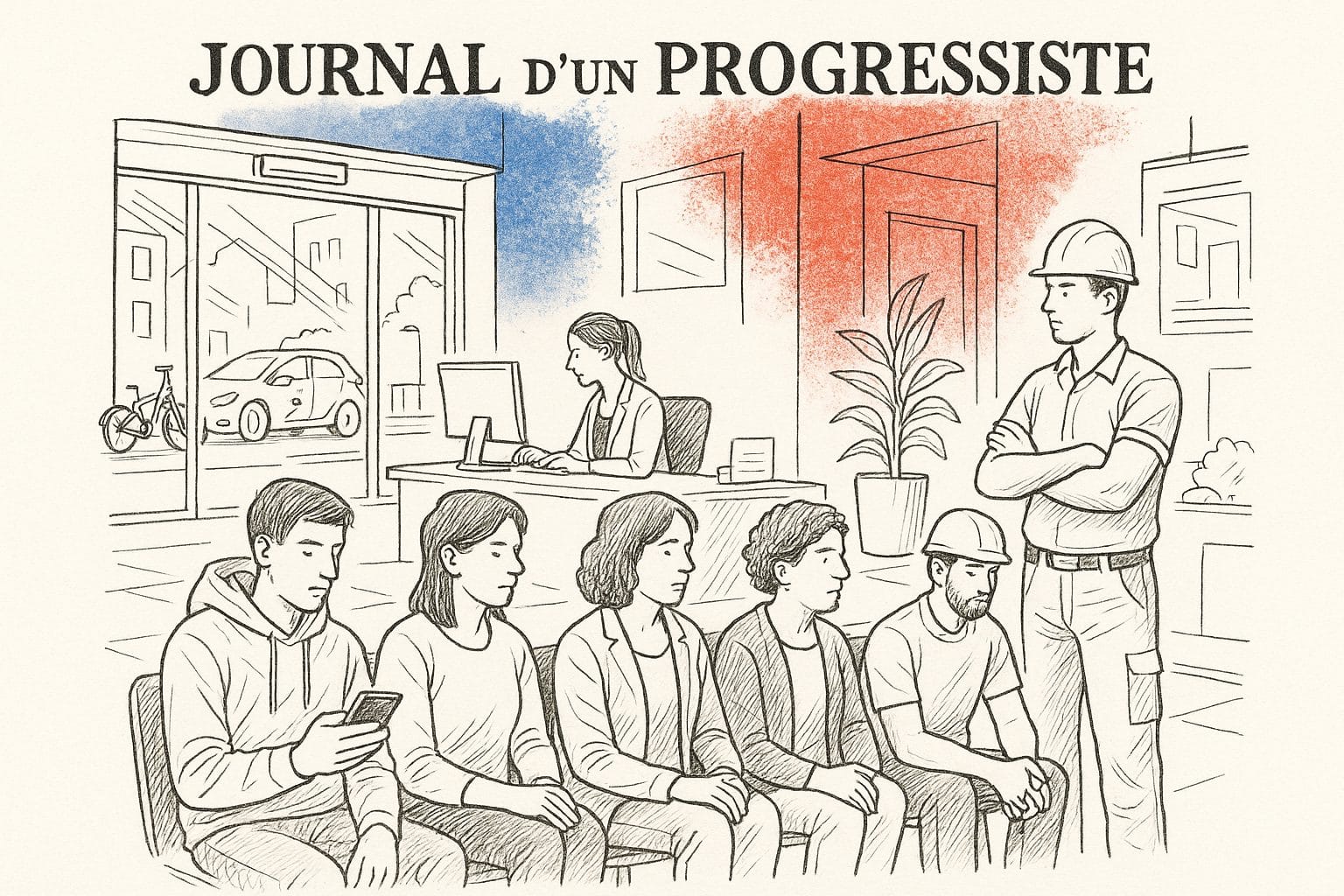
A LinkedIn post mentioning “AI profile sought” can designate two very different realities. The first is that of the LLMOps engineer, who calibrates data pipelines, adjusts training parameters, and designs safeguards for a model deployed at an organization’s scale. The second is that of the augmented worker, consultant, analyst, or content manager, whose profession has been reconfigured by AI without their position in the value chain having fundamentally changed. For a confirmed LLMOps Engineer in Paris, Silkhom indicates 85 to 105 k€ gross annual fixed salary. The floor of 32 k€ concerns a junior Prompt Engineer in regions; salaries vary according to geographic area and seniority.
This threefold differential is not new in the history of technological revolutions. What strikes here is the speed at which the line of demarcation was drawn, and the way training mechanisms consolidated it rather than crossed it. AI bootcamps developed in France in recent years: a few weeks, sometimes a few months, to learn to use tools, formulate prompts, integrate APIs into existing workflows. These trainings respond to real demand. They equip employees whose professions evolve quickly.
But they do not guarantee access to positions where decisions about models are made.
Short-form trainings can develop usage skills without systematically preparing for system design positions. The gap between the two is both technical and institutional.
The Limits of Complementarity
Economist Axelle Arquié, who works on the political regulation of AI, provides a useful framework for reading this stratification. The complementarity between humans and machines, the fact that AI increases a worker’s productivity without entirely replacing them, is real and documented. Technical complementarity alone does not determine who captures the productivity gains. Two workers equally augmented by AI can find themselves in radically different market positions depending on their access to decision-making levers about models. The redistribution of gains also depends on power relations and institutional choices.
French data from 2026 illustrates precisely this mechanism. A communications manager who uses ChatGPT to produce three times more content than two years ago is technically augmented. Their productivity has progressed. But if their salary remained at 38,000 euros while the company capturing their increased output saw its margins progress, the complementarity indeed occurred, and the gain was redistributed differently. The engineer who designed the internal deployment of the model, for their part, receives 90,000 euros.
Daron Acemoglu and Simon Johnson, in their work on institutions and technology, formulated the hypothesis that the direction of technical progress is not neutral: technologies can be oriented toward augmenting workers or substituting them, depending on technical capabilities, tasks, costs, firm organization, and the institutional framework. Applied to France in 2026, their framework invites examination of the role of institutions in salary stratification. The article “AI Is Everywhere but Remains Invisible in Accounts” had documented this statistical invisibility of the phenomenon, the fact that productivity gains linked to AI struggle to materialize in aggregate indicators. Salary stratification may be the first place where they become visible, concentrated in a small number of positions.
Mass Training in Structural Deadlock
One should avoid concluding too quickly that AI bootcamps are useless. They are not. For an accountant, a lawyer, a marketing manager who must integrate AI tools into their daily professional life, an intensive training of a few months represents a real gain in skills and often job security. France Stratégie analyzes task transformations and recommends anticipating training needs. Bootcamps partially fill this gap.
These positions can offer limited career development prospects.
These positions generally require advanced technical skills and, in the profiles studied by Silkhom, a Bac+5 level. These skills are acquired over several years, in long-form trainings, master’s degrees, engineering schools, doctorates, whose access remains strongly correlated with classic social determinants: school background, family economic capital, networks. The AI market can reproduce inequalities in access to qualifications and remuneration. This is an old problem brought to a new scale of pay.
The challenge for training policies is therefore not to multiply bootcamps—supply is already abundant, sometimes excessive, with very heterogeneous quality. It is to fund long-form pathways for populations that do not spontaneously access them: deep reconversion for experienced employees, parallel routes toward master’s levels for self-taught profiles, reinforcement of professional degrees in computer science in public universities. Some experiments exist, the Grande École du Numérique program, certain AFPA initiatives, but their scale remains marginal relative to needs.
Algorithmic Governance as a Regulatory Issue
Behind the salary question, a broader question emerges. Positions in model governance, those that salary barometers call LLMOps, MLOps, AI Safety Engineers, or company AI managers, do not merely produce technical gains. They decide, in practice, on the rules that AI applies at scale in an organization: which biases are filtered or not, what types of decisions are automated, what safeguards are put in place for edge cases.
These decisions have distributive effects. An HR scoring algorithm that penalizes candidates with career gaps makes a decision that touches millions of applications. A dynamic pricing model calibrated by an LLM Engineer directs considerable economic flows. The composition of these teams and the regulatory framework can influence the distribution of gains linked to AI.
Decisions about models can have political effects and call for a responsibility framework. The concentration of governance skills in one part of the labor market raises the question of power distribution over AI systems. The European AI regulation attempts to frame this situation through transparency and audit obligations for high-risk systems, without however addressing the distribution of human competencies that would enable such control.
“Three Frameworks for AI Agents, None to Converge Them” had highlighted this regulatory fragmentation at the European level. The AI Act mainly frames systems and also imposes AI culture obligations, without organizing equal access to long-form governance trainings.
The Crystallization of 2026 and Its Extensions Through 2030-2035
Current salary data are not a stable snapshot. They describe a situation likely to evolve according to labor market transformations and public policies.
A first scenario, called unequal complementarity, extends the current trend. Compensation gaps between specialties could persist or evolve according to qualifications, firms, and training policies. In this scenario, salary gaps and possibilities of mobility toward decision-making positions could evolve unevenly. France Stratégie examines several scenarios and recommends anticipating transformations linked to AI.
A second scenario, more favorable, assumes deliberate intervention on at least two levers. The first is formational: develop long-form pathways toward AI professions for publics with little access to them. The second is regulatory: transparency requirements can increase the need for oversight and compliance, without in themselves imposing internalization or particular distribution of these competencies within the company. This scenario is not utopian. Germany, through its dual training structures, and Denmark, through its active reconversion policies, have demonstrated that technological transitions could be accompanied without leaving the market alone to draw the hierarchy.
The signals to follow to distinguish the two trajectories are legible: the evolution of the rate of graduates from long-form AI trainings among those under 30 without an engineering degree; the effectiveness of audits provided for by the AI Act for HR and scoring systems; and, perhaps more revealing still, the evolution of median salary for intermediate positions, data analysts, AI consultants, in the next two years. If this segment compresses while the top of the hierarchy continues to progress, dualization will be confirmed. If it progresses, it means that technical complementarity is finally translating into real redistribution.
2026 data do not permit establishing a comparison between access to AI governance levers and access to leading schools. As explained in “The Same Interface for All, Power for One Alone”, the uniformization of the usage surface masks deep power asymmetries. The issue is to decide who participates in designing the rules, not to train more prompt engineers.
Sources
- Silkhom Barometer 2026, AI and ML Salaries in France: https://www.silkhom.com/les-salaires-ia-et-ml/
- Axelle Arquié, AI Analysis and Political Regulation: https://www.axellearquie.fr/
- Factoriel Barometer 2026, Digital Remuneration and Professions (Factoriel, link not guaranteed)
- INSEE-DARES 2026, Employment Survey, Digital Professions (INSEE, link not guaranteed)
- France Stratégie, Artificial Intelligence and Labor Market (France Stratégie, link not guaranteed)
- Daron Acemoglu and Simon Johnson, Power and Progress (2023), Basic Books