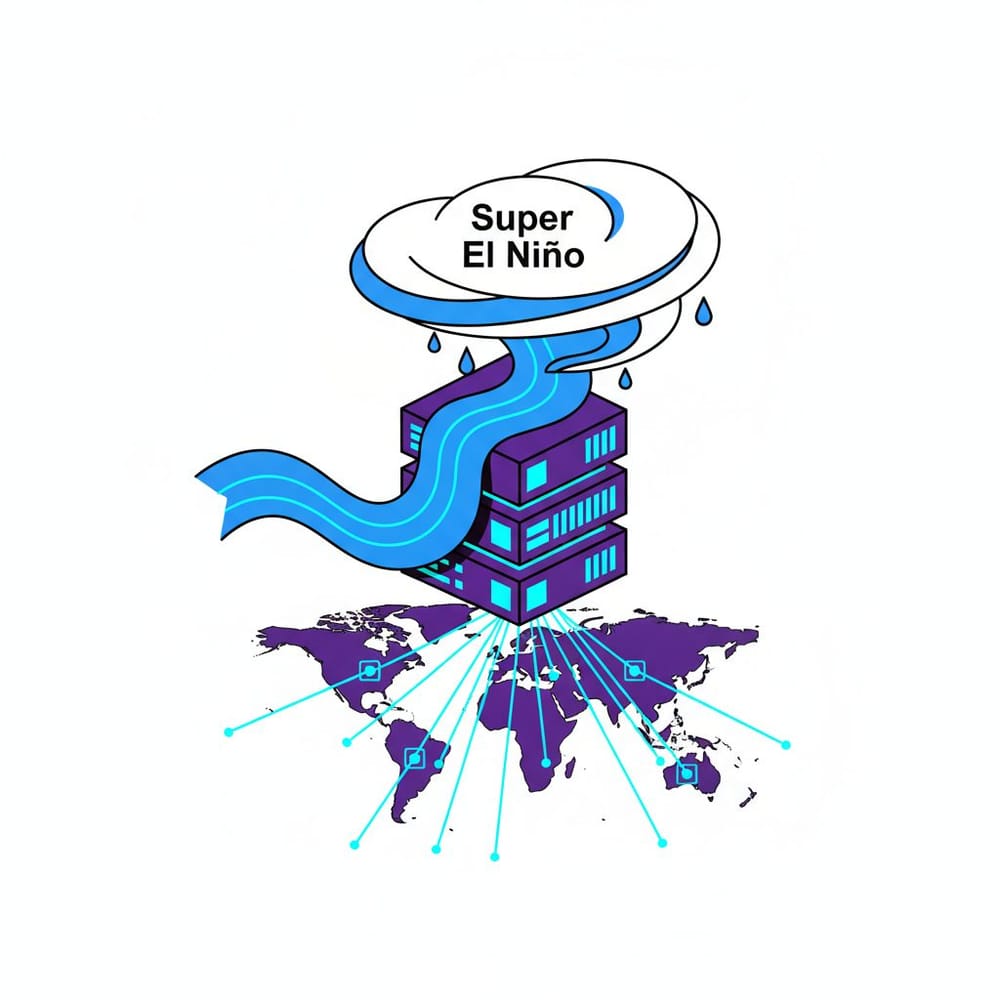
The water demand from semiconductors will skyrocket 600% by 2050. The Super El Niño shaping up for June-August 2026, with 80% probability according to the World Meteorological Organization, risks brutally revealing this critical dependency. Temperature anomalies could reach +4°C, putting pressure on a digital infrastructure that already consumes 10% of global electricity.
The economy of artificial intelligence and electronic chips rests on a resource it has long ignored: water. As data centers and semiconductor factories multiply to support the AI revolution, their water vulnerability is becoming a major geopolitical issue. The extreme climate phenomenon expected in 2026 could transform this silent dependency into an open crisis.
The Essentials
- 600% increase projected in water demand from semiconductors by 2050, according to the World Economic Forum
- 80% probability of a Super El Niño in June-August 2026 with peaks of +4°C according to the WMO
- 40% of global data centers located in water-stressed zones
- 30% of semiconductor factories located in regions at risk of water shortages
- 10% of global electricity consumption already captured by digital infrastructure
An Thirsty Industry Unaware of Its Thirst
Manufacturing a single chip requires approximately 130 liters per standard chip, or 7,500-12,000 liters for a 12-inch chip. This water, demineralized and decontaminated, serves to clean silicon wafers between each etching step. The more sophisticated chips become — moving toward 3-nanometer architectures, then 2-nanometers — the more water their production demands.
TSMC, the Taiwanese giant that produces 90% of the most advanced chips, consumes daily the water equivalent of a city of 100,000 inhabitants. Its Tainan factories use 156,000 tons of water per day, or 57 million tons annually. The company had to invest 2.8 billion dollars in recycling systems to achieve 86% reuse, but this performance remains insufficient given planned expansion.
Data centers are not far behind. Google consumes 21.2 billion liters of water annually to cool its servers, equivalent to Santa Fe’s consumption. Microsoft saw its consumption jump 34% between 2021 and 2022, reaching 6.4 billion liters. This thirst is explained by evaporation: cooling towers lose between 20% and 40% of their water into the atmosphere.
Artificial intelligence is accelerating this trend. Training GPT-3 required the equivalent of 700,000 liters of water to cool servers. ChatGPT consumes approximately 500 milliliters of water for 50 question-answer exchanges. With 100 million daily active users, this represents a billion liters per day for this application alone.
The Geography of Water Risk
The global map of the semiconductor industry reveals a dangerous concentration. Taiwan, which produces 63% of global chips, faces recurring droughts. The island experienced its worst water shortage in 56 years in 2021, forcing TSMC to bring in water by tanker trucks.
South Korea, the second producer with Samsung and SK Hynix, suffers increasingly irregular precipitation. Samsung’s factories in Pyeongtaek consume 280,000 tons of water per day, or 20% of the region’s treatment capacity. The company invested 1.7 billion dollars in a water recycling plant but remains dependent on local groundwater.
Arizona crystallizes these tensions. The American state attracts chip manufacturers — Intel is investing 20 billion dollars, TSMC 12 billion — while experiencing a 23-year megadrought. The Colorado River, which feeds Phoenix, has never been lower. Authorities have imposed water restrictions on individuals but exempt the technology industry, deemed strategic.
China is multiplying mega chip factories in semi-arid regions. SMIC is building an 18.8 billion dollar complex in Beijing, a city already short on water. Yangtze Memory plans to expand its capacity in Hubei Province, where summer droughts regularly paralyze factories.
This geography of risk extends to data centers. Amazon Web Services concentrates 40% of its European servers in the Netherlands, a country already under structural water stress. Microsoft installs its largest data centers in Arizona and Nevada, desert states. Google is building extensively in India, where 21 cities risk running out of groundwater by 2030.
The Super El Niño 2026 as Revealer
The El Niño phenomenon anticipated for summer 2026 is shaping up to be of exceptional intensity. Models from the European Centre for Medium-Range Weather Forecasts indicate an 80% probability for a major episode between June and August, with temperature anomalies potentially reaching +4°C in the tropical Pacific.
This intensity would transform El Niño into a drought accelerator. Australia, where Intel plans a mega factory, could experience its worst drought since 1902. India, an emerging hub for data centers, risks failing monsoons affecting 400 million people. East Africa, where Google and Amazon are expanding their cloud infrastructure, could see precipitation drop 60%.
The impact on the chip industry would be immediate. Taiwan Semiconductor Manufacturing Company already experienced the effects of El Niño during previous episodes: considerably reduced production, rationed water supply, significantly higher operating costs. The 2026 episode could be of unprecedented intensity.
Data centers facing exceptional temperatures would see their water consumption explode. Each additional degree increases cooling needs by 8%. A data center that normally consumes 4 million liters per day could exceed 6 million during the El Niño episode.
This crisis would reveal the scale of hidden dependencies in the digital economy. Europe, betting on its AI Factories, would discover that digital sovereignty also depends on water security. The countries that control water will control tomorrow a portion of global artificial intelligence.
The First Technological Adaptations
Facing this growing constraint, the industry is beginning to react. Microsoft is testing the immersion of its servers in baths of dielectric liquid, reducing water consumption by 95%. These “liquid cooling” systems maintain processors at optimal temperature without evaporation. The cost remains prohibitive — 40% more expensive than conventional cooling — but Microsoft plans to generalize the technology by 2027.
Google is developing predictive algorithms to optimize water use. Its data centers automatically adjust temperature and humidity according to weather conditions, saving up to 30% of water. The company is also testing desalinated seawater for its coastal installations, despite 50% higher energy costs.
Intel is revolutionizing chip manufacturing with its “dry etching” process that reduces water use by 40%. This dry etching uses ionized gases rather than liquid solutions to carve silicon. The technique, perfected on its 4-nanometer chips, will be extended to all production by 2026.
TSMC pushes recycling to the extreme with its “closed-loop” system that reuses 95% of water. Wastewater undergoes seven purification stages — filtration, reverse osmosis, distillation — to regain the required purity. The energy cost is considerable, but the company saves 200 million liters daily.
Research is exploring more radical paths. American laboratories are testing chips operating at 85°C instead of 25°C, drastically reducing cooling needs. Others are experimenting with superconducting materials that eliminate electrical resistance and thus heat.
Water Becomes a Technological Geopolitical Issue
This water dependency is reshuffling the technological geopolitical cards. Water-rich states are becoming aware of their strategic advantage. Norway is massively attracting data centers thanks to its abundant hydroelectric resources and cool climate. The country now hosts 3% of European servers on 0.6% of continental territory.
Canada is betting on its freshwater reserves — 20% of global reserves — to become a cloud computing power. Amazon is investing 15 billion dollars there, Microsoft 3.5 billion. The Trudeau government is conditioning these installations on 90% recycling quotas and priority use of renewable energies.
Finland is turning its Nordic climate into a commercial asset. Google built its largest European data center in Hamina, using Baltic Sea water directly for cooling. Energy consumption drops 50% compared to temperate installations.
Conversely, technology powers are discovering their vulnerability. Singapore, Asia’s financial and technology hub, imports 40% of its water from Malaysia. Recurring diplomatic tensions between the two countries directly threaten tech giants implanted in the city-state.
Israel is developing a technology water diplomacy. The country, a global leader in desalination, is exporting its expertise to chip manufacturers. Israeli companies IDE Technologies and Mekorot are equipping TSMC and Samsung factories with ultrapure water treatment systems.
This geopolitical reshuffling is already influencing investment strategies. American AI is discovering that water geography could limit its growth. Investment funds are now integrating “water stress” into their evaluation criteria for technology projects.
Innovation Against the Water Wall
The technology industry is entering a race for water innovation comparable to the energy efficiency race of the 2000s. Investments in “water-efficient” R&D have jumped 340% since 2020, reaching 8.7 billion dollars annually according to the World Economic Forum.
Apple is developing “water positive” data centers that produce more water than they consume. The company captures atmospheric humidity through condensation, purifies rainwater, and treats wastewater to feed local aquifers. The Maiden facility in North Carolina injects 75% of its recycled water into the regional aquifer.
IBM is testing artificial intelligence to optimize water use in chip factories. Its algorithms predict water needs 72 hours in advance, adjust production cycles according to water availability, and detect leaks before they become critical. Water savings reach 25% at pilot sites.
“GreenTech” startups are raising massive funds to solve this equation. Fluid Handling is commercializing compressed air cooling systems that eliminate water entirely. CoolIT Systems is developing integrated “liquid-cooled” chips, where liquid cooling circulates directly in the processor.
Innovation goes beyond efficiency; it rethinks the very architecture of data centers. Microsoft submerges servers in the ocean with its Natick project, eliminating the need for land-based cooling. Google is testing floating data centers powered by waves and cooled by seawater.
These innovations remain for now expensive and experimental. But water urgency is pushing them toward industrialization. The Super El Niño of 2026 could accelerate this transition by revealing the true cost of inaction.
The digital economy is thus discovering that it cannot escape physical constraints. Water becomes the next frontier of technological innovation, after energy and rare materials. Those who master this resource will hold a part of the future of artificial intelligence.
Sources