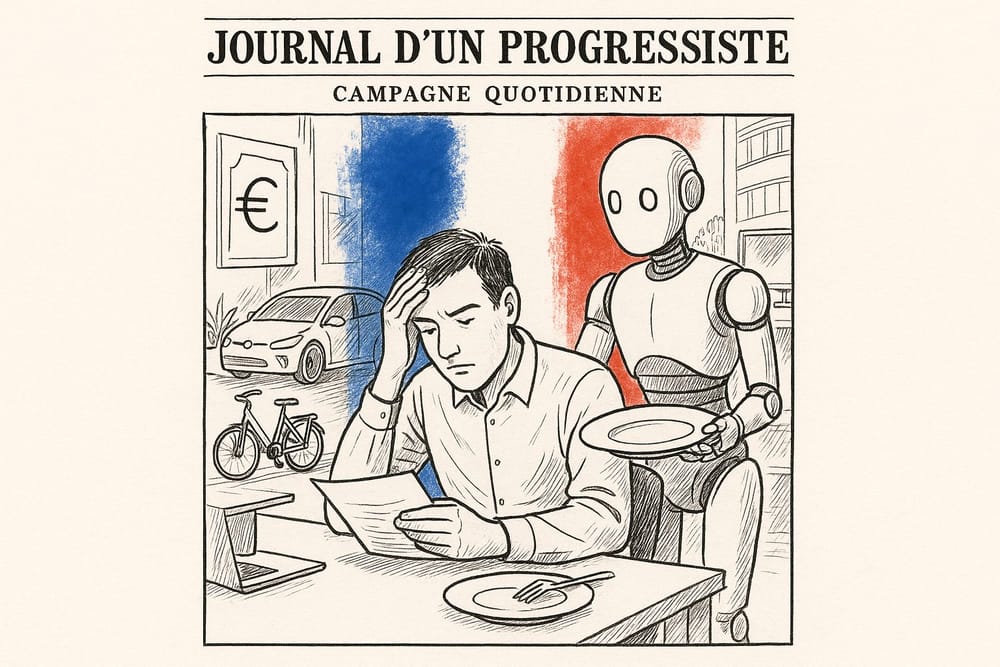
France collects 45.3% of GDP in 2024, the second-highest rate in the eurozone [1]. The 2027 choice is concrete: shift the burden from salaried work to automated capital, before AI contracts the tax base where it bears most heavily.
France, second-highest tax take in Europe spread across a poorly distributed base
The 2024 rate of 45.3% of GDP exceeds the eurozone average of 40.9% by 4.4 percentage points [1]. France ranks behind Denmark at 45.8% and ahead of Belgium at 45.1%. Germany stands at 40.9% [1].
This headline figure needs immediate qualification. The countries being compared do not produce identical services through identical financing channels. Denmark funds its welfare state through taxation; France does so through payroll contributions.
Part of the gap stems from different scopes for public administration, notably for health insurance and pensions [20]. The argument is real. It does not eliminate the structural gap: at comparable service levels, France remains at the top.
Over thirty years, the rise has occurred in stages [5]. The rate stabilized around 41% of GDP in the early 1990s. It exceeded 43% by the end of that decade.
It then grew by nearly 4 percentage points until approaching 45% in 2013. The last decade shows a dual movement: a decline from 2018 to 2024, interrupted by a temporary spike in 2022. The rate stands at 43.6% of GDP in 2025, down from 42.8% in 2024 [3].
What the aggregate rate hides: a burden massively concentrated on work
The overall rate is an average. What it conceals is decisive.
The first imbalance concerns taxes on production—levies that companies pay before earning a single euro of profit. Their weight reached 4.4% of GDP in France in 2024. The eurozone average was 2.2%, and Germany’s was 1.0% [6]. These levies increase costs and compound difficulties for unprofitable enterprises [6]. The elimination of the CVAE (contribution on value added by enterprises), initiated in 2021, has been repeatedly postponed: deferred to 2030 by the initial 2025 budget law, it is now scheduled for 2028 in the 2026 draft budget law [7].
The second imbalance concerns salaried work. The implicit tax rate on labor reached 38.8% in France in 2024, against 37.5% on average in the eurozone and 36.3% in Germany [8]. French employers pay 26.6% of labor costs in social security contributions in 2024, the highest level in the OECD [12].
By contrast, taxation of high-income dividends is steep. In 2024, France ranks fourth in the OECD for individuals earning twenty times average salary, with an average rate of 51% [9]. Ahead of it: Spain at 57%, Denmark at 55%, and Canada at 53% [9]. But the central imbalance lies less in rates than in the tax base. Capital income accumulated in holding companies escapes income tax, while every euro of salary triggers contributions and withholding tax at source.
The third imbalance is tax expenditures—money the state voluntarily forgoes through tax breaks. In 2024, their cost exceeded 100 billion euros for the first time, reaching 101.4 billion [10]. This amount represented 3.4% of GDP in 2022, versus 3.3% in 2017 [10].
In 2024, 467 tax breaks cost the state 83.29 billion euros, more than a quarter of net tax revenue [11]. The research tax credit accounts for 7.8 billion in 2024 and primarily benefits large companies. Exemptions tied to profit-sharing and employee stock ownership concern the best-paid salaries [11]. Their proliferation over twenty years has rendered the system opaque and eroded tax consent.
AI contracts the base before policy notices
French employment exposure to AI is now mapped. In 2026, 3.8% of jobs are immediately vulnerable to generative AI [14]. This rises to 16.3% over a two- to five-year horizon, roughly 5 million positions out of 30 million [14]. Managers and white-collar workers pay higher income tax and social contributions than other categories. A shock of this magnitude in the labor market would produce a sharp scissor effect on public finances [15].
The simultaneous shock of AI and automation shifts the tax base toward less-taxed poles: software, data, intangible capital. Fiscal pressure, meanwhile, still weighs overwhelmingly on work.
AI on its current trajectory automates routine and intermediate tasks first. It produces a net loss of well-paying jobs with no offsetting equivalent, primarily benefiting capital holders and intensifying wealth concentration [16]. Daron Acemoglu and Simon Johnson, 2024 Nobel Prize winners in economics, conclude in Power and Progress that payroll contributions must be significantly reduced with a modest increase in capital taxation [16]. Redirecting fiscal policy toward investment in human capital figures among the conditions for AI favorable to workers [17].
The distinction between productive capital and rent capital, central to the work of Philippe Aghion, 2025 Nobel Prize winner in economics, traces the symmetric constraint [18]. Innovation policy in isolation, without an excellent education system or a fluid labor market, remains ineffective. Tax on production, levied before the first euro of profit, is the exact opposite of a fiscal system oriented toward risk-taking.
Shift the base or let AI do it by default
The complete mechanism reads as follows. The highest employer contributions in the OECD increase labor costs [12]. Taxes on production hit companies before any profit materializes [6].
Tax breaks proliferate as partial compensation, but opaquely and unequally [10]. Meanwhile, intangible capital—data, algorithms, software—remains only lightly taxed. AI will accelerate this base shift [14].
Raising levies on work to fill the deficit deepens the imbalance that fuels it. France already stands at 45.3% of GDP in 2024 [1]. The 2025 budget correction consisted of 27 billion euros in tax increases for 3 billion euros in savings [19]. The public deficit for 2025 stands at 5.1% of GDP and public debt reached 115.6% of GDP by end-2025 [4].
Four workstreams are documented and can be conducted simultaneously.
The first is completing the elimination of production taxes. Even after CVAE abolition, the gap with Germany will remain on the order of 100 billion euros [7]. The budgetary cost is estimated at 4.5 billion euros annually [7]. It must be offset by base broadening, not by raising other levies on work.
The second is realigning capital taxation toward productive investment. Distinguishing capital that creates jobs and funds R&D from pure rent capital requires fiscal differentiation [18]. Neither the uniform 30% flat tax nor the wealth tax replaced by the real estate wealth tax truly achieved this. The debate over holding company taxation and reinvested versus distributed profits remains open.
The third is creating a digital tax base. If 16.3% of jobs shift within five years [14], the contributions-salary base contracts mechanically. Social protection cannot remain exclusively anchored to wages [15]. A contribution on automated value added, distinct from the current CVAE and based on value produced by AI systems, is under study in several OECD countries. In France, it is not yet in formal budget discussion.
This contribution follows the distinction posed above: tax capital that substitutes for work; preserve productive capital that creates industrial capacity. Its articulation with investment effort is detailed in the piece “French industry weighs less than Greece’s“.
The fourth is rationalizing tax breaks. Their number and cost have not fallen since 2017 [10]. A decennial audit of each tax break, with automatic expiration unless explicitly renewed with stated justification, is a structural reform applicable without raising rates.
The 2027 choice looms between two trajectories. Treating each budget crisis through higher levies on wages and onshore companies deepens the gap between what generates value and what is collected. Simultaneously conducting debt reduction and base shifting—by collecting less on labor costs and more on intangible capital income—anticipates what AI will make inevitable through revenue default, before default forces the hand.
Sources
[1] Eurostat / FIPECO, François Ecalle, “Tax and mandatory social security contributions in France and the eurozone in 2024,” November 2025, https://www.fipeco.fr/commentaire/Les%20prélèvements%20obligatoires%20en%20France%20et%20dans%20la%20zone%20euro%20en%202024 (accessed 09/08/2026).
[2] INSEE, “Tax and mandatory social security contribution rates as a share of GDP,” Annual national accounts base 2020, data 1959–2025, https://www.insee.fr/fr/statistiques/2381412 (accessed 09/08/2026).
[3] FIPECO, François Ecalle, “The evolution of tax and mandatory social security contributions,” 2025, https://www.fipeco.fr/fiche/L’évolution-des-prélèvements-obligatoires (accessed 09/08/2026).
[4] INSEE, DGFiP, DG Trésor, “In 2025, the public deficit stands at 5.1% of GDP, public debt at 115.6% of GDP,” Rapid Information no. 78, March 2026, https://www.insee.fr/fr/statistiques/8956575 (accessed 09/08/2026).
[5] FIPECO, François Ecalle, “The evolution of tax and mandatory social security contributions,” 2025, https://www.fipeco.fr/fiche/L’évolution-des-prélèvements-obligatoires (accessed 09/08/2026).
[6] FIPECO, François Ecalle, “Taxes on production from 2016 to 2024,” November 2025, https://www.fipeco.fr/commentaire/Les%20impôts%20sur%20la%20production%20de%202016%20à%202024 (accessed 09/08/2026).
[7] FIPECO, François Ecalle, “The contribution on the value added of enterprises,” October 2025, https://www.fipeco.fr/fiche/La-cotisation-sur-la-valeur-ajoutée-des-entreprises (accessed 09/08/2026).
[8] FIPECO, François Ecalle, “Tax and mandatory social security contributions on work,” 2024, https://www.fipeco.fr/fiche/Les-prélèvements-sur-le-travail (accessed 09/08/2026).
[9] FIPECO, François Ecalle, “The taxation of wages and dividends in France and the OECD,” October 2024, https://www.fipeco.fr/commentaire/L’imposition%20des%20salaires%20et%20dividendes%20en%20France%20et%20dans%20l’OCDE (accessed 09/08/2026).
[10] FIPECO, François Ecalle, “Tax expenditures,” 2024–2025, https://www.fipeco.fr/fiche/Les-dépenses-fiscales (accessed 09/08/2026).
[11] Court of Audit / National Assembly, report on tax breaks, 2024–2025 Draft Budget Law, cited in Wikipedia “Tax break,” accessed 09/08/2026.
[12] OECD, “Taxing Wages 2026,” annual report on tax wedges, https://www.oecd.org/fr/publications/les-impots-sur-les-salaires_20725132.html (accessed 09/08/2026).
[13] Axelle Arquié (CEPII / OEM), Coface, “Mapping of French employment’s exposure to AI,” March 2026, https://anthemcreation.com/en/artificial-intelligence/ai-jobs-5-million-at-risk-france-coface-oem/ (accessed 09/08/2026).
[14] Axelle Arquié, “The dual shock of AI: employment and fiscal policy,” L’Économie politique, no. 110, 2026/2, https://shs.cairn.info/publications-de-axelle-arquie–111394 (accessed 09/08/2026).
[15] Daron Acemoglu, Simon Johnson, Power and Progress: Our Thousand-Year Struggle over Technology and Prosperity, Basic Books, 2023.
[16] Daron Acemoglu, David Autor, Simon Johnson, “Building Pro-Worker Artificial Intelligence,” NBER Working Paper no. 34854, February 2026, https://ssrn.com/abstract=6290347 (accessed 09/08/2026).
[17] Philippe Aghion (2025 Nobel Prize winner in economics), Resetting the Innovation Clock, 2025; interviews and courses at the Collège de France 2024–2025, https://www.assemblee-nationale.fr/dyn/17/comptes-rendus/cion-eco/l17cion-eco2526012_compte-rendu.pdf (accessed 09/08/2026).
[18] Agnès Verdier-Molinié (iFRAP), “Public deficit: we are hitting the wall,” 2025, https://www.ifrap.org/budget-et-fiscalite/deficit-public-nous-arrivons-face-au-mur-constate-agnes-verdier-molinie (accessed 09/08/2026).
[19] FIPECO, François Ecalle, “Where does the gap between France’s and the eurozone’s tax take come from,” November 2025, https://www.fipeco.fr/fiche/Do%C3%B9-provient-l%C3%A9cart-entre-les-pr%C3%A9l%C3%A8vements-obligatoires-de-la-France-et-de-la-zone-euro (accessed 09/08/2026).