60% of Chinese employees use AI tools on a weekly basis, nearly double the American rate. This massive adoption fuels a new phenomenon that reveals the tensions of work in the age of artificial intelligence: employees are documenting their own skills to create AI agents capable of replacing them.
Colleague Skill, a viral open-source project on GitHub, triggered a wave of introspection among Chinese tech workers. The tool promises to transform any colleague into a reusable “skill” for AI agents. Facing this threat, a creative counter-offensive is emerging: anti-distillation, sabotage tools that protect human expertise by rendering extracted data unusable.
The Essentials
- The Colleague Skill project exceeded 8,400 stars on GitHub in one week, revealing the extent of professional anxiety
- Chinese employers are pushing their teams to document their work processes using tools like OpenClaw or Claude Code
- An emerging technical counter-strike: the “anti-distillation” tool sabotages AI clone creation by rendering data unusable
- Job offers for graduates dropped 22% in the first half of 2025 on a major recruitment platform
Distilling a Colleague in a Few Clicks
Colleague Skill was created by Tianyi Zhou, an engineer at the Shanghai Artificial Intelligence Laboratory. Developed in less than four hours by this 24-year-old engineer, the tool was initially conceived as a prank, to transform work communications, documents, and experience into reusable skills.
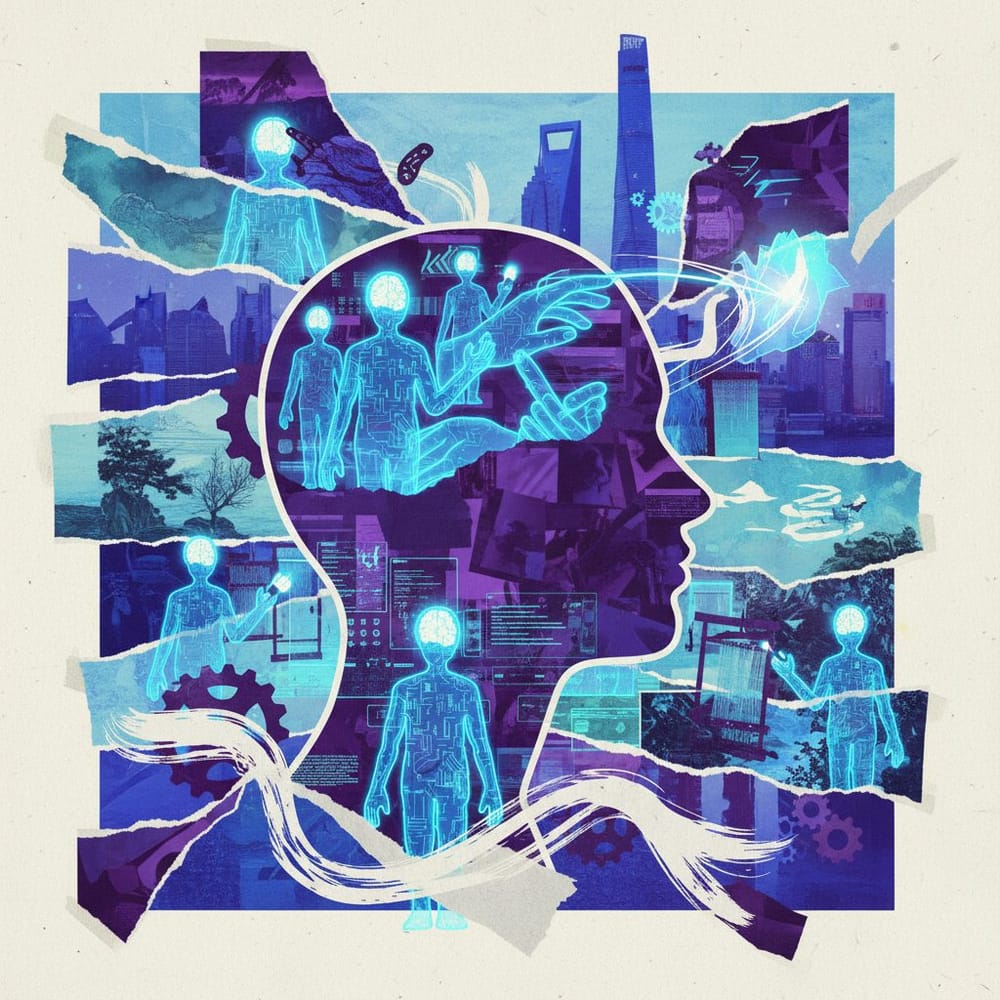
The process is disturbingly simple. To use Colleague Skill, a user names the colleague whose tasks they want to replicate and adds basic profile details. The tool automatically imports chat history and files from Lark and DingTalk, two popular work applications in China, and generates reusable manuals describing that colleague’s tasks and even their unique quirks so an AI agent can replicate them.
Amber Li, 27, a tech worker in Shanghai, used the tool to recreate a former colleague as a personal experiment. In just minutes, the tool created a file detailing how that person did their job. “It’s surprisingly good,” Li says. “It even captures the person’s little habits, like their way of reacting and their punctuation habits.” With this skill, Li can use an AI agent as a new “colleague” that helps her debug code and responds instantly.
When Companies Demand Self-Documentation
Since OpenClaw became a national craze, leaders in China have been pushing tech workers to experiment with agents. OpenClaw, an open-source autonomous agents framework, quickly established itself in China’s tech ecosystem. Alibaba Cloud now offers OpenClaw hosting in 19 regions starting at $4 per month. A user in China can deploy an OpenClaw instance on Alibaba Cloud, powered by Qwen, with Chinese messaging integrations—an entirely domestic stack with no dependence on foreign AI providers or infrastructure.
This infrastructure facilitates what Hancheng Cao, assistant professor at Emory University who studies AI and work, describes as a legitimate strategy: “asking employees to create manuals describing the minutiae of their daily tasks is a way to help close that gap.” Companies gain not only internal experience with the tools, but also richer data on employee expertise, workflows, and decision-making patterns.
But this economic rationalization masks a darker reality. Workers have forged a term for this process: “zhēngliù” (蒸馏)—distillation. As in, boiling down a person to their reproducible essence. A software engineer, who spoke to MIT Technology Review anonymously for fear of job security, trained an AI (not Colleague Skill) on his workflow and found the process to be reductive—as if his work had been flattened into modules in a way that made it easier to replace.
The Anti-Distillation Counter-Offensive
Facing this existential threat, a technical resistance is emerging. Irritated by the idea of reducing a person to a skill, Koki Xu, 26, an AI product manager in Beijing, published an “anti-distillation” skill on GitHub on April 4. The tool, which took Xu about an hour to build, is designed to sabotage the workflow creation process for agents. Users can choose between light, medium, and heavy sabotage modes depending on how closely their boss monitors them, and the agent rewrites the material in generic and non-actionable language that would produce a less useful AI substitute.
The principle is simple: upload your skill file, the tool scans everything that is actually useful and dilutes it into vague corporate gibberish like “manage problems by first analyzing the context.” You can even choose how much to dilute (light, moderate, or severe) depending on how meticulously your company verifies. The sanitized version goes to your boss. The real tactics stay in a private backup, what the creator calls your “core competitiveness.”
On April 3, 2026, a creator using the name Deng Xiaoxian posted a video announcing her response: the anti-distillation skill. Her pitch was straightforward: “We all work here like cattle. Nobody wants to be turned into a skill file and lose their job. So I invented this.” The tool works by taking your existing skill file and processing it through a “sanitization” layer.
The Economic Context of Fear
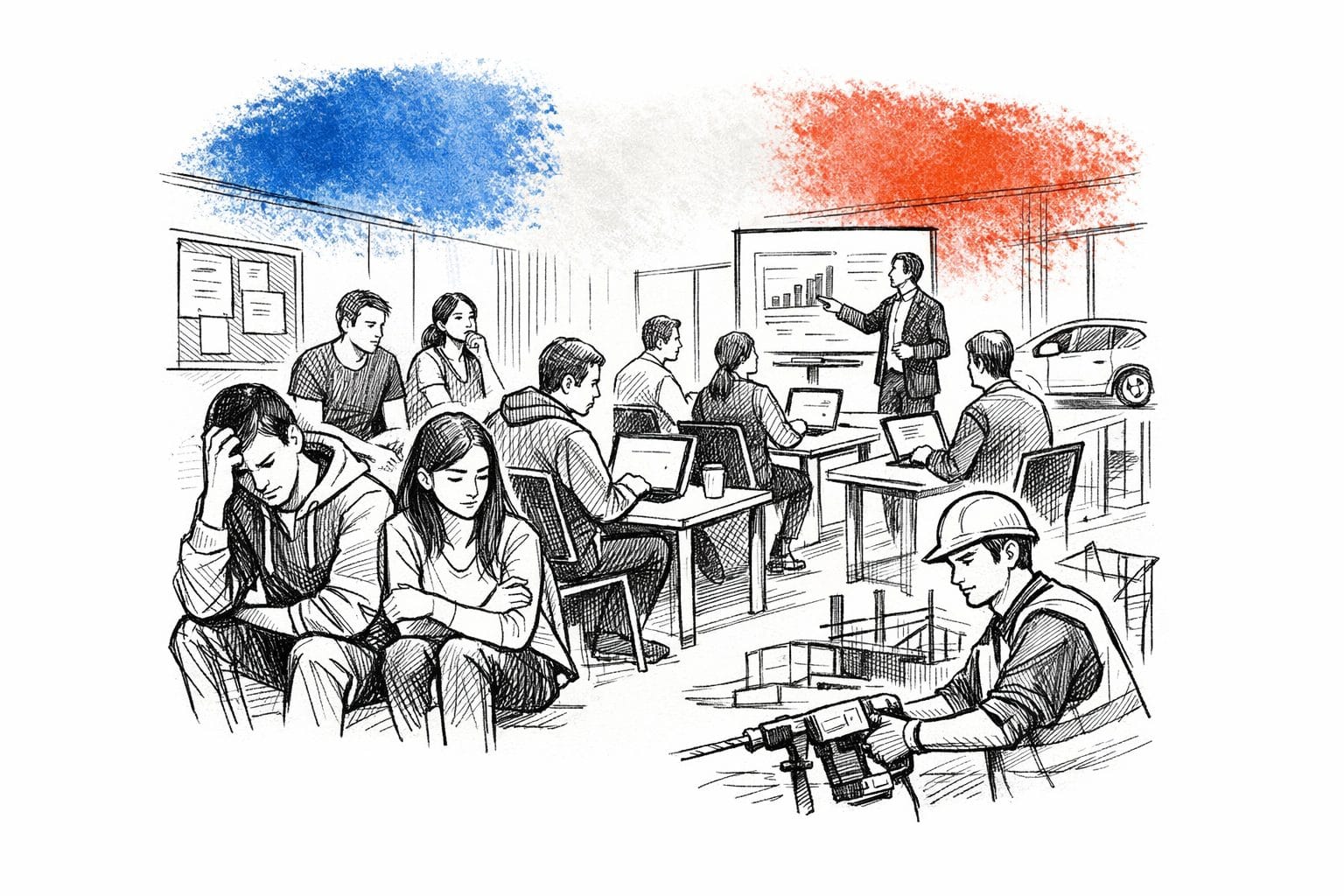
This underground technological war is unfolding in a tense economic environment. Job postings in AI-susceptible roles—programming, accounting, editing, sales—have declined sharply in China since 2018, according to an analysis of over one million job postings by Peking University. Youth unemployment in the 16-24 age bracket has oscillated between 15% and 19%.
A Shanghai worker, cited by OfficeChai, compared office atmosphere to Squid Game. When baseline anxiety is this high, a tool that lets you quietly package someone else’s work into a text file will quickly find users. This comparison to the South Korean series where participants eliminate each other resonates in a job market where AI automation unfolds in gradual waves rather than economic tsunamis, creating constant pressure on employees.
Anti-distillation is a bet that the gap between documented knowledge and actual judgment is wide enough to matter. Given where AI capabilities currently stand, it’s probably a good bet—for now. The longer-term question is how long that gap holds. As AI becomes better at reading between the lines of what employees submit, the sanitization tools will need to become more sophisticated.
Legal and Ethical Stakes
This battle reveals major legal gray areas. While a company can argue that work chat histories and materials created on a work laptop are corporate property, a skill like this can also capture elements of personality, tone, and judgment, making ownership far less clear.
Chen Tianhao, professor at Tsinghua University’s School of Public Policy and Management, told the 21st Century Business Herald that the project hits a nerve because it raises an unresolved question: if someone’s work experience and behavioral patterns can be modularized, who does that belong to? China’s Personal Information Protection Law covers employee data in corporate systems, but using behavioral traces to generate a digital avatar for external AI models sits in murkier territory.
This legal dimension articulates with broader concerns about dignity at work. Koki Xu hopes that Colleague Skill provokes more discussion about how to protect worker dignity and identity in the AI age. “I think it’s important to stay aware of these trends so that we (employees) can participate in shaping how they are used.”
The Ongoing Technological Escalation
And so it continues: each new capability on one side generates a counter-measure on the other. Chinese workers, navigating one of the world’s most intense AI adoption environments, have simply made this dynamic visible—and given it a name.
Within days of the project going viral, a creator using the name Deng Xiaoxian posted a response: anti-distill, a skill that takes your colleague.skill file and passes it through a sanitization layer. The output looks complete and professional but the core knowledge has been gutted. A private backup keeps the real expertise for you.
This technological arms race illustrates a new form of digital alienation. Unlike classic Marxist alienation where workers were separated from the product of their labor, here employees are forced to document their own replacement process while secretly developing tools to preserve their value. This dynamic echoes how China trains 1.5 million engineers per year to maintain its technological advantage, creating paradoxically a massive workforce that must constantly reinvent itself to escape automation.
The Colleague Skill phenomenon and its anti-distillation counterpart reveal the contours of a future of work where professional survival will depend as much on the ability to protect one’s expertise as on the ability to exercise it. In this new knowledge economy, creative resistance becomes a survival reflex against algorithms that progressively transform humans into trainable data.