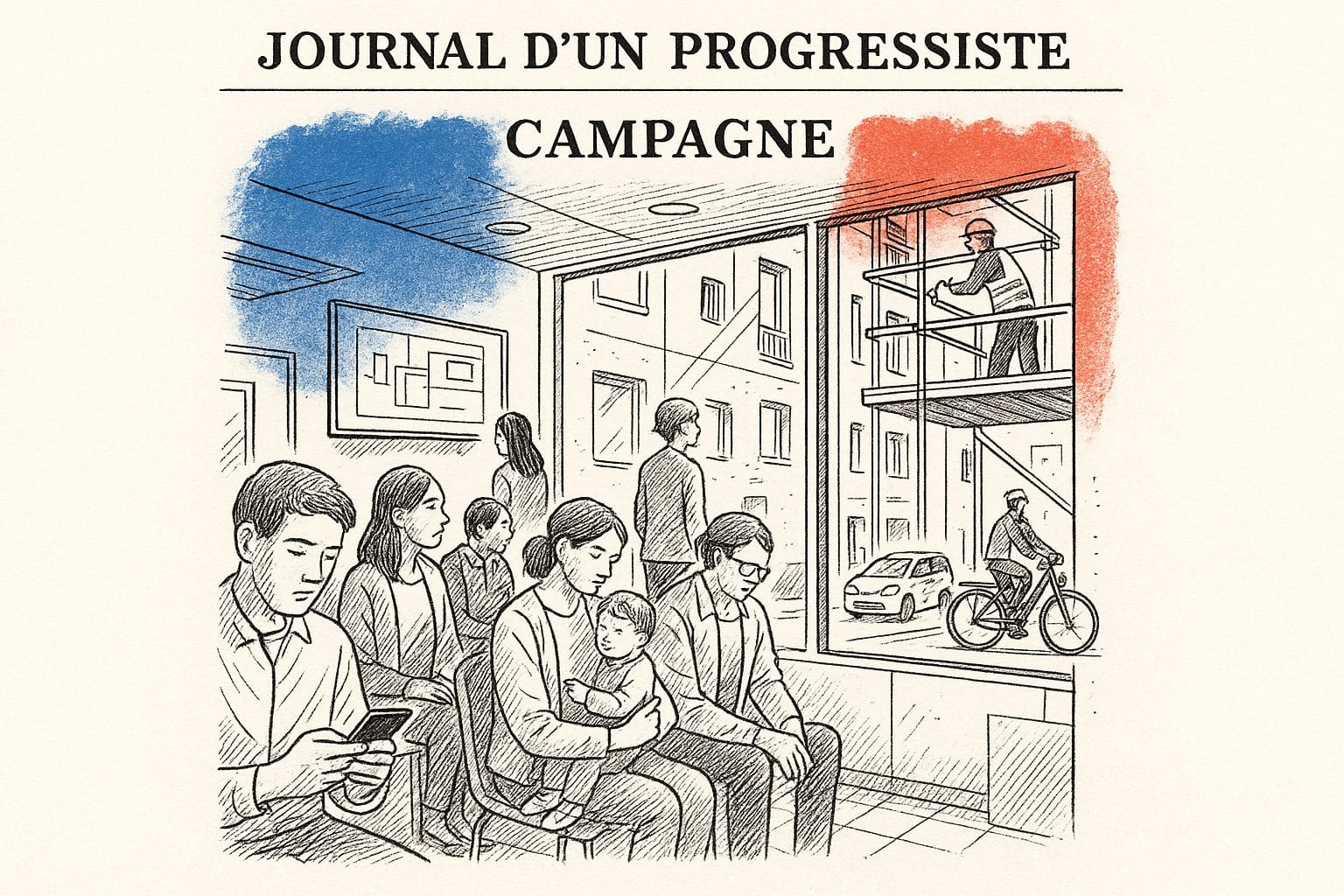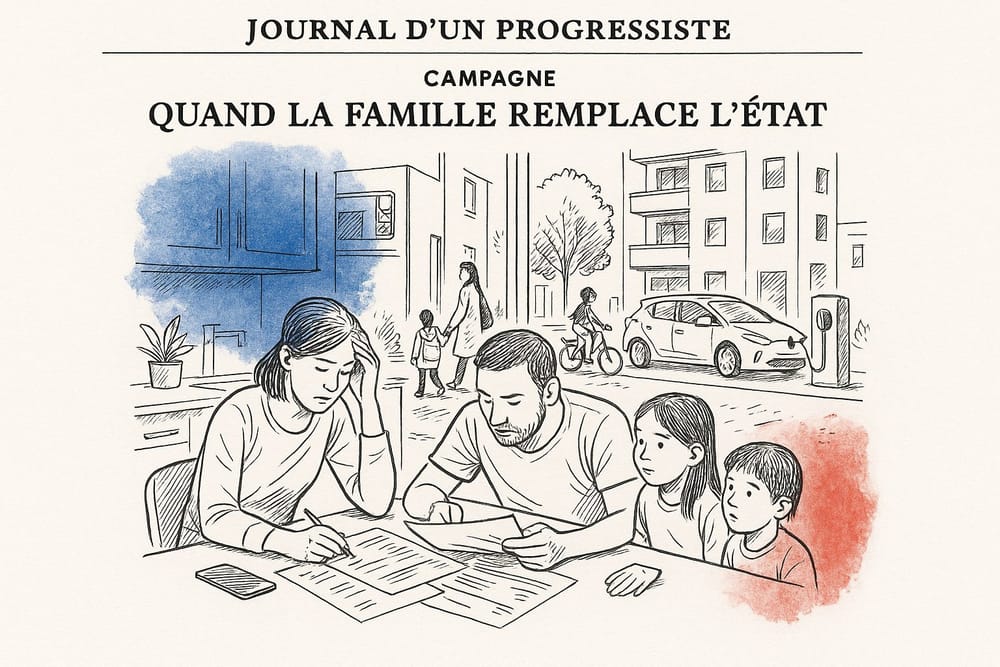
Family as a safety net penalizes those without one
One child in four can buy their first home only with money from their parents. One parent in two enters a nursing home with a bill their pension doesn’t cover. Between the two, the same mechanism: family has become the safety net for those who have one. In 2027, transforming this family accident into a guaranteed right or letting the gap widen—that’s the choice the next government will have to make explicit.
The 14.5 billion euros circulating outside any legal framework
In early 2024, 41% of French households had already inherited and 20% had already received a gift [1]. These figures measure the visible part of the phenomenon.
In 2017, of the 20.7 billion euros in financial aid recorded by INSEE between households living separately, 14.5 billion went toward descendants: children, grandchildren, or step-children [2]. This flow exceeds the annual budget devoted to public secondary education. It circulates without institutional framework, without enforceable rights, without systematic statistical visibility.
Households aged 55 to 59 are the largest givers: 178 euros per month on average in 2017, or 5% of their income [2]. Those aged 60-64 follow with 161 euros, and those 50-54 with 144 euros. These are the generations who bought their homes in still-accessible markets. They transfer downward, not by legal obligation, but because the public system no longer transfers fast enough.
Hippolyte d’Albis, in his Economics of Life Stages (2026), shows that public debate considers only part of intergenerational transfers—those from public authorities [5]. The rest, what families do among themselves, remains invisible in accounts and in policies.
Ten years’ difference depending on whether your parents can pay
In 2026, 26.1% of first-time buyers received help from their relatives to purchase [4]. This aid would allow homeownership nearly ten years earlier.
Ten years. That’s a decade of rent paid elsewhere, a decade of wealth-building deferred, a decade of distinct economic life depending on whether your parents can advance the down payment.
In 2026, 16.6% of all buyers received this boost [4]. The average amount reached 45,000 euros, mainly in the form of a gift [4]. Forty-five thousand euros is precisely what most households lack to gather the 10% down payment required by banks on a property at median price. For those whose parents can give this sum, the door opens. For others, it stays closed or opens a decade later.
Pensions don’t pay for nursing homes
At the other end of the life cycle, the same mechanism operates in reverse. Aging parents depend on their children not for a one-time down payment, but to finance years in a care facility that their pension doesn’t cover.
In 2025, the average monthly rate in a nursing home is estimated at about 2,556 euros for a person with minor care needs, and up to 3,060 euros for a person with severe care needs [6]. The average pension comes in around 1,500 euros per month. The gap, between 1,000 and 1,500 euros each month, must be filled by someone.
From 2014 to 2023, the national effort devoted to the autonomy of elderly persons rose from 1% of GDP to 1.24%, reaching 29.5 billion euros [8]. This increase followed the rise in the number of dependent persons. The out-of-pocket expense for families did not decrease.
The heaviest demographic effect begins from 2030 onward, when the generation born in 1945 reaches age 85 [7]. The Libault, El Khomri, and Vachey reports estimated additional needs at 9 billion euros annually at that horizon [7]. These needs are not covered.
The fifth branch of Social Security, created in 2021 to house the dependency risk, draws less than 10% of its revenue from dedicated contributory financing [8]. The rest depends on annual budget choices. An announced right without guaranteed funding remains a promise subject to the next finance law.
Private family protection, itself very unequally distributed
For thirty years, a silent privatization of social risk has taken hold. The state simply did not finance what it should have financed, and families compensated. Those who could.
In 2024, 85% of households that made a gift had a retired person of reference [1]. These retirees have assets to pass on. But only 15.4% of inheritances exceed 100,000 euros [1]. Private family protection is itself very unequally distributed: abundant in the fifth of most affluent households, nearly absent in the two-tenths that are most modest.
Households at the top of the distribution benefit from double coverage: universal state benefits, plus family. Those at the bottom have only the state, whose benefits cover neither the cost of a first home nor that of dependency. The Senate stated it thus in 2018: private solidarities, mainly familial, supplement the public system [9]. In 2026, the architecture has not changed. The gap between resourced families and families alone continues to widen.
Moving two guarantees from family to the collective
The architectural choice for 2027 concerns two distinct decisions, which share the same mechanism: moving from the family to the collective the guarantee of risks that the state promises without covering.
On dependency, the question is making financing actuarial, with a dedicated contribution levied on all income, including capital returns. Germany made this choice in 1994, Japan in 2000. Bruno Palier, specialist in the political economy of social protection, documents how these countries guaranteed a right without subjecting it to the budget constraint of the year [13]. France created a branch in 2021.
It did not create the funding base. Creating this base changes who pays and shifts the decision: it exits the annual finance law to become a guaranteed right. The direct counterpart is a new contribution bearing on labor and capital income. This is the shift in burden that a government must assume explicitly.
On housing access, the inequality between helped and non-helped first-time buyers stems from family chance, not merit. A down payment guarantee fund, managed by a public institution, would advance the initial down payment to any first-time buyer without family support. The advance would be repayable when the property is sold.
The collective would bear the risk during the period of ownership, that is, until resale [4]. This mechanism creates a right symmetrical to that which family provides today to a quarter of buyers. Its counterpart is a public risk in case of falling property prices, and governance to be built to set access conditions without creating new rents.
Without these two decisions, intergenerational solidarity continues to depend on the thickness of family assets. Those who have family with resources will have a down payment and a financed old age. The others will navigate a system that promises rights without financing them.
Sources
[1] INSEE, “Intergenerational Transfers in 2024: Gifts, Inheritances and Aid,” Life History and Assets survey 2023-2024, April 7, 2026, https://www.insee.fr/fr/statistiques/8960228 (accessed 12/10/2026).
[2] INSEE, “Children and Grandchildren, Main Beneficiaries of Financial Solidarity Between Households,” INSEE Focus no. 319, Family Budget survey 2017, https://www.insee.fr/fr/statistiques/7757468 (accessed 12/10/2026).
[3] INSEE, “In 2018, in France, 18% of Households Have Already Received a Gift and 8% Have Given One,” INSEE Focus no. 232, 2021, https://www.insee.fr/fr/statistiques/5359234 (accessed 12/10/2026).
[4] Nestenn, “1st Nestenn Observatory of Property Trajectories,” September 2026, https://www.medicis-patrimoine.com/actualites-immobilier-neuf/prix-de-l-immobilier/2026/09/07/4260-achat-immobilier-un-quart-des-primo-accedants-aides-par-leurs-familles.html (accessed 12/10/2026).
[5] Hippolyte d’Albis, Economics of Life Stages, Odile Jacob, 2026.
[6] Malakoff Humanis, “Nursing Home Care: Prices, Financial Assistance and Operations,” updated September 2026, https://www.malakoffhumanis.com/s-informer/sante/ehpad-prix-prise-en-charge-aides-financieres/ (accessed 12/10/2026).
[7] CNSA, “Financing of Autonomy Policy at the 2030 Horizon,” Opinion to Parliament, March 2021, https://www.ifrap.org/emploi-et-politiques-sociales/quest-ce-que-la-cnsa-cette-caisse-qui-verse-42-mds-eu-pour-lautonomie (accessed 12/10/2026).
[8] IRDES, “The Financing of Dependency in Elderly Persons in France,” synthesis, 2024 edition, https://www.irdes.fr/documentation/syntheses/le-financement-de-la-dependance-des-personnes-agees-en-france.pdf (accessed 12/10/2026).
[9] Senate, Information Report “Inventing Tomorrow’s Solidarities Facing the New Generational Challenge,” 2018, https://www.senat.fr/rap/r18-038/r18-038_mono.html (accessed 12/10/2026).
[13] Bruno Palier, Governing Social Security, Presses de Sciences Po, and publications on the Bismarckian model of dependency coverage, Cairn, 2025, https://droit.cairn.info/publications-de-bruno-palier–46561 (accessed 12/10/2026).