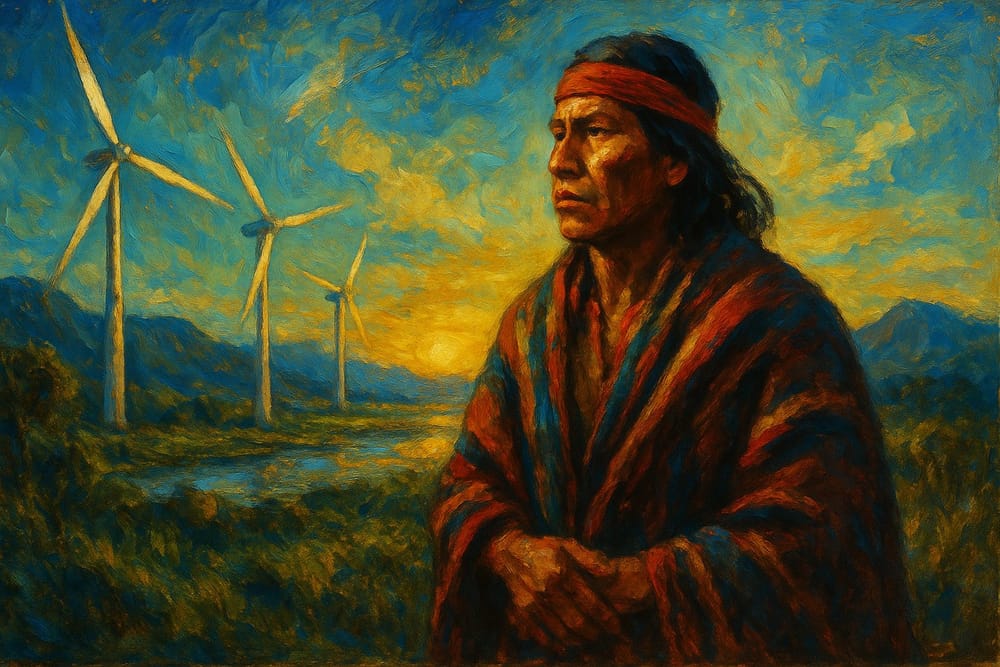
Significant reserves of minerals without which no battery, no solar panel, no wind turbine can be made lie beneath lands inhabited for centuries by indigenous peoples. In many Latin American states that have ratified convention no. 169, standards require consultation with indigenous peoples for measures or projects likely to affect them. These consultations take place in certain cases and extraction projects can be implemented afterward. The global energy transition raises territorial dispossession issues reminiscent of the fossil fuel era.
The Essential Points
- The International Energy Agency projects sharp growth in demand for critical minerals; significant reserves are located on indigenous peoples’ lands.
- In Latin America, the right to free, prior and informed consent has existed in texts since the International Labour Organization’s Convention 169 (1989), but states implement it as an information procedure, not as a veto right.
- The result is green extractivism: lithium, copper and cobalt extraction projects advance on indigenous territories with new climate legitimacy, without revenue sharing or real decision-making power in certain cases.
- Two scenarios face off for the 2030-2040 decade: a transition with effective territorial rights and binding mechanisms, or a reproduction of dispossession hierarchies under climate cover.
- Instruments exist—revenue capture mechanisms in Australia, integration into certified supply chains—but none has yet been made universally binding.
Bolivian Lithium and the Consultation That Isn’t One
In 2022, the Bolivian government launched the expansion of lithium extraction in the Salar de Uyuni, one of the world’s largest reserves of this metal. Neighboring Aymara and Quechua communities participated in consultations. The consultation lasted a few weeks. The project advanced after this consultation.
This pattern is not Bolivian. It is regional. In Chile, in the Salar de Atacama, where the Lickanantay people live, Chile accounted for approximately 22% of global lithium production according to a recent USGS estimate. In Peru, Andean communities bordering the Las Bambas copper deposits blocked the national highway for months in 2022 after being excluded from negotiations. In Colombia, wind transition projects in Guajira, Wayuu territory, met massive opposition born from the same feeling: being informed is not being consulted.
The ILO counted fourteen ratifications in Latin America; including the Caribbean and Dominica, there are fifteen. Convention 169 requires prior consultation with consent requirements in certain cases. The international acronym is FPIC. It designates free, prior and informed consent; it requires, in particular, that states consult in order to obtain this consent before projects affecting indigenous lands or resources. In practice, states generally apply a procedural approach: the state decision may not be legally subordinated to a general veto, but the consultation must be prior, substantive and conducted in good faith.
Consent becomes a form.
These Lands and These Peoples
Critical minerals are concentrated geographically on indigenous lands. Some of the critical minerals projects are located on or near indigenous territories, often exposed to historical forms of territorial marginalization. These characteristics correspond precisely to the territories that states have, over centuries, left to indigenous peoples, or that they lacked the means to fully colonize.
According to the IEA, total lithium demand in the APS scenario is projected at approximately eight times its 2023 level by 2040. The IEA projects approximately 30% growth in copper demand by 2040 in the STEPS 2025 scenario. The IEA projects growth of approximately 50 to 60% in cobalt demand by 2040 in the STEPS 2025 scenario. These orders of magnitude correspond to extraction projects already identified, already mapped, already financeable.
The transition increases needs for primary mineral supplies, but the scale and location of new projects also depend on recycling, technologies and political choices. Certain regions, including the Andean lithium triangle, concentrate significant reserves of critical minerals. The expansion of mining raises the question of access to territories where reserves are concentrated. The political question that this prerequisite raises has not yet found a satisfactory institutional response.
The Law Exists, Power Is Missing
To say that indigenous peoples have no legal tools would be inaccurate. Since 1989, convention 169 has set an international standard for prior consultation, with specific consent requirements in certain situations. In 2007, the United Nations Declaration on the Rights of Indigenous Peoples reaffirmed it. Several Latin American constitutions—Bolivia, Ecuador—explicitly recognize collective territorial rights. Mexico has constitutionalized consultation.
Colombia has constitutional court jurisprudence that has sometimes, in isolated cases, suspended projects.
The texts exist; international mechanisms and their effectiveness vary depending on the instrument and applicable national law. States invoke national interest against local opposition, which can reduce the effectiveness of FPIC. Courts can invalidate this circumvention, some have, but the procedure lasts years, during which work advances. The International Rights Protection Institute systematically documents this gap between formal law and operational reality.
Communities sometimes win before judges, but the implementation of decisions remains unequal.
This tension also runs through Australia, Canada and Nordic countries, which nonetheless have more robust legal frameworks. Climate pressure can accelerate projects, which can reduce consultation timelines and political tolerance for opposition. Potential pressure on certain territories may increase depending on urgencies defined by climate trajectories, but its intensity depends notably on institutional responses, recycling and technological developments.
This movement of extractive acceleration under climate pressure resembles, in structural terms, the dynamics observed in other sectors of the transition. The explosion of global solar capacity also creates distortions that markets and institutions struggle to absorb: the pace of deployment exceeds regulatory capacity.
Green Extractivism as a Political Category
The term appeared in Latin American academic work in the early 2010s. It designates a regime of natural resource exploitation that, while adopting a discourse of sustainability or climate necessity, maintains the structures of territorial dispossession that characterized the colonial economy. The adjective changes. The logic remains.
The International Rights Protection Institute documents for 2025-2026 the consolidation of this category into concrete practice. States that most need critical minerals export revenues—Bolivia, Peru, Chile and Argentina—are also those with the narrowest political margin to slow extraction. Companies financing these projects are often European, American or Chinese; they face limited regulatory pressure in their countries of origin regarding extraction conditions abroad.
The justification for extraction projects has adjusted: from national economic progress to climate necessity. Once, extraction projects were justified by national economic progress. Today, they are justified by the need to decarbonize. The affected populations change little; the argument changes. This substitution of argument without change in mechanism is precisely what indigenous organizations denounce most frontally in their exchanges with delegations at COP30.
Australian Mechanisms: Achievements and Limits
Australia offers, to date, the most documented example of revenue capture mechanisms for indigenous communities. The Native Title Act of 1993, followed by successive amendments, created a legal framework recognizing First Peoples’ land rights over their ancestral lands and imposing, in certain cases, good faith negotiation, but does not make a benefit-sharing agreement with mining companies mandatory. Some agreements have generated substantial revenues for communities that were previously entirely excluded from them.
The limits are real. Agreements are unequal: communities with better-resourced legal and negotiating capacity obtain far better terms than those lacking it. The veto right remains contested: the Native Title Act provides for arbitration procedures that can ultimately allow extraction without complete agreement. And redistribution, even when it occurs, does not always compensate for environmental impacts on livelihoods and cultural practices tied to territory.
But the Australian model at least proves that a partially functional revenue-sharing mechanism is conceivable and practicable. Its extension to Latin America would suppose complex institutional transfers; legal systems differ, political power balances differ too. It is not impossible. It is simply absent from current government agendas.
The Issues the 2030s Will Impose
Two trajectories are open for the 2030-2040 decade, according to documentation from the IEA and IPRIGHTS. They are not symmetric in probability, but each has identifiable conditions for realization.
The first is the reproduction of extractivism. If consultation processes remain procedural and if no binding mechanism for revenue sharing is imposed in supply chains, global decarbonization risks occurring on the same territories, with the same populations bearing the impacts, under climate cover. IEA projections signal increased risks of pressure on mineral supply; its intensity depends notably on institutional responses, recycling and technological developments.
The second trajectory rests on several distinct conditions. First, that FPIC becomes more enforceable in trade agreements concerning critical minerals, with sanction mechanisms more effective than a declaratory clause. Second, that revenue-sharing mechanisms are designed as a distinct reform and adapted to Latin American jurisdictions. Finally, that supply chains for batteries and solar panels are certified on the basis of verifiable social criteria, the way certain forest or agricultural certifications function today, with the same monitoring limitations, but a responsibility framework.
These three conditions are not currently in place. Some are advancing. The European Union is working on critical minerals regulation that integrates social sustainability criteria. The European Union’s deforestation regulation, which conditions access to the European market on supply chain traceability, offers a transposable model, even if its implementation has already suffered delays under pressure from the industries concerned. COP30, scheduled for Belém, in Brazilian Amazonia, places geographically and symbolically the question of indigenous territorial rights at the center of global climate debate for the first time with this intensity.
The signals to watch are precise. What share of critical minerals extraction projects can document undisputed consent from the affected communities? What volume of revenue is redistributed per ton extracted, and how does this volume evolve between jurisdictions? These two measures would make it possible to distinguish, in ten years, whether the transition has produced a change or simply a change in rhetoric.
The question posed by IPRIGHTS, and that COP30 will not be able to avoid, is ultimately this: can a green supply chain be based on violated territorial rights and remain credible as a decarbonization instrument? The energy transition raises governance questions that technology deployment alone does not resolve; it is true for electricity in Africa, it is true for minerals in Amazonia.
Indigenous peoples of Latin America have developed, over thirty years, a capacity for legal and political mobilization that allows them to weigh in on these debates. Their organizations participate in climate negotiations. They argue before constitutional courts. They build alliances with NGOs, ESG investment funds and European governments that have an interest in certifying their supply chains.
The question is whether this capacity for resistance will be sufficient to transform a formal right into real power, or whether it will only serve to slow, without reversing, a structural dynamic.
Sources
- International Rights Protection Institute, Just Transition and Indigenous Peoples in Latin America (2026)
- International Energy Agency, Critical Minerals 2026 (annual report, available at iea.org)
- Convention 169 of the International Labour Organization on Indigenous and Tribal Peoples (1989)
- United Nations Declaration on the Rights of Indigenous Peoples (2007)
- Natural Resource Governance Institute, reports on extractive governance and indigenous rights
- Native Title Act (Australia, 1993, successive amendments), Australian Attorney-General’s Department
- COP30 Documentation, Belém (Brazil), UNFCCC