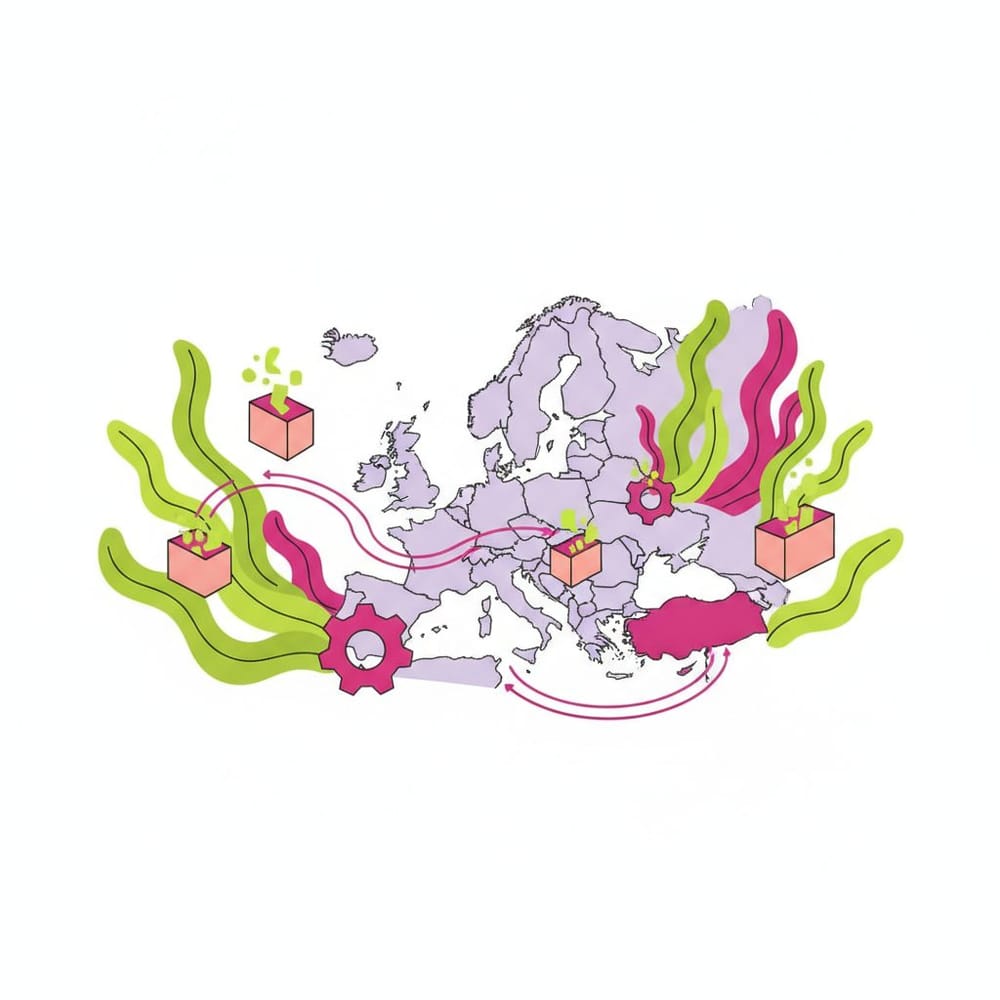
Europe borders 68,000 kilometers of coastline and possesses some of the world’s best seaweed deposits. Today it watches Asia capture approximately 97% of the global commercial seaweed cultivation market — while its own pilot farms struggle to obtain exploitation rights over their stretch of sea. The main producing countries are China (~58%), Indonesia (~28%), South Korea (~5%), the Philippines (~4%), and Japan (~1%); South Korea, China, and Japan combined represent only about 65% of this production.
The question is not one of willpower or technology. It’s a matter of law.
The Essentials
- The global commercial seaweed market is projected to grow from $72.3 billion in 2025 to $142.6 billion by 2035, according to Global Market Insights (December 2025).
- France, Ireland, and Norway have all launched pilot farm programs — but Norway is progressing significantly faster, thanks to a maritime concession system inherited from its aquaculture industry.
- The main bottleneck in Western Europe is not technological: it’s the absence of a clear legal framework for attributing maritime public domain to private actors for seaweed cultivation.
- If nothing changes over the next ten years, European dependence on seaweed imports will replicate the pattern of mineral raw materials — a subject that has already concerned the European Commission since the adoption of the Critical Raw Materials Act in 2024.
A Market That Doubles, an Opportunity That Closes
For a long time, seaweed was a niche product: sushi, cosmetics, organic fertilizers. That is no longer the case. The convergence of several underlying trends — alternative proteins, carbon sequestration, bioplastics, food additives — has made macroalgae a strategic raw material.
The projection of doubling to $142.6 billion by 2035 rests on several simultaneous dynamics. Human food still represents the largest share of the market, but agriculture is driving near-term growth: seaweed-based biostimulants are progressively replacing part of synthetic fertilizers in several European countries. Third-generation biofuels come next, supported by American and European public investments. And carbon capture — seaweed absorbs CO2 during growth — is attracting the first serious carbon credits, notably through British and American programs tested since 2022.
What changes the nature of the challenge is speed. Market windows in industries with high regulatory and capital intensity do not stay open indefinitely. When an industrial actor seeks to source seaweed for its packaging or additives, it builds relationships with producers that last ten years. Europe that misses the next five years will not easily recover lost ground.
Norway as a Laboratory of What’s Possible
To understand why Norway advances faster than France or Ireland, one must look not at geography — all three have nutrient-rich coasts — but at institutional history.
Norway built one of the world’s most important aquaculture industries starting from almost nothing in the 1970s. To achieve this, it had to solve a fundamental legal problem: who owns the coastal sea, and who can exploit it to produce sellable goods? The Norwegian answer, developed over several decades, is a system of fixed-duration concessions, awarded by the state, with clear rules on distances between farms, authorized volumes, and renewal conditions. This system enabled the salmon industry to raise private capital on the basis of stable and enforceable usage rights.
When the first Norwegian seaweed cultivators wanted to establish themselves, they were able to use this pre-existing framework, adapt it to their needs, and obtain concessions. Companies like Seaweed Solutions and Algea were able to raise financing because their investors could evaluate an asset: the right to exploit a defined maritime zone for a known period. That is precisely what France and Ireland do not yet have.
In France, maritime public domain is managed by a layering of authorities — maritime prefectures, departmental territorial and maritime directorates, nautical commissions — none of which have an established doctrine on seaweed concessions. Applications are processed case by case, according to timelines that vary from eighteen months to several years. Ireland faces a similar constraint, complicated by poorly mapped historical coastal fishing rights. Result: technically operational pilot farms remain blocked waiting for authorizations that nobody knows exactly how to issue.
What French and Irish Pilots Prove Despite Themselves
It would be unfair to say Europe is doing nothing. France has financed, through the European Maritime Affairs and Fisheries Fund, a dozen seaweed cultivation pilot projects since 2018. Ireland launched a specific program in 2022 through Bord Iascaigh Mhara, its fisheries development agency, which supports a handful of experimental sea farms in the Irish Sea. Breton cooperatives have been producing seaweed for longer than Norway seriously began to take interest in it.
These projects prove several important things. European species — kelp, dulse, laminaria — grow well in temperate waters. Vertical rope cultivation techniques work at depths and temperatures corresponding to Atlantic coasts. Production costs fall with each generation of farm. Local industrial demand exists: Breton agribusinesses, Norman cosmetics companies, biostimulants used in agriculture in the Grand Ouest.
What these projects fail to do is scale up. The challenge is not to produce a few dozen tons per year in a pilot farm — it is to produce tens of thousands to be competitive with Asian imports. This scaling requires investments that rational entrepreneurs will not make on the precarious basis of provisional authorization.
This is where the parallel with critical minerals becomes relevant. Europe took years to understand that its dependence on Chinese rare earths resulted not from a lack of resources in its soil, but from a regulatory framework and market context that made extraction unviable. The Critical Raw Materials Act attempts to correct this structural error. The same logic applies to seaweed: the resource is there, the actors are there, the demand is there. What is missing is the legal stability that allows capital to mobilize. This mechanism has been described at work in other sectors — countries advancing fastest on industrial sovereignty are those that first clarify exploitation rights to their resources.
First Attempts to Unlock the Situation
The situation is not frozen. Several ongoing initiatives merit close monitoring.
At the European level, the Nature Restoration Regulation adopted in 2024 opens an unexpected window for seaweed cultivation: offshore seaweed farms can be qualified as marine ecosystem restoration zones, giving them access to financing distinct from classical fishing funds. This is an opportunity several French and Irish project leaders are actively exploring.
In France, reflections are underway within competent authorities on simplifying authorization procedures for offshore seaweed cultivation. Avenues being explored include creating a single maritime public domain occupation title for seaweed farms, which would merge several authorizations currently issued separately. This is not yet a concession regime in the Norwegian sense — but it is a step in the right direction.
Ireland has an additional card to play: its waters are home to some of Europe’s largest natural giant kelp populations. A systematic mapping program of natural stocks, conducted by the National University of Ireland at Galway in partnership with the Marine Institute, should provide by 2026 the baseline data to calibrate sustainable exploitation volumes. Without this mapping, setting concession quotas remains impossible — and granting rights to a non-quantified resource exposes decision-makers to litigation.
Norway, for its part, is not stopping. Since 2023, it has been experimenting with seaweed farms integrated into its existing aquaculture structures, using nutrients generated by salmon farms as fertilizer for seaweed crops. This multitrophic aquaculture model reduces operating costs and improves the environmental balance of both productions simultaneously. Groups like Cermaq and SalMar are testing these configurations at large scale. If the model proves economically viable — results from the first years are encouraging according to the Norwegian Institute of Food, Fisheries and Aquaculture Research — Norway will combine its regulatory head start with a structural cost advantage.
The 2035 Horizon and What’s at Stake Now
Doubling the market to $142.6 billion by 2035 is a projection, not a certainty. It rests on assumptions that actors must name honestly: adoption of seaweed proteins at mass-market scale, scaling of seaweed biofuels, development of a credible market for marine carbon credits. Each of these markets is the subject of serious programs, but none has reached industrial maturity yet.
What is less uncertain is the supply chain structure being built during this decade. Large industrial buyers — food groups, chemicals, cosmetics — are currently rationalizing their seaweed suppliers. They seek stable volumes, traceability certifications, predictable prices. Asian producers, who benefit from a forty-year head start and still-lower labor costs, are best positioned to meet these criteria today.
But the preference of European buyers for local supplies is not negligible. The movement toward shorter supply chains, accelerated by post-2020 logistics disruptions and traceability requirements of European corporate sustainability regulation, creates a window for competitive European producers. This window closes as contracts are signed and infrastructure consolidates.
The social innovation model that could work resembles what we observe in other territorial transitions: cooperatives of fishermen partially converted to seaweed cultivators, mixed fishing-cultivation models that amortize risks, coastal territories using seaweed farms to diversify a fragile maritime economy. Brittany, Irish coasts, the Lofoten Islands — these territories have the communities, maritime expertise, and aligned economic interests. What they lack is the legal framework that would allow them to raise necessary capital to move from a few hectares to a few thousand.
The question facing French and Irish decision-makers is not whether a seaweed market should be created. It already exists. The question is whether Europe will be a producer or simply a consumer — and whether its coastal communities will benefit, or whether they will watch container ships pass by their shores.
Sources
- Global Market Insights, Commercial Seaweed Market, December 2025 — https://www.gminsights.com/industry-analysis/commercial-seaweed-market
- European Nature Restoration Regulation (Regulation EU 2024/1991), Official Journal of the European Union, 2024
- Critical Raw Materials Act (Regulation EU 2024/1252), European Commission, 2024
- Norwegian Institute of Food, Fisheries and Aquaculture Research (Nofima), reports on integrated multitrophic aquaculture, 2023-2024
- Bord Iascaigh Mhara, Seaweed Aquaculture Programme, Ireland, 2022
- European Maritime Affairs and Fisheries Fund (EMAF), assessment of seaweed cultivation pilot projects France, 2018-2024
- Wikipedia, Seaweed farming — market shares by country (FAO 2022) — https://en.wikipedia.org/wiki/Seaweed_farming
- Nature Restoration Law — entry into force 2024 — https://environment.ec.europa.eu/news/nature-restoration-law-enters-force-2024-08-15_en
- Norwegian Seafood Council — History of Norwegian aquaculture 1970s — https://en.seafood.no/news-and-media/news-archive/celebrating-50-years-of-modern-aquaculture/
- Marine Institute Ireland — Kelp mapping NUI Galway — https://www.marine.ie/site-area/news-events/news/cullen-fellow-developing-methods-map-ireland%E2%80%99s-seaweed-species
- EBIC — Seaweed biostimulants in Europe — https://biostimulants.eu/advocacy/seaweed/
- Springer — Norway Aquaculture Act and seaweed licenses 2014 — https://link.springer.com/article/10.1007/s10499-017-0120-7
- Mer.gouv.fr — Maritime public domain management France (prefect/DDTM) — https://www.mer.gouv.fr/domaine-public-maritime-naturel