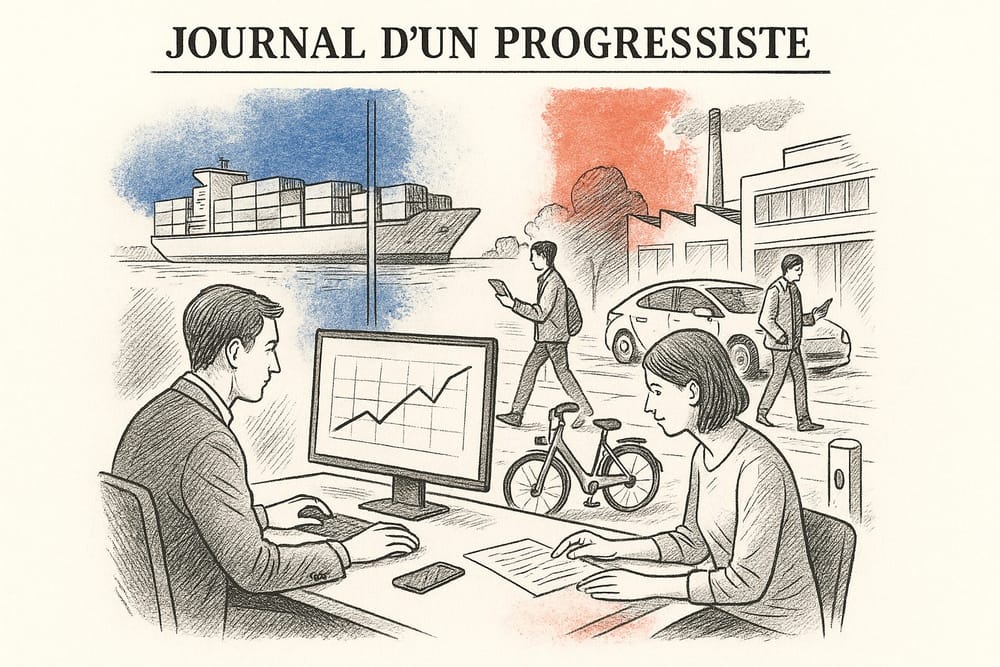
In twenty-five years, France has seen its share of global merchandise exports fall from 5% to 2.6% [3]. The trade balance has improved in recent years, but mainly because the country is importing less energy, not because its industry is exporting more. In 2025, industry represents less than 10% of GDP [10] and the country has destroyed roughly 20,000 manufacturing jobs in a year, whereas it was creating 15,000 per year between 2017 and 2023 [5]. The choice facing 2027 is architectural: transform public procurement into an enforceable right conditioned on employment quality and the location of critical nodes, rather than continuing to subsidize structures with unchanged cost bases.
Twenty-five years of decline, an export base increasingly narrow in scope
Between 2000 and 2015, French exports lost 2.0 percentage points of global market share. Sales in the eurozone accounted for 1.4 points of that [9]. In 2025, France represents 2.6% of global merchandise exports, down from 3.1% in 2019 [3].
The export base has also weakened in its structure. French industries display a high extensive margin, on the order of 70% to 84% [9]. Their intensive margin, by contrast, remains weak, between 20% and 34% depending on technological intensity [9]. About 10% of industries concentrate 88% of total exports [9]. Such concentration produces sectoral records, but exposes the country to sudden shocks.
Aeronautics illustrates both sides of this profile. The aerospace and aviation sector’s surplus reaches a record 32.6 billion euros in 2025, driven by exports up 18.3% above their 2019 level [1]. But this peak masks generalized decay. The agri-food sector’s surplus has fallen to a historic low of 0.2 billion euros in 2025, after exceeding 8 billion in 2015 [1].
The recent improvement in the trade balance deserves to be read soberly. After an improvement of 62.7 billion euros in 2023 and 19.5 billion in 2024, it is now only 10.3 billion in 2025 [1]. The pace is slowing, and much of it owes to lower energy imports. The trade balance deteriorated sharply between 2000 and 2010, from 0.6 to 2.7 percentage points of GDP, and has barely recovered since [2].
The deindustrialization underlying this decline is documented with damning precision. Despite a stated priority on reindustrialization and the France 2030 program, launched in 2021 with 54 billion euros over five years, industry’s share remains below 10% of GDP in 2025 [10]. In 2025, the country recorded some sixty factory closures [5]. The loss of competitiveness is a major economic fact of the last two decades, closely linked to more severe deindustrialization than in other large eurozone countries [9]. It is also the primary factor in the divergence of living standards compared with Germany.
Fragmentation of the world, accelerator of vulnerability
The global context of 2025-2026 structurally worsens the position of a country whose industry has not completed its conversion. Two simultaneous ruptures are redrawing the rules of the game.
The first is the militarization of trade. The dollar, advanced microprocessors, energy supply chains: the United States and its allies have mobilized their control over these critical nodes to confront their rivals. Edward Fishman describes in Chokepoints (2025) an “impossible trinity” of geo-economic dynamics [6]. States cannot simultaneously maintain deep economic interdependence, protect their economic security, and engage in geopolitical competition. France finds itself here in an uncomfortable position, too integrated into global chains to break free without cost, insufficiently equipped to master their nodes.
American tariffs have risen from an average of 3% before the Trump mandate to an effective rate between 29.8% and 37.8% in 2025 [7]. The European Union faces an effective rate of 17% according to an analysis by the Centre for Economic Policy Research [7]. Isabelle Méjean, during a hearing before the Senate Finance Committee in May 2025, quantified the effect as a loss of 0.1% growth in Europe [12]. This overall figure masks much more severe sectoral exposures in automobiles, aeronautics, or nuclear power, whose components shuttle back and forth among multiple countries [12].
The second rupture concerns the slow pace of repositioning within global value chains. OECD estimates for 2023-2024 show limited aggregate changes, with slower deglobalization than in 2020-2022 [11]. Heterogeneity remains substantial depending on industrial structure and political choices [11]. The rise in the immaterial component’s share within manufactured exports is documented, but France has not benefited from it as much as its neighbors, lacking a sufficient network of mid-size internationally active firms.
France’s position vis-à-vis China crystallizes this vulnerability. In 2024, the bilateral deficit with Beijing reached 40 billion euros, making it the country’s primary source of trade deficit [4]. China’s ascent in technological capability and its offensive in electric vehicles directly threaten the segments where France retained export positions.
The vicious cycle that subsidies have not broken
The reflexive response consists of demanding more industrial policy, more subsidies and preferential credit. The structural diagnosis invites resistance to this.
The loss of French positions stems first from the growing share of emerging economies in global exports [9]. But two movements converge. On one side, losses in each major market.
On the other, a structural effect linked to concentration in the eurozone, the least dynamic export zone. Faced with rising production costs, industry preferred to compress its margins to preserve price competitiveness, at the expense of moving up the value chain [9]. Subsidies paid over twenty years often helped firms survive in lower-value positions without shifting them toward higher value-added segments.
The hemorrhaging of market share in the 2000s and 2010s was stemmed at the price of effort on export prices for manufactured goods, which grew less strongly than those of major neighbors [2]. But with American trade war, Chinese technological offensive, and energy handicap, it is now the eurozone as a whole losing ground [1]. The eurozone’s share of global exports fell to 20.1% in 2025, down from 23.3% in 2019 [1].
The underlying mechanism loops back on itself. Insufficient remuneration of skilled labor in industry blocks moving up the value chain. Blocked value-chain movement renders exports sensitive to prices.
Price sensitivity forbids the margins necessary for investment. Insufficient investment widens the productivity gap. This circle does not break through subsidies paid to structures with unchanged cost bases.
Dani Rodrik formulates it in Shared Prosperity in a Fractured World (2025): modern industrial policy should go beyond targeting internationally competitive manufacturing industries to extend to services and small and mid-size firms [8]. Restoring the middle class through the distribution of good jobs would help restabilize democratic societies.
Public procurement as an enforceable right for moving up the value chain
The choice facing 2027 is this: public procurement by the state and local authorities ceases to be just another market. It becomes an enforceable right for firms that commit contractually on their employment structure and the location of their critical nodes.
A criterion inscribed in the public procurement code opens or closes access to tens of billions of euros in annual purchases each year. Olivier Lluansi, professor at CNAM and former industry adviser at the Elysée, posed it bluntly: public procurement is the most underused lever [5]. The rupture consists in making it a right, not a discretionary gesture.
This change in architecture has an explicit cost. Firms positioned at the low end, those surviving through public contracts without investing in moving up the value chain, lose access they currently enjoy without compensation. Certain sectors, notably construction, services, and logistics, will see it as a severe constraint in the short term.
Existing aid does not disappear. The research tax credit represents roughly 7 billion euros per year [10]. Export assistance continues. But they lose their status as primary lever. Public money now buys verifiable commitments on the quality and quantity of jobs, as Rodrik formulates it in his framework of iterative interaction between public agencies and firms [8].
A criterion inscribed in the public procurement code resists political alternations. A subsidy program, by contrast, dies with the coalition that voted for it. Measures taken in 2027 will not have their effect before end 2028 at best, Lluansi reminds us [5]. This is precisely why the choice must be structural.
Sources
[1] Directorate General of the Treasury, “2026 Report on France’s External Trade,” February 2026, https://www.tresor.economie.gouv.fr/Articles/2026/02/06/rapport-2026-sur-le-commerce-exterieur-de-la-france (accessed 23/08/2026).
[2] Directorate General of the Treasury, “2025 Report on France’s External Trade,” February 2025, https://www.tresor.economie.gouv.fr/Articles/2025/02/07/rapport-2025-sur-le-commerce-exterieur-de-la-france (accessed 23/08/2026).
[3] Rexecode, “French Competitiveness in 2025,” 2025, https://www.rexecode.fr/competitivite-croissance/documents-de-travail/la-competitivite-francaise-en-2025 (accessed 23/08/2026).
[4] INSEE / WTO, “Market shares in merchandise exports of selected countries in the world,” annual data 2000-2025, https://www.insee.fr/fr/statistiques/2413545 (accessed 23/08/2026).
[5] Olivier Lluansi, “Reindustrializing: a Challenge, Solutions… and a Societal Choice,” Institut Montaigne, April 29, 2026, https://www.institutmontaigne.org/expressions/reindustrialiser-un-defi-des-solutions-et-un-choix-de-societe (accessed 23/08/2026).
[6] Edward Fishman, Chokepoints: American Power in the Age of Economic Warfare, Penguin Random House, 2025.
[7] Centre for Economic Policy Research (CEPR), analysis of effective tariff rates applied to the European Union, 2025, https://cepr.org (accessed 23/08/2026).
[8] Dani Rodrik, Shared Prosperity in a Fractured World: A New Economics for the Middle Class, the Global Poor, and Our Climate, Princeton University Press, 2025.
[9] INSEE, “Why Have French Exporters Lost Market Share?,” working paper, 2016, https://www.insee.fr/fr/statistiques/fichier/2531684/122016_d2.pdf (accessed 23/08/2026).
[10] Directorate General of Customs and Indirect Duties, “Results of External Trade: Annual Analysis 2025,” February 2026, https://www.douane.gouv.fr/sites/default/files/medias/documents/bdf235-6_competitivite-prix-cout.pdf (accessed 23/08/2026).
[11] OECD, “Global value chain repositioning: Insights from the 2023-24 TiVA nowcasting exercise,” OECD Statistics Briefs, no. 2026/01, April 2026, https://doi.org/10.1787/8c97068d-en (accessed 23/08/2026).
[12] Isabelle Méjean, hearing before the Senate Finance Committee, May 2025, reported by Public Sénat, https://www.publicsenat.fr (accessed 23/08/2026).