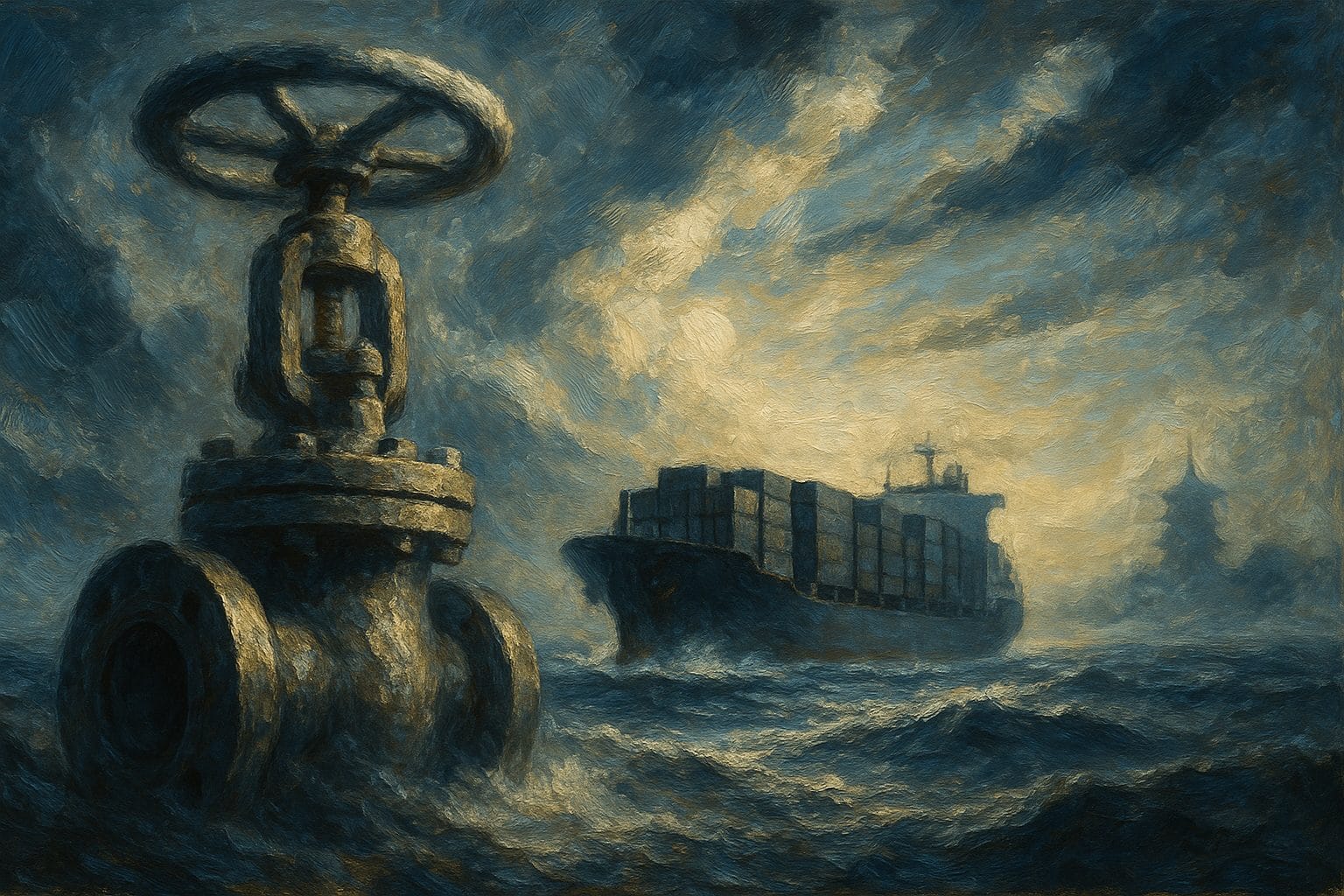
In 2023, drought reduced the daily transit capacity of the Panama Canal—not the annual traffic of nearly 40 percent. Global supply chains rest on bottlenecks, some of which have adaptation plans and financing, though needs remain substantial. Adapting a Pacific island port represents a significant cost, whose comparison to national budgets depends on the project, currency, and budget perimeter considered. Island States do not necessarily capture all revenues from flows, but they do receive income linked to certain maritime activities.
The essentials
- The 2023 drought severely reduced the Panama Canal’s daily capacity, exposing the structural fragility of global logistics hubs in the face of climate disruption.
- Adapting a Pacific island port represents a significant cost, whose comparison to national budgets depends on the project, currency, and budget perimeter considered.
- These States occupy a strategic position for international maritime trade routes but do not necessarily capture the full value created by flows, though they do receive revenues linked to certain maritime activities.
- Existing financial mechanisms for pooling adaptation costs among flow beneficiaries and vulnerable territories remain insufficient or inadequate.
- Financing climate bottlenecks will remain a central issue as long as international trade governance does not integrate it into its institutional frameworks.
The Panama Canal showed what no one wanted to see
The Panama Canal is not an ordinary piece of infrastructure. Each year, approximately 14,000 ships pass through it, representing between 5 and 6 percent of global maritime trade. Cargoes of liquefied natural gas, soybeans, and containers from Asia bound for the American East Coast transit through an 80-kilometer corridor that depends, to function, on a sufficient water level in Lake Gatún.
In 2023, that level dropped. Drought linked to the El Niño phenomenon forced the Canal Authority to reduce the number of daily passages and impose draft restrictions. The authorized daily capacity was sharply reduced. Shipping companies rerouted vessels around Cape Horn or through the Suez Canal, lengthening routes by several weeks. Freight costs surged.
This shock was foreseeable. Climate models have anticipated for years an intensification of droughts in Central America. Yet water adaptation measures and programs were only partially in place before the 2023 crisis. Shipping companies managed the disruption as a capacity constraint, playing with alternative routes and delays. The cost of resilience was passed on to shippers, final consumers, and economies most dependent on these flows.
The 2023 Panama crisis reveals an unresolved governance problem at the international level: sustainable financing for adapting the infrastructure on which global trade depends remains insufficient in several cases.
The Pacific islands, the blind spot of global logistics
The Panama Canal attracts attention because it is massive, visible, and quantifiable. Pacific island ports pose the same problem in total obscurity.
Pacific island States—from Fiji to Tonga through Papua New Guinea and Kiribati—occupy a strategic geographic position for routes linking Southeast Asia to North and South America. Their ports serve as stopover points, transshipment hubs, and beachheads for routing extractive resources. Some also supply regional industrial chains, particularly in agribusiness and raw materials.
These ports face cumulative climate threats: sea level rise, intensified cyclones, and coral reef degradation—which naturally protect port infrastructure—can combine at certain island sites. Adapting a port to this triple risk represents a significant cost. This is a figure worth anchoring in concrete reality: Tonga’s total budget in 2023-2024 was approximately 784 million pa’anga, or about 330 million U.S. dollars. Kiribati’s is under 300 million. The budgetary impact of an adaptation project depends on exact cost, currency, and budget considered and cannot be uniformly reduced to one or two years of public budget.
These States do not have the means to finance alone what they cannot afford not to finance. They receive commercial and maritime revenues, particularly from fisheries, without financing alone the necessary climate adaptations. Major shipping companies, shippers, and distributors participate little in structural financing mechanisms for adaptation. The OECD documents supply chain resilience issues; there exist stable institutional mechanisms for climate finance, but no universal mechanism directly links private benefits from maritime flows to financing adaptation for vulnerable States.
A systemic vulnerability that the market cannot correct alone
Global maritime commerce rests on an implicit principle: infrastructure exists and functions. Shipping companies calculate their routes, costs, and margins assuming ports will be there, operational, and accessible. When this assumption breaks down, market reactions focus first on prices and alternative routes rather than on adaptation investments.
This is precisely what happened in 2023 with Panama, and what will happen with other bottlenecks. Market signals alone do not activate the adaptation investments necessary for public infrastructure in low-income sovereign States. Shipping companies can reroute. Insurers can raise their premiums. Shippers can accumulate buffer stocks.
But no one sends a penny to the Fiji port authority to raise its wharves.
This gap between flow beneficiaries and States bearing adaptation costs constitutes a systemic asymmetry. Economists call it an externality: private users of routes can capture commercial benefits, while a substantial share of adaptation costs may remain borne by vulnerable countries—the cost is socialized onto vulnerable territories. This asymmetry distinguishes itself from other externalities by its scale: the sums at stake exceed the financial capacities of several small States and adaptation timeframes are shrinking.
Drewry Container Shipping data show that disruptions in major maritime corridors are multiplying: the Red Sea, Panama, tensions in the South China Sea. Each disruption generates significant surcharges for connected economies. But these costs remain diffuse, absorbed in consumer prices, invisible in the balance sheets of infrastructure that should have received preventive investment.
Existing climate financing is not designed for this problem
International climate financing mechanisms exist. The Green Climate Fund, the World Bank’s adaptation windows, regional facilities of the Asian Development Bank: these instruments were designed to finance projects in vulnerable developing countries. Pacific island States are eligible for them.
But three obstacles hinder their use for critical port infrastructure.
The first is project size. Multilateral mechanisms do finance adaptation projects of over 50 million dollars, though their global volume remains insufficient against infrastructure needs. Processing procedures are lengthy, debt conditions are constraining for already fragile States.
The second is the nature of beneficiaries. These mechanisms finance adaptation for local populations and national economies. Financing a resilient port can fit within the mandate of existing climate mechanisms, subject to criteria and project design. The dimension of global public good—the idea that the resilience of a Fijian port benefits consumers in Europe and North America—remains difficult to monetize within current institutional architectures.
Private contribution to adaptation financing remains limited and insufficiently measured. Major shipping companies, port terminals, and industrial shippers participate little in structural mechanisms able to capture their benefits for infrastructure adaptation. Market logic prevails: private incentives may be insufficient or variable, but they are not inexistent by principle.
Decisions for the next ten years
Between now and 2030-2040, several trajectories are open. They are not equivalent, and the signals that would allow distinguishing them are already partially legible.
In the first trajectory, the current situation continues. Climate bottlenecks adapt on an ad hoc basis, at the pace of crises. Panama invests in its own water reservoirs after the 2023 drought. An island port receives a loan from the Asian Development Bank after a devastating cyclone. Logic remains reactive.
The problem is that this approach leaves windows of vulnerability open: between the rupture and reconstruction, global supply chains absorb significant shocks whose accumulation suggests that preventive adaptation would be more efficient than reactive management. For the smallest island States, reactive financing often arrives too late or remains insufficient to rebuild at a higher level of resilience.
In the second trajectory, major economies and private maritime trade actors agree on a contribution mechanism. This scenario exists in outline form in several international forums. The idea of a tax on maritime freight, a fraction of which would feed an adaptation fund for critical transit infrastructure, has circulated for several years. The International Maritime Organization adopted a 2023 roadmap for sector decarbonization that opens the way to levies on ship emissions. An extension toward climate adaptation of transit infrastructure would be logical in this framework.
Insurers like Lloyd’s, which now price the climate risk of maritime routes, have an interest in a preventive system: a major incident at a strategic port costs more to indemnify than a preventive adaptation project.
The third trajectory is one of route reconfiguration, partly imposed and partly chosen. If certain bottlenecks became durably less reliable, shipping companies would invest more in alternatives, whether Arctic routes, land corridors, or new ports in less-exposed geographies. This movement is already perceptible: the reorganization of production chains toward alternative geographies is accelerating under combined pressure from geopolitical tensions and climate hazards. But this reconfiguration does not solve the problem of island States that lose flows without receiving compensation, and it can create new dependencies as fragile as the old ones.
The retained trajectory depends above all on a political choice: major trading States will or will not agree to contribute to the resilience of infrastructure they benefit from without owning. This choice will be conditioned by the visibility and accountability of real costs. As long as the surcharges from rerouting around Cape Horn are diluted in consumer prices without being linked to the lack of Panama Canal adaptation, pressure to reform the system remains weak. Cost-tracing data on disruption impacts, aggregated and published by organizations like the OECD or WTO, could alter this calculation.
The governance problem no one has yet settled
The fundamental difficulty is institutional. Global supply chains do associate States and private operators, but maritime transport is subject to common international regulation by the International Maritime Organization. Yet supply chains have no single authority covering all their links.
The Panama Canal is managed by a Panamanian authority. Fiji’s ports belong to the Republic of Fiji. The shipping company using these routes may be registered in Panama, belong to a Danish group, operate under Bahamas flag, and carry Chinese goods destined for an American distributor. Incentives for responsibility vary depending on entities involved in climate adaptation of transit infrastructure.
Yet a few experiences of cost-sharing between users and managers of critical infrastructure do provide useful indications. Panama Canal transit rights finance its operation and, partially, its maintenance. An analogous mechanism, but oriented toward climate adaptation and extended to other bottlenecks, would be technically conceivable. It would require agreement between managing States and organizations representing shipping companies, with some form of international arbitration over contribution levels.
The Pacific Islands Forum has been pushing for several years for the region’s climate vulnerability to be recognized in international economic forums, not just in climate negotiations. This demand gains coherence as disruptions multiply. The next major Panama drought, the next devastating cyclone at a Fijian port, the next Red Sea closure will relaunch the debate. The question is whether this debate will result in a sustainable mechanism or another series of improvised emergency measures.
Sources
- OECD, Review on the Resilience of Supply Chains (2024-2025)
- Panama Canal Authority, annual traffic reports 2023
- Drewry Container Shipping, traffic analysis and disruption costs 2023-2024
- International Maritime Organization, maritime sector decarbonization strategy (2023)
- Asian Development Bank, reports on climate finance in the Pacific islands
- Pacific Islands Forum, official positions on climate vulnerability and adaptation finance