Switzerland remained a net exporter over the year 2024, although it frequently experiences supply deficits in winter. Gross physical imports represented approximately 48% of national consumption in 2019 and 42% in 2024, while hydrological deficits and the price crisis affected certain years without triggering a structural increase in imports or a generalized effective exit from nuclear power. What looked like a robust energy model—two low-carbon sources, controlled and complementary—proved vulnerable once the climatic and geopolitical conditions on which it implicitly rested shifted at the same time.
The essentials
- Gross physical imports accounted for approximately 48% of consumption in 2019 and 42% in 2024, while Switzerland was a net exporter in 2019 and remained a net exporter in 2024, according to the Swiss Federal Office of Energy.
- The marked hydrological deficit documented by the SFOE concerns mainly the 2021/2022 hydrological year, with productivity approximately 17% below the reference level. The recent actual closure removed approximately 0.373 GW net with Mühleberg.
- Between 2021 and 2024, the average annual EU/EEA day-ahead price fell by approximately 20%, after the exceptional peak of 2022, while Swiss commercial purchase spending declined relative to the 2021-2022 price shock.
- The lesson extends beyond Switzerland: any small economy concentrated on two energy vectors remains vulnerable to their simultaneous failure.
- The challenge for 2030-2035 is whether diversification—solar, storage, demand flexibility—can restore autonomy before the next convergence of shocks occurs.
Two pillars that held together, then no longer
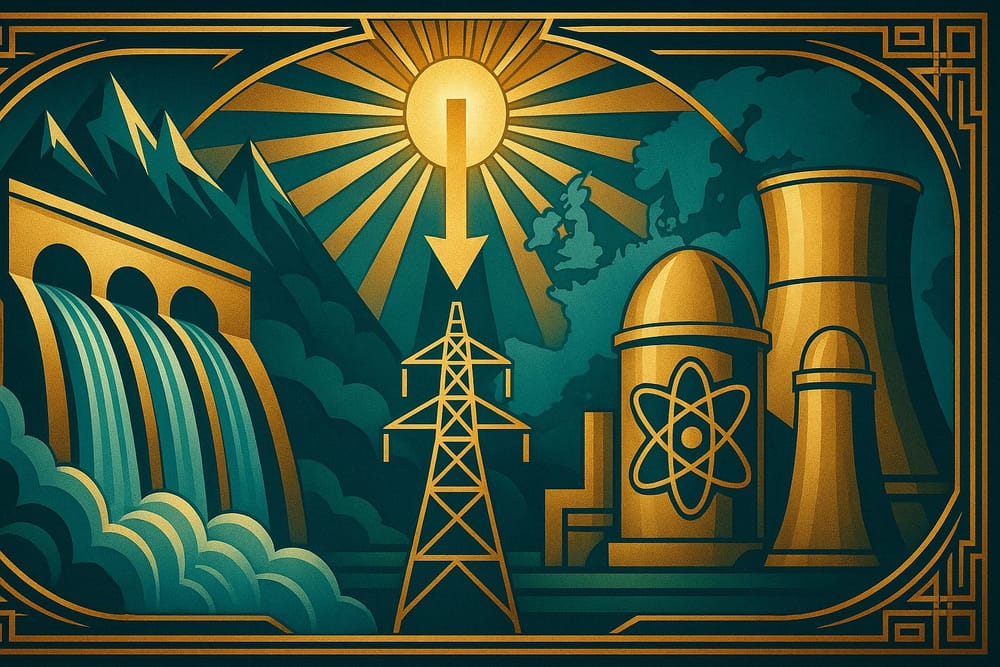
The Swiss electrical system was enviable. Sixty percent of production came from rivers and lakes, the rest from nuclear. Both sources produce virtually no CO₂, their marginal cost is low once infrastructure is amortized, and they complement each other well over the year: nuclear produces continuously, hydropower peaks in spring and summer with snowmelt. Switzerland exported in summer, imported a little in winter, and the balance remained largely positive.
This model operated under implicit conditions that no one had formulated as hypotheses. Precipitation had to remain within historical norms. Nuclear had to keep running. And the European market had to remain accessible at a reasonable price. These three conditions held for decades.
The changes varied from year to year, with net deficits in 2021 and 2022 but export surpluses in 2019, 2020, 2023, and 2024.
Drought as a structural revelation
Swiss hydropower depends on winter snowfall and spring snowmelt, two variables that climate warming directly disrupts. The marked hydrological deficit documented by the SFOE concerns mainly the 2021/2022 hydrological year, with productivity approximately 17% below the reference level. These deficits are now occurring at a new frequency.
Swiss hydropower includes a large share of run-of-river power plants, which do not store water and cannot compensate for a deficit by drawing on reserves. The large storage installations, Grimsel and Grande Dixence, offer real flexibility, but their capacity is limited and their filling depends on precipitation and snowfall as well. When spring is dry and summer is too, the reservoir empties faster than it is replenished.
This is exactly the mechanism that the 2022 heat wave revealed for French nuclear power: twentieth-century low-carbon infrastructure was built for a climate regime that is now changing. Switzerland faces the same reality on the hydropower side: the physical asset remains intact, but the natural fuel that feeds it is becoming less reliable.
Three and a half gigawatts that will not return
The drought could have remained manageable if the nuclear fleet had remained complete. It no longer is. Only one Swiss reactor was closed in the recent period: Mühleberg in 2019. The two Beznau units were still in operation in 2024. The recent actual nuclear withdrawal represents approximately 0.373 GW net, a power source that produced electricity around the clock, independent of weather.
Post-Fukushima policy banned replacement by new power plants without imposing a scheduled shutdown of existing reactors. The timeline was known. The closure of Mühleberg in 2019 does not coincide, in SFOE data, with a national hydrological deficit or with an annual shift to an importer balance.
The Mühleberg closure represented 373 MWe according to the Swiss Federal Nuclear Safety Inspectorate. Switzerland still has the Gösgen and Leibstadt plants, but their lifespan raises questions that have not yet been resolved. The trajectory is therefore clear: without a new decision by operators or the safety authority, no general statutory date imposes a reduction in the remaining nuclear fleet in the next fifteen years.
Importing at 80% higher cost than before
Turning to the European market could have been a neutral solution if European prices had remained stable. They surged. Between 2021 and 2024, the average annual EU/EEA day-ahead price fell by approximately 20% after the exceptional peak of 2022. The war in Ukraine, the reduction in Russian gas exports, and tensions over fossil fuel supply propelled spot prices to unprecedented levels in 2022, before a partial recovery in 2023-2024 that remains far above pre-crisis levels.
Physical imports declined between 2019 and 2024 and Switzerland was a net exporter in 2024. Compared to 2019, commercial purchase spending increased slightly in volume and significantly in value in 2024, but fell relative to the 2021-2022 price shock. For consumers, the effect was direct: electricity rates increased for Swiss households, feeding political debate over supply security that the country thought it had definitively settled in the 1970s.
There is also a geopolitical dimension that Bern follows closely. Relations between Switzerland and the European Union have remained complicated since the failure of negotiations on the framework agreement in 2021. Legally guaranteed access to the internal electricity market now depends on the entry into force of the Switzerland-EU agreement signed on March 2, 2026, and still in parliamentary procedure, which would allow Switzerland to trade more smoothly and participate in network balancing mechanisms. Swiss room for maneuver in electricity trading negotiations was constrained by its absence from several mechanisms of the European internal electricity market.
The limits of the two-vector model
The Swiss energy model illustrates a risk that energy strategists call risk correlation. When an economy concentrates production on two sources whose hazards are partially linked—nuclear and hydropower both share a dependence on water, one for cooling, the other for turbines—and when a political decision removes one of these sources at the same time a climate shock strikes the other, the result is cumulative exposure that robustness plans had not anticipated.
Diversification of energy vectors is not a bureaucratic obsession: it is a response to this type of correlation. An electricity portfolio that includes solar, wind, cogeneration, and storage distributes risks over hazards less correlated with each other. A windless day can coincide with a cloudy day, but it does not necessarily coincide with a dry year and a power plant closure. Multiplying vectors reduces the probability that all will fail together.
Switzerland long managed without such diversification because its two pillars functioned well and external conditions allowed it. Small island or landlocked economies that adopted variable renewable energies very early—Denmark with wind, Austria with a more balanced hydropower-solar mix—offer instructive contrast: their exposure to sectoral climate shocks is lower, even if managing their intermittency poses other challenges.
The decisions Switzerland must make before 2030
The Confederation is not without assets to correct its trajectory. It has significant solar potential; the Alps capture high solar irradiation, and the rooftops and facades of buildings remain vastly underexploited. The Energy Strategy 2050 and Energy Perspectives 2050+ foresee significant acceleration in photovoltaics to increase installed capacity by 2035. If this pace holds, solar could cover a growing share of summer consumption and ease pressure on hydroelectric reservoirs during seasons of maximum sunshine.
But solar poses precisely the opposite problem of hydropower: it produces in summer, not in winter. Yet Switzerland’s deficit deepens especially in winter, when river flows are low, days are short, and heating consumption rises. Filling this winter gap without relying heavily on imports or gas requires seasonal storage—a problem that neither current batteries nor existing pumped-storage stations can solve alone by 2030.
Two complementary levers are under discussion. The first is demand flexibility: shifting certain industrial and tertiary consumption to hours or seasons of surplus, which requires dynamic pricing and curtailment contracts that Swiss networks are only beginning to deploy. The second is the nuclear question, returned to the political agenda after being considered closed. In 2024, the Federal Council proposed easing the ban on building new reactors; Parliament had not yet adopted it that year. The industrial timeline of these options, extending beyond 2035 for a new reactor, makes them inoperative for the 2025-2035 window, but the decision to pursue them or not must be made now for them to take effect in the following decade.
The question posed to Switzerland is, in reality, the one that every small European economy engaged in transition must resolve: to what degree of energy vector diversification can one absorb the simultaneous convergence of drought, dispatchable capacity closure, and a break in the import market, without falling back into fossil dependence or geopolitical dependence? The answer varies by country, but it requires everywhere three things that Switzerland does not yet have in place: a diversified energy mix, seasonal storage capacity or equivalent flexibility, and solid interconnection agreements with neighbors. On this last point, the deadlock with Brussels remains the least technical and most difficult risk to manage.
The Swiss case should interest far beyond its borders. Economies that bet on one or two low-carbon vectors, telling themselves that complementarity would suffice—Norway with hydropower, France with nuclear—share an analogous structural vulnerability. The hydrological and market variations that Switzerland experienced between 2019 and 2024 illustrate the risks that climate disruption and geopolitical instability can jointly produce on under-diversified energy systems. The robustness of an energy strategy is now measured by its capacity to hold when several basic assumptions degrade at the same time.
Sources
- Swiss Federal Office of Energy, Electricity Statistics and Annual Reports
- Swissgrid, System Adequacy Report 2025 (Swissgrid SA, Aarau)
- IEA, Switzerland Energy Review 2025 (International Energy Agency, Paris)
- Swiss Federal Office of Energy, Energy Master Plan (Energy Perspectives 2050+)